For those who are interested, I will be defending my dissertation proposal in a few weeks (I guess even if you aren’t interested I will still be defending in a few weeks). In brief I will be examining how service-learning in high school mathematics might serve as a vehicle for instilling in students what is often discussed as simply an abstract notion: getting students to habitually appreciate the truth, beauty, and goodness of mathematics.
This week I am leading a workshop at the 2015 AP Conference in Austin, TX on “Serving the Community through Statistics: A Capstone Project.” The talk is on integrating service-learning projects into AP Statistics. Being that this is kinda my dissertation topic, I’ve written about it numerous times before here on GodandMath.com. In addition to the resources that you will find below, feel free to check out some of the prior posts on service learning:
CAMT 2012 Presentation: Presentation I gave at the Conference for the Advancement of Mathematics Teaching based on the first statistics service-learning project mentioned above.
Geometry and the Homeless: the first service-learning project I did with my geometry students. An updated version from this last school year should find its way onto the site by mid summer.
ABSTRACT:
This session will equip participants to design, implement, and evaluate service-learning based statistics projects in which students partner with non-profit organizations in their local community. These projects synthesize the major concepts of experimental design, data analysis, and statistical inference in the real-world context of community service. Through these projects students integrate their conceptual understanding of statistics with the practical functioning of their local community, ultimately gaining a deeper appreciation for the role statistics plays in the organization and evaluation of service societies. In this session participants will explore several successful examples of such projects, identify the key components of a successful project, engage in discussion assessing the feasibility and logistics of implementing service projects in their own curriculum, and critique project evaluation rubrics.
PRESENTATION:
You can click the image below to find the PowerPoint that accompanied my presentation.
SUMMARY PACKET:
I prepared a packet of information for those attending my session. You can access the packet here. The packet contains the following:
Presentation Outline
Classroom Handouts
Resources
ADDITIONAL HANDOUTS:
I could not include every classroom handout that I use in the packet that I prepared. Here are some of those additional handouts:
Here is a video on MLF’s heart for the Community First project:
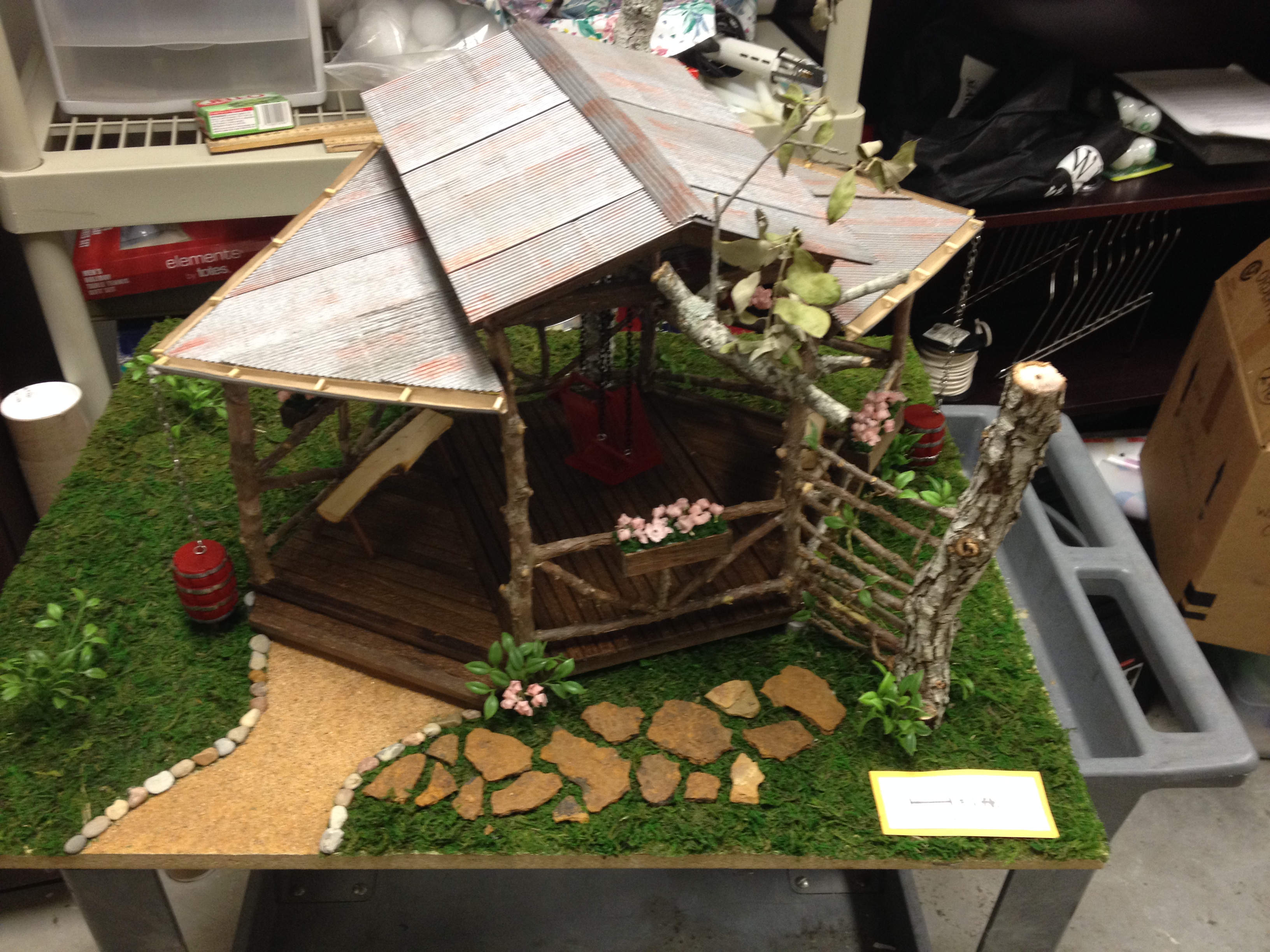
I have worked with geometry students on designing RV covers, gazebos, bike racks, and spiral herb gardens. Below is a picture of last year’s winning gazebo design and the current building progress:
I am beginning my dissertation this summer. It will focus on the benefits of service-learning projects in mathematics and it will specifically examine the partnership between my students and MLF. So needless to say, you can expect a lot of future posts on this topic. Ultimately I believe that service-learning is an incredible way to impact a student’s appreciation of mathematics. To use terminology that I’ve written on before: service-learning is an excellent tool for cultivating mathematical affections.
While you can expect much more on this topic here, I wanted to share a recent video that I came across of other institutions partnering with MLF through the process of service-learning. The institution in the video below just so happens to be my alma mater of Texas A&M (Whoop!): Aggies design, build ‘tiny homes’ for homeless as part of curriculum – The Eagle: Local News.
Construction science senior Laura Malek said working on a project that was going to help a “great cause” was a huge motivator during the process. The project also mimicked a real-life work environment, she said, by bringing together students who wouldn’t normally work together.
“Today was so much fun,” she said. “It was amazing to actually see our work in place and actually get some outside feedback. It felt a little surreal to finally see it there today finished and painted. It meant a lot. People seemed to really enjoy the space and that felt really great after our hard work.”
An interesting side note is that the student quoted in the story is the sister of one of the students that was a part of the first ever service-learning project I initiated (see: Serving through Statistics).
Like I said, there will be a lot more to come on this.
Always feel free to contact me if you have any questions about implementing service-learning into your math class.



 GOD & MATH: Thinking Christianly About Math Education