AP Conference Presentation: Serving the Community through Statistics

2015-apac-home

This week I am leading a workshop at the 2015 AP Conference in Austin, TX on “Serving the Community through Statistics: A Capstone Project.” The talk is on integrating service-learning projects into AP Statistics. Being that this is kinda my dissertation topic, I’ve written about it numerous times before here on GodandMath.com. In addition to the resources that you will find below, feel free to check out some of the prior posts on service learning:

ABSTRACT:

This session will equip participants to design, implement, and evaluate service-learning based statistics projects in which students partner with non-profit organizations in their local community. These projects synthesize the major concepts of experimental design, data analysis, and statistical inference in the real-world context of community service. Through these projects students integrate their conceptual understanding of statistics with the practical functioning of their local community, ultimately gaining a deeper appreciation for the role statistics plays in the organization and evaluation of service societies. In this session participants will explore several successful examples of such projects, identify the key components of a successful project, engage in discussion assessing the feasibility and logistics of implementing service projects in their own curriculum, and critique project evaluation rubrics.

PRESENTATION:

You can click the image below to find the PowerPoint that accompanied my presentation.

wilkerson apac 2015

SUMMARY PACKET:

I prepared a packet of information for those attending my session. You can access the packet here. The packet contains the following:

  1. Presentation Outline
  2. Classroom Handouts
  3. Resources

ADDITIONAL HANDOUTS:

I could not include every classroom handout that I use in the packet that I prepared. Here are some of those additional handouts:

EXTERNAL RESOURCES:

Cultivating Mathematical Affections: The Influence of Christian Faith on Mathematics Pedagogy

Here is some information on my talk at the 20th ACMS Conference (2015) at Redeemer University College. More information can be found in my article of the same title in the June 2015 issue of Perspectives of Science and Christian Faith:

Abstract:

The goal of this paper is to make the case that Christian faith has an opportunity to impact the discussion on best practices in mathematics not primarily through the cognitive discussion on objectives and standards, but through the affective discussion on the formation of values, the cultivation of mathematical affections – not merely knowing, but also loving, and practicing the truth, beauty, and goodness inherent in mathematics.

First I will outline the work being done on affect in mathematics education, examining what values are actually endorsed by the community of mathematics educators. After summarizing this work on affect it will be clear that, even in the words of leading researchers, the field is lacking any cohesive, formal approach to analyzing and assessing the affective domain of learning. In part two of this paper I will argue the thesis that Christian faith offers solutions to the frustrations and shortcomings admitted by researchers on affect in mathematics education. Christian faith offers insight into how mathematical affections might actually be shaped. Here I will draw heavily on the work of philosopher James K.A. Smith and make explicit connection between his work and the mathematics classroom. Finally, I will conclude with a call to action discussing how we as Christian educators might begin to have fruitful contributions to and dialogue with the current research being done in mathematics education.

PowerPoint:

ACMS Cultivating affections

Outline:

PDF of talking points outline

References:

Goldin, G.A. (2002). Affect, meta-affect, and mathematical belief structures. In G.C. Leder, E. Pehkonen, & G. Törner (Eds.),  Beliefs: a hidden variable in mathematics education? Netherlands: Kluwer Academic Publishers, pp. 59-72.

Hadlock, C. R. (2005). Mathematics in service to the community: Concepts and models for service-learning in the mathematical sciences (No. 66). Mathematical Association of America.

Krathwohl, D.R., Bloom, B.S., & Masia, B.B. (1964). Taxonomy of educational objectives: Handbook II. Affective Domain. New York: Longman.

McLeod, D.B. (1992). Research on affect in mathematics education: A reconceptualization. In D. A. Grouws (Ed.), Handbook of research on mathematics teaching and learning (pp. 575-596). New York: Macmillan.

National Council of Teachers of Mathematics. (1991). Standards for teaching mathematics. Reston, VA: NCTM.

National Council of Teachers of Mathematics. (1995). Mathematics Assessment Standards. Reston, VA: NCTM.

National Research Council (2001). Adding it up: Helping children learn mathematics. Washington D.C.: National Academy Press.

Smith, J.K.A. (2009). Desiring the kingdom: Worship, worldview, and cultural formation. Grand Rapids, MI: Baker Academic.

Veatch, M. (2001). Mathematics and values. In R. Howell & J. Bradley (Eds.), Mathematics in a Postmodern Age: A Christian Perspective. GrandRapids: Eerdmans, pp.223-249.

Zan, R., Brown, L., Evans, J., & Hannula, M.S. (2006). Affect in mathematics education: An introduction. Educational Studies in Mathematics (Affect in Mathematics Education: Exploring Theoretical Frameworks: A PME Special Issue), 63:2, 113-121.

Mathematics: Building Community

A while back I wrote a post on “Geometry and the Homeless.” That post was after my first year if partnering with Mobile Loaves and Fishes Community First on a service-learning project for my advanced geometry students. I have now been blessed to have worked with MLF on service-learning projects for the past three years.

Here is a video on MLF’s heart for the Community First project:

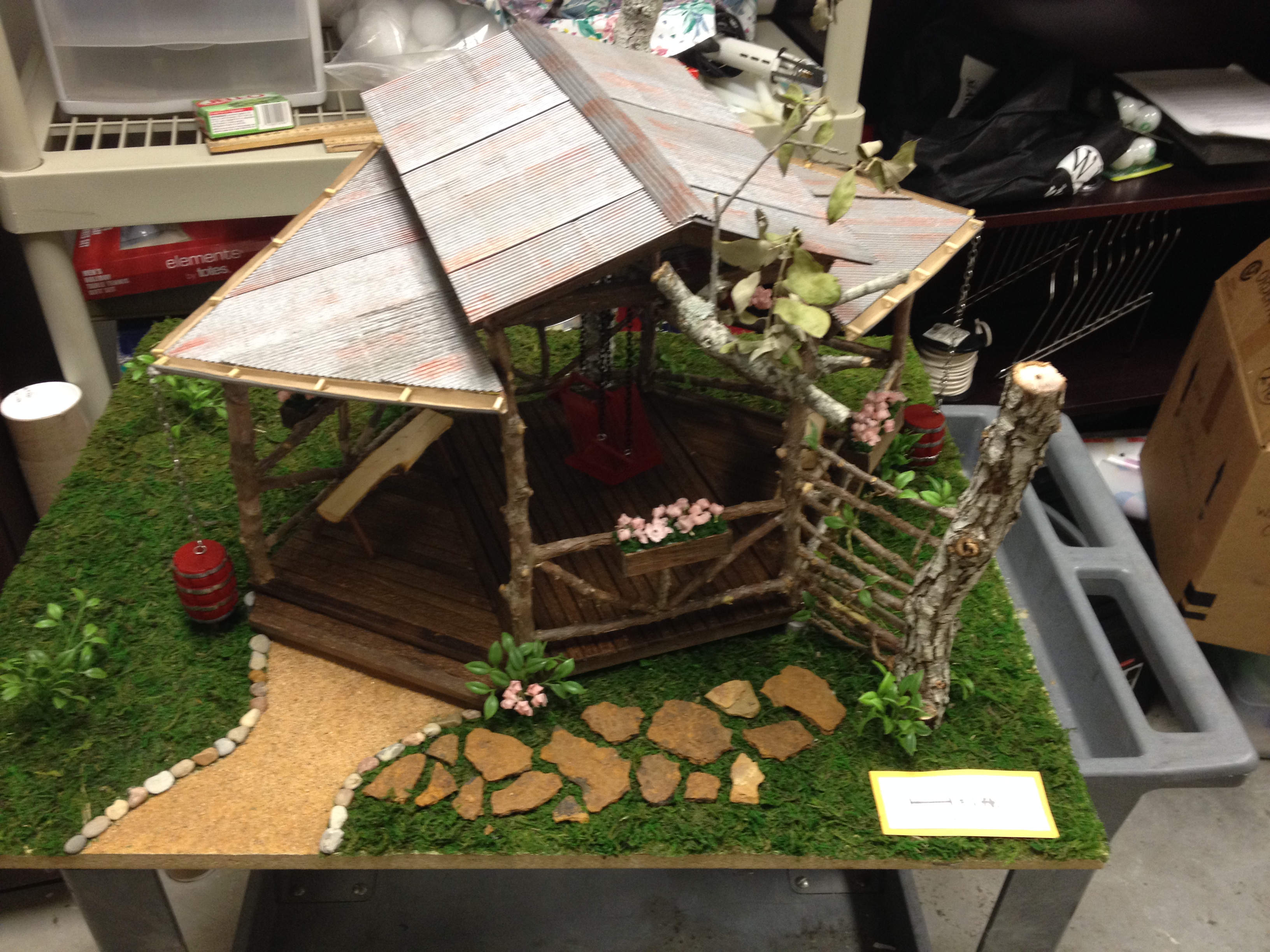
I have worked with geometry students on designing RV covers, gazebos, bike racks, and spiral herb gardens. Below is a picture of last year’s winning gazebo design and the current building progress:

photo (1)IMG_2246

I am beginning my dissertation this summer. It will focus on the benefits of service-learning projects in mathematics and it will specifically examine the partnership between my students and MLF. So needless to say, you can expect a lot of future posts on this topic. Ultimately I believe that service-learning is an incredible way to impact a student’s appreciation of mathematics. To use terminology that I’ve written on before: service-learning is an excellent tool for cultivating mathematical affections.

While you can expect much more on this topic here, I wanted to share a recent video that I came across of other institutions partnering with MLF through the process of service-learning. The institution in the video below just so happens to be my alma mater of Texas A&M (Whoop!): Aggies design, build ‘tiny homes’ for homeless as part of curriculum – The Eagle: Local News.

Tiny House Video from TAMU College of Architecture on Vimeo.

Here are a few quotes from the local article that accompanied the video that speak to the impact of this type of project on the learning outcomes the students experienced:

Construction science senior Laura Malek said working on a project that was going to help a “great cause” was a huge motivator during the process. The project also mimicked a real-life work environment, she said, by bringing together students who wouldn’t normally work together.

“Today was so much fun,” she said. “It was amazing to actually see our work in place and actually get some outside feedback. It felt a little surreal to finally see it there today finished and painted. It meant a lot. People seemed to really enjoy the space and that felt really great after our hard work.”

An interesting side note is that the student quoted in the story is the sister of one of the students that was a part of the first ever service-learning project I initiated (see: Serving through Statistics).

Like I said, there will be a lot more to come on this.

Always feel free to contact me if you have any questions about implementing service-learning into your math class.