The definition of a “math person”

It has been awhile since I have posted here. My new responsibilities as the math department chair have taken up quite a bit of my time – but I am certainly relishing the opportunity to put into practice many of the ideas I have espoused here on GodandMath over the years. One of my responsibilities has been hosting a series of math talks for parents. This has been a great way for me to meet more families in our school community and to have a platform to explain our department’s philosophy of math education. This post is a summary of that philosophy that I have been sharing with parents.

Our department’s number one aim is to cultivate the mathematical affections of students – a phrase I have written about numerous times here. Essentially, the aim is to provide students a meaningful experience of mathematics that solidifies their appreciation of the discipline regardless of their future studies or career trajectories. This goal is in contrast to the prevailing attitude of society towards their mathematics education, summed up in the phrase “I’m not a math person.”

I start these parent meetings by asking who in the audience has ever said or thought “I’m not a math person”? I then ask for a few brave volunteers to explain what they mean by that. Without fail (whether in these parents meetings or in any context when someone admits to me that they aren’t a math person – which always seems to happen whenever you tell someone you’re a math teacher) there explanation falls somewhere along the lines of: I couldn’t remember all the rules, I wasn’t good at memorizing multiples, I never completed the problems fast enough, etc. Basically reiterating the prevailing view of society that to be a math person is to be efficient and accurate in computation and factual recall.

My typical response to people is “Yeah, I hate that stuff too. But I’m still a math person. What you’re describing isn’t how I see math. Can I show you how I see math?”

Our goal is to give students a very different impression of mathematics than what society has. We want to take away from students this go-to opt-out phrase of “Well, I’m not getting it, I’m just not a math person.” Mathematics, true mathematics, is inviting and uplifting for everyone.

How we as a department aim to cultivate students’ mathematical affections is through developing problem solvers. Below is a working summary of how our department defines problem solving (written to the student).

Defining Problem Solving: [1]

 Problem solving has been defined as what to do when you don’t know what to do. In some of your math classes, you probably learned about mathematical ideas by first working on an example and then practicing with an exercise. An exercise asks you to repeat a method you learned from a similar example. A problem is usually more complex than an exercise, so it is harder to solve because you don’t have a preconceived notion about how to solve it.

Problem Solving Expectations:

  1. Perseverance: Humility paired with confidence. Grit. In this class you will be asked to solve some tough problems. You will be able to solve most of them by being persistent and by talking with other students. When you come across an especially difficult problem, don’t give up. You may find that sometimes your first approach to a problem doesn’t work. When this happens, don’t be afraid to abandon the approach and try something else. Be persistent. If you get frustrated with a problem, put it aside and come back to it later. But don’t give up on the problem.
  2. Collaboration: You will be expected to talk to your classmates! Your teacher will ask you to get help from one another.
  3. Communication: In addition to working with your classmates, reading the book, and learning from your teacher, you will also be expected to communicate about your work and your mathematical thinking. You will do this by presenting your solutions to the entire class and by writing up complete solutions to problems. You will do presentations and write-ups, because talking and writing allow you to show your thinking. These communication processes will further develop your thinking skills.
  4. Grace: When you work with other students, you are free to make conjectures, ask questions, make mistakes, and express your ideas and opinions. You don’t have to worry about being criticized for your thoughts or your wrong answers.
  5. Service: Your growth in your math educational journey is not just about you. If the big problems of this world (curing disease, ending hunger, ending human trafficking, addressing sustainability, etc.) are going to be solved then mathematics will play a central role in their solution. If you are going to truly become a problem-solver then there has to be action taken.

At this point, after having explain our departmental goals and philosophy, I return to my original question.

“Ok, so you may not be a math person. But do you believe in the value of perseverance? Do you think collaborating in community and communicating ideas well are important skills? Do you believe in showing others grace and receiving grace yourself? I should hope so in our Christian community. Do you believe that we are called to serve others and put their needs before our own? If you said ‘yes’ to any of these, then congratulations, you’re a math person!


[1] Adapted from Johnson, K. & Herr, T. Problem Solving Strategies: Crossing the River with Dogs and Other Mathematical Adventures, 2nd Ed., Key Curriculum Press, 2001.


APAC 2018: Service-Learning and Statistics

Screen Shot 2018-07-20 at 1.36.45 PM.png

This week I am leading a workshop at the 2018 AP Annual Conference on “Statistics and Service-Learning” in Houston, TX. The talk is on integrating service-learning projects into AP Statistics curriculum, specifically with the goal of impacting students on an affective level.In addition to the resources that you will find below, feel free to check out some of the prior posts on service learning:

ABSTRACT:

This session will equip participants to design, implement, and evaluate AP Statistics service-learning projects in which students partner with nonprofit organizations in their local community. These projects synthesize the major concepts of experimental design, data analysis, and statistical inference in the real-world context of community service. Through these projects students integrate their conceptual understanding of statistics with the practical functioning of their local community, ultimately gaining a deeper appreciation for the role of statistics in the organization and evaluation of service societies.

PRESENTATION:

You can click the image below to find the PowerPoint that accompanied my presentation.


Screen Shot 2018-07-20 at 1.40.54 PM.png

For many of the service-learning projects that my students have completed I am indebted to the willing partnership of Mobile Loaves and Fishes. Here is some introductory information on this great ministry:

Community First! Village Goes Beyond Housing for Austin Homeless, from the Austinot

10 THINGS TO CONSIDER BEFORE IMPLEMENTING A SERVICE-LEARNING PROJECT:

The following are the foundational questions that you as an instructor should consider and reflect upon prior to implementing a service-learning project. This list is not meant to be chronological though some aspects will naturally precede others. Start by considering the course learning objectives and your method of assessing those objectives and then go from there.

1.What are the major learning objectives/big ideas/enduring understandings for your course?

The purpose of the AP course in statistics is to introduce students to the major concepts and tools for collecting, analyzing and drawing conclusions from data. Students are exposed to four broad conceptual themes:

  • Exploring Data: Describing patterns and departures from patterns
  • Sampling and Experimentation: Planning and conducting a study
  • Anticipating Patterns: Exploring random phenomena using probability and simulation
  • Statistical Inference: Estimating population parameters and testing hypotheses

2. What are real-world situations where students can apply the concepts studied in your course?

  • Identifying a non-profit service agency which requires survey research (program evaluation, client needs assessment, etc.)
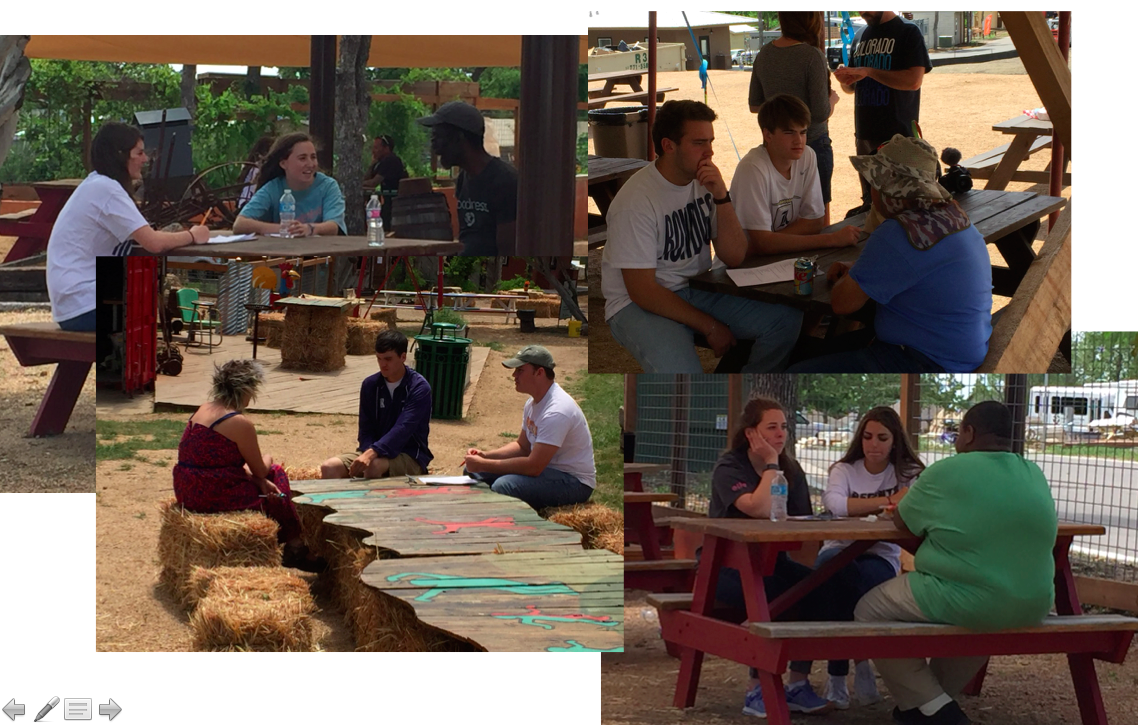
  • Students develop a survey instrument, conduct survey, compile and code data, analyze data, present results

3. List some potential community partners along with some basic descriptors that may impact how your students work with each partner (ex: What is the size of the organization? What issues does the organization address? Is the organization non-profit, governmental, religiously affiliated? Etc.) In lieu of a partner organization you can also consider a general community need for students to address. List some general descriptors of the project involved in addressing this community need.

4. Look for potential matches between organizations on your list from question 3 and your responses to questions 1 and 2. If there are multiple potential matches then consider the pros/cons of each and list them. Be sure to recognize how your matching affects the organization of the project (large scale as a class v. small scale as groups), which in turn may affect your response to question 5 below.

5. Once you have begun narrowing potential community partners that offer opportunities for students to interact with course content, consider how will you assess students? What will be the final product? What expectations will you have for students throughout the project and how will you communicate that to the students?

6. How will students be organized to meet the objectives that they will be assessed on? Will students work as individuals, teams, as a whole class?

7. How will students be equipped to complete the project successfully? What will they have gained from the course up to the point of assigning the project that will aid them? What additional tools/skills/knowledge will students need as the project proceeds?

8. What will be the timeframe for the project? How will students be held accountable to the timeframe? At what points will students receive feedback on their progress?

9. Why should students care about the project? What will you do as an instructor to get student buy-in on the project?

10. How will students reflect throughout the project? What opportunities will you provide for students to pause and consider the work they have done?

HANDOUTS:

From my AP Statistics Project 2018:

Screen Shot 2018-07-20 at 1.57.49 PM

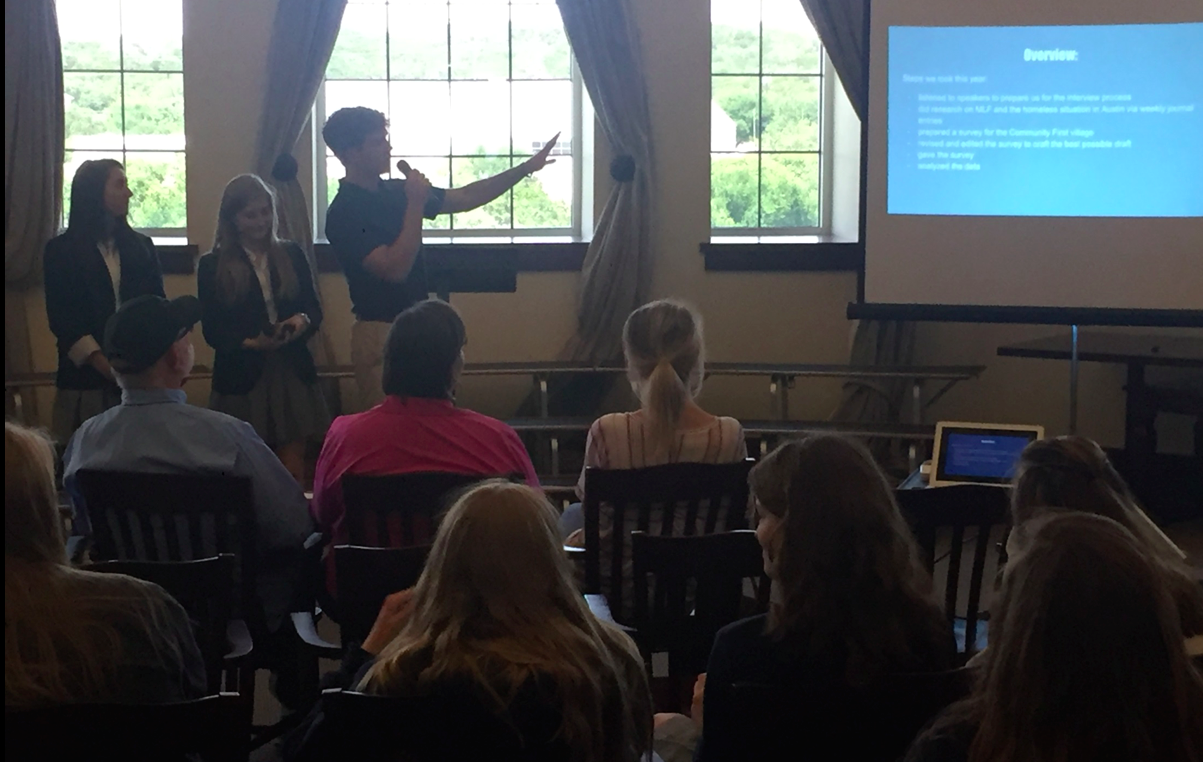
(Clicking the image above will take you to the students’ final presentation)

From my AP Statistics Project 2016-17:

Screen Shot 2016-06-29 at 1.09.07 PM

Screen Shot 2016-06-29 at 1.10.27 PM

From my 2015-16 AP Statistics Project (Organized as an entire class project over the full year):

From my 2014-15 AP Statistics Project (Organized as small group projects in the spring semester):

*NOTE: some documents above were also used in this project, either in the form in which they are posted above or in a slightly modified version

EXTERNAL RESOURCES:


Is it the journey or the arrival?

stock-photo-nature-outdoors-journey-adventure-landscape-hiking-rocky-activity-vacation-2eb52f03-11eb-4582-a8be-d1c64e3b4a30
Photo by @przemekklos: https://www.twenty20.com/photos

I have probably read the same argument a dozen times. The language and the nuances of the argument very only slightly between articles. These are just the two most recent articles to cross my path:

Calculus Is the Peak of High School Math. Maybe It’s Time to Change That. ~ Education Week

Should We Stop Teaching Calculus in High School? ~ Forbes

The basic synopsis: not everyone needs calculus. Stop making calculus the end goal of the K-12 math sequence. Everyone needs a better grasp of data analysis and digital technology. Teach more statistics and computer science. Teach students the math that they really need.

Typically these articles focus on replacing AP Calculus with AP Statistics and/or AP Computer Science or some other programming course. Each article on this topic does note the exception that those interested in STEM fields do actually need Calculus. These articles are typically framed around what everyone else should take – how to offer better (framed as more useful) math for the “I’m not a math person” crowd.

Some, most notably Andrew Hacker, go so far as to suggest that the “I’m not a math person” crowd doesn’t even need algebra much less calculus.

Is Algebra Necessary? ~ NY Times

However, upon closer inspection one might come to realize that the argument is not one of course sequencing or graduation requirements. Here is a quote from Hacker in the above article:

Instead of investing so much of our academic energy in a subject that blocks further attainment for much of our population, I propose that we start thinking about alternatives. Thus mathematics teachers at every level could create exciting courses in what I call “citizen statistics.” This would not be a backdoor version of algebra, as in the Advanced Placement syllabus. Nor would it focus on equations used by scholars when they write for one another. Instead, it would familiarize students with the kinds of numbers that describe and delineate our personal and public lives.

This issue seems to be one of “usefulness.” Calculus isn’t useful for most people. Statistics is useful for most people. Algebra isn’t useful for most people. Programming (or some type of computer course) is useful for most people.

However, things start to get muddled when you define the end goal or purpose of education as one of utility. Picking up right where the above quote leaves off:

It could, for example, teach students how the Consumer Price Index is computed, what is included and how each item in the index is weighted — and include discussion about which items should be included and what weights they should be given.

So we should teach how a certain applicable function is influenced by variable inputs but we shouldn’t teach Algebra? Isn’t that the definition of Algebra? How can we jump to the “useful” application without grounding students’ understanding enough for the application to mean anything?

I believe what is really happening is that Hacker would rather see “useful” algebra rather than something like, say, factoring trinomials. Nobody (well, almost nobody) factors trinomials for their profession or to get through their daily life. One could make the counter argument that nobody (well, almost nobody) diagrams sentences for their profession or to get through their daily life – but an understanding of grammar and syntax lays a foundation for language development that allows people to craft a blog post (or something more substantial).

Perhaps the sentence diagramming argument isn’t really a counter argument but just the same argument Hacker and others are making but applied to English rather than mathematics. Perhaps what is really underlying these articles that are making the argument of teaching more “useful” mathematics is that these articles are less a commentary on the content in the mathematics curriculum and more a commentary on (perceived) pedagogies in the mathematics curriculum. In other words, perhaps the argument is less about what is taught and it is more about how it is taught.

Disenchantment with the traditional teaching methods employed have left people looking to jump to the practical applications without journeying through foundations to get there.

If you try to convince students that the value in learning to factor trinomials is in its usefulness then it should be no surprise that we see articles like Hacker’s today – eventually those students grow up and realize the farce they endured in math class (actually, they recognized it as a farce instantly but now as adults they are able to make their voices heard more easily).

How we teach math certainly matters. I’ve written about that numerous times (see: Cultivating Mathematical Affections). The problem with these articles is that they don’t really address the how question but rather focus on changing the what. Their focus is on altering the end goal and not about altering the methods of the journey. It saddens me that this argument has gained such wide popularity (as seen in the number of these types of articles).

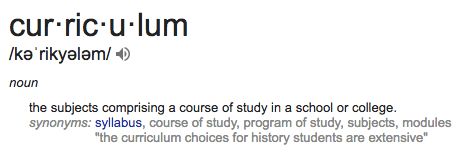
Let’s try a different approach and let’s start by defining terms.

Screen Shot 2018-06-11 at 2.47.24 PM

Notice the term “course” in the definition above. Curriculum, from Latin, literally refers to the act of running or a race track. It is the same concept used in Hebrews 12:1-2 and in 2 Timothy 4:7. It is a reference to being active, to engaging in the struggle of the race, to enduring the distance, to competing. It is not an arrival or a finish line – it is the journey through the race itself.  Discussions about the “peak” of the math curriculum miss this.

I have thoroughly enjoyed reading through Teaching and Christian Imagination. In it, David Smith uses the metaphors of journeying, building, and gardening to reflect on educational practices in light of Christian teaching. Below is an extensive quote from his section on journeying that I believe will be very instructive:

The journey metaphor offers us a different picture of the learner than the passive receptacle. And yet it still leaves the nature and purpose of the journey open for debate. As educational history has walked hand in hand with cultural history, imagery associated with educational journeys has shifted from travel on foot to riding in a coach and then to driving along a highway. In older Christian appropriations of the image, the path was given by God and led (at a more deliberate and deliberative pace) towards God as its destination. In the Enlightenment, the sense of destination remained, but the goal was reframed in terms of movement towards the virtuous life of the useful citizen. As travel became more widely available, the idea of education opening up new horizons took hold. The image of the 19th century explorer offered a version of travel as deliberatively leaving the well-trodden path and collecting new experiences in exotic, uncharted territories. Later still, the rise of mass tourism tilted the image of travel towards comfort, efficiency, and consumption, evoking anxieties concerning educational tourists whose shallow gaze skims the main sights but does not linger for long enough to be changed. The educational path is now giving way to talk of an educaitonal superhighway with a powerful emphasis on speed of information. Alongside these shifts came a gradual yet momentous reversal in which the experience of journeying itself overtook the pursuit of a hallowed destination as the central emphasis; simply being in motion at increasing speed and with increasing range became an end in itself. Eventually, with the fading of a shared destination, any self-chosen destination became equally valid.

Page 17

Any self-chosen destination becomes equally valid – be in calculus or statistics or whatever else appears most “useful.”

In contrast to this modern perspective, Smith goes on to discuss the concept of journeying on a pilgrimage in the Biblical narrative, particularly in the Old Testament pilgrimages to the temple.

To read Scripture is to encounter on a regular basis people leaving the security of home and setting out into the unknown. (p. 19)

The worshipers find their strength not ultimately in the place of worship, but in the one worshiped there, who is with them on the road as well as in the sanctuary… It is not a journey from where God is not to where he is, but a celebration of God’s rule over the entire land. (p. 24)

Blessing is not tied to arrival… They (the pilgrims) doggedly seek blessing, practice works of mercy, and erect signs of the kingdom. Treading a pilgrim path involves placing oneself within a tradition… The paths were not already cut into the landscape, but had to be made and maintained by walking. (p. 25)

The individual pilgrim learns the path both from elders who passed this way in previous years, and by walking, by going along it for the first time and gaining a familiarity that might lead to becoming a future guide for others. (pp. 25-26)

It is a journey not towards spring break, towards a strong grade point average, or towards employment, but towards standing in the presence of God and seeing God give new life to the world… God’s glory fills creation, and setting our faces towards God and our hearts on the highway is a celebration of God’s sovereignty over every territory through which we pass. (p. 26)

In these arguments over content and methodology, destinations and journeying, the what and the how, I find it refreshing as a Christian math teacher to recall that God is not just the author of the content but also how we come to know it. There is something the journey is meant to do to us – it is not simply meant to be endured until reaching a destination.

Is factoring trinomials presented in the classroom as a task to be endured until students can reach the more useful destination of the Consumer Price Index? Or is there a way that we as math teachers can reshape our classroom and reframe our teaching methods so that students experience the value of the journey?

I think there is.

I can’t offer a prescription of how to do this in every class so I conclude by simply challenging teachers to consider how their classrooms and their curriculum are focused on getting students to a destination versus equipping students for a transformative journey.

“If you want to build a ship, don’t drum up people to collect wood and don’t assign them tasks and work, but rather teach them to long for the endless immensity of the sea.”

~Antoine de Saint-Exupery (from the beginning of Paul Lockhart’s “A Mathematican’s Lament” book)