The Need for Affective Learning

Later this week I will be giving a talk at the 19th ACMS Conference entitled “Mathematical Affections: Assessing Values in the Math Classroom.” Overall I argue for 1) the need for affective learning, 2) the place of affective learning in mathematics, and 3) how we cultivate what I’ve termed as “mathematical affections.” I will post the talk in its entirety once I have given it. For now, I thought I would share a teaser from the introduction. Enjoy.

mathheart

How many of you, as math educators, have heard the question “When am I ever going to use this?” be uttered by your students? If you have been teaching for more than 5 minutes then it’s safe to assume that phrase has been mentioned in your presence. Occasionally it is posed as a valid question; the student is genuinely interested in the future career application of the topic at hand. However, I believe the majority of the time the phrase “When am I ever going to use this?” is spoken it is not as a question, but as a statement. A statement which implies that the obvious answer is “I will never use this so learning it is a waste of time.” The real issue being raised by these students is not one of application, but rather one of values. If we could translate their question into what they are really trying to communicate then “When am I ever going to use this?” will become “Why should I value this?” Students express their inquiry in terms of mathematical practicality because that is the language in which their culture, including their math teachers, has conditioned them to speak.

To illustrate how we as math educators have contributed to this misconception that value equals utility, let us turn our attention to the foundational document for composing the learning objectives and outcomes of an academic course: Bloom’s Taxonomy (pictured below).

Picture1

A quick glance at this chart will reveal that ‘application’ falls under the cognitive (mental/knowledge) domain of learning while ‘valuing’ falls under the affective (heart/feeling) domain of learning. The cognitive domain is almost exclusively emphasized in the preparation of teachers within the modern educational system while the affective domain is largely ignored. So while we ‘improve’ our teaching and questioning to make mathematics less abstract and to focus on real-life applications so that we can address the question of “When am I ever going to use this?” before it is even asked, we are actually implicitly teaching students that mathematical value is to be found only in application. If we really want to help those students address the true foundational question of “Why should I value this?” then we need to do so through increasing our attention on the affective domain of learning; writing rigorous learning objectives and developing quality assessments just as we do for the cognitive domain.

Now, application is certainly useful in the teaching process and it should not be ignored. I am not advocating the promotion of the affective domain over and above the cognitive. My goal is to simply bring the affective up to the same level as the cognitive. The best learning is done when both domains are utilized in conjunction with each other. In The Abolition of Man, C.S. Lewis writes “Education without values, as useful as it is, tends to make man a more clever devil.” I believe this is a fairly accurate statement of the modern day system of education. If we don’t focus on values, if we don’t focus on the affective learning of our students, then their education will still be useful – they’ll increase in cognitive ability and learn to apply their thinking. But is that really valuable in and of itself? Without a proper sense of values to guide their application, aren’t we really just making students “more clever devils”?

You see, you can never actually remove values from education. Education is inherently value laden, and I believe Lewis knew this. It is not a question of “Are you teaching values?” but rather “Which values are you teaching?” Lewis’ point is that the value we instill in education should be affective – loving learning for its own sake and valuing wisdom. If you don’t focus on affections, then you still have usefulness, but is that really beneficial? In the words of the Bishop in Victor Hugo’s Les Misérables: “The beautiful is as useful as the useful…Perhaps more so.”

Application is indeed useful but it should be presented in a way that promotes the development of what I’ll term mathematical affections. Learning has little meaning unless it produces a sustained and substantial influence not only on the way people think, but also on how they act and feel.

Geometry and the Homeless

This week I had the pleasure of writing a short note about my Geometry students’ spring project for my school’s newsletter. I thought I would include that below (as well as some pictures that weren’t included in the newsletter). I’ll provide a full write up here upon the completion of the semester.

Regents School of Austin eNewsletter

Regents high school students are partnering with a local ministry to apply their math skills. Please read this inspiring story from Mr. Josh Wilkerson. He is one of our math teachers in the School of Rhetoric.

~ Rod Gilbert, Head of School

1 Peter 4:10 commands us: “Each of you should use whatever gift you have received to serve others, as faithful stewards of God’s grace in its various forms.”

I use this foundational truth as the basis to address that customary question of the high school mathematics classroom: When am I ever going to use these math concepts? God instilled a mathematical gift into every human being, enabling humanity to fulfill the purposes of the Great Commandment (to love our neighbors) and the Great Commission (to take the good news to all people). How might we employ our “math-mindedness” in serving others as the Apostle Peter commands?

Mobile Loaves and Fishes (MLF) ministers to the homeless community here in Austin. They recently purchased a tract of land on which they plan to construct an affordable living community for the chronically homeless called Community First. The acreage includes space for trailers, RVs, micro-homes designed by University of Texas architecture students, a large garden with animals, a workshop, chapel, and a medical facility all in the hopes of being a self-sustaining community. The vision of Community First seeks to overcome the homeless mindset and demonstrate that home is more than a physical structure. Home is relationships and far more than just a roof.

MLF graciously allowed our freshman geometry class to participate with them in this project. They have asked our students to utilize their understanding of geometry by designing an awning for RVs. These awnings provide shade and protection to the roof of the RV but it is also creative and energy efficient. Furthermore, these awnings contribute to the mission of MLF in developing relationships and fostering true community.

This past Monday the students visited the MLF Community First project site so they could see the immediate fruit of their labor. The students spent time hearing directly from MLF representatives about their vision and their heart for the homeless, and also about the very real need they have in their design process that the students can meet. There were many questions asked, many measurements taken, and then more questions asked. The MLF representatives were very accommodating and thrilled to see the excitement that the students of Regents had over this opportunity. At the end of the project, these same MLF representatives will travel to Regents to hear the presentation of each team of students and then select a winning design.

As their teacher, I marvel at these students as they mature to understand that learning has NO meaning unless it produces a sustained and substantial influence not only on the way people think, but also on how they act, feel, worship, and serve. I am excited to see what the remainder of this semester holds.

Josh Wilkerson
SOR Mathematics Appreciation Teacher
Appreciating AP Statistics and Geometry
www.GodandMath.com

Additional Pictures Not Included in the Newsletter:

Students hearing a presentation from MLF
Discussing layout with Dave Sekel of MLF
Students analyzing the RV that they will design an awning for
Analyzing EVERY component of the RV

Aims for Christian Math Education

By Steve Bishop

(Disclaimer: The views expressed by guest authors do not necessarily reflect those of GodandMath.com. Guest articles are sought after for the purpose of bringing more diverse viewpoints to the topics of mathematics and theology. The point is to foster discussion. To this end respectful and constructive comments are highly encouraged.)

It has been said that the most incomprehensible thing about the world is its comprehensibility. Mathematics is only possible because God has created an ordered, law-full, universe that is comprehensible. Part of the task of mathematics is to describe the wonder of God’s good creation and thereby reveal some of the invisible attributes of God e.g. his faithfulness. Mathematics is also integral to the fulfilling of the creation mandate to open up and develop the creation. Mathematics is an important tool to help us steward and unfold the potentialities of the earth. Music, art, science and economics are four subjects that would be severely impoverished without the aid of mathematics.

Mathematics is a collective term for a number of related fields: arithmetic, geometry, topology, statistics, probability, … . All of which investigate and open up the two most basic aspects of reality: the numerical and spatial. (Applied mathematics also deals with a third aspect: the kinematic).

Math is a human activity therefore, it comes replete with human limitations: it is fallible, corrigible, culture- and value-laden. However, it is based in creation – it is not arbitrary or the product of social agreement. This is where a Christian view of math diverges from the social constructivist view. This Christian view of math does justice to both epistemological subjectivity and ontological objectivity.

Mathematics is based in created reality. It is not neutral; religious beliefs shape mathematical theories.

Mathematical Education Aims

Hence, mathematics education should:

1. Be placed in a historical and cultural context.
This will help to expose the myth of mathematical objectivity.

2. Be rooted in reality and everyday applications.
This will help show mathematics as a tool for unfolding and developing the creation.

3. Be integrated with other subjects.
Mathematics deals with the two most basic aspects of reality, the numerical and the spatial, these aspects are basic to all other curriculum subjects. The integration with other subjects, particularly science, reveals the role of mathematics as a tool to help fulfill the cultural mandate.

4. Describe the beauty and order of creation and to help students understand creation.

5. Reveal some of the attributes of God (Rom 1:20; Ps 19:1). Particularly the faithfulness of God to His creation exemplified in His laws and the lawfulness of creation. Without this mathematics would be impossible.

6. Enable us the be better stewards of God’s creation.

7. Provide fun and enjoyment.

8. Focus on understanding rather than rote or memorization.

9. Recognize that each student is created in God’s image and that each student is unique.
Differentiation will be important.  We all learn in different ways and at different rates, this should be taken into account.

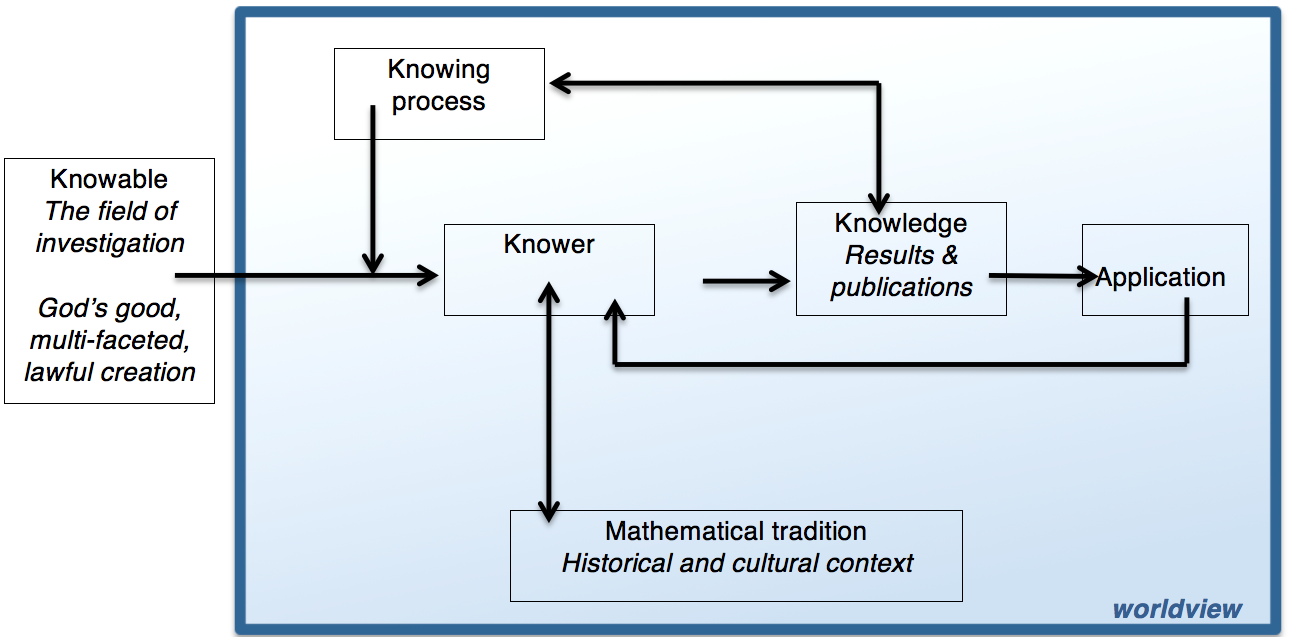
A model for mathematics – all activity takes place within a worldview. Hence epistemological subjectivity, but ontological objectivity. History and application play important roles (Adapted from an original diagram by Revd Richard Russell.)

Steve Bishop is the compiler of A Bibliography for a Christian Approach to Mathematics and the author of several articles on the relationship between faith and math, including his series on Christian Mathematicians here at GodandMath.com.