How Math Illumines Our Infinite God

I was recently directed to a great article by John Van Sloten at thinkChristian on “How math illumines our infinite God.” In the article, Van Sloten addresses how a proper mathematical understanding of infinity informs our perception of our infinite God. The article also comes from a growing concern over the decreasing mathematical ability of the general populace. The closing question is a significant one:

If we don’t possess even basic math skills, how will we ever be able to engage the mathematical – that is, the logical, precise, trustworthy, universal, elegant, infinite and awe-inspiring – mind of God?

In addition to the article, John Van Sloten also gave a sermon at New Hope Church in Calgary entitled “God, Infinity, and Mathematics.” An entire sermon, given in a church, dealing with God and math. Preach on John. Preach on.

Corpus Hypercubus

Courtesy of the Association of Christians in the Mathematical Sciences:

Salvador Dali’s painting Corpus Hypercubus (1954) is a fascinating visual representation of a mathematical metaphor for the theological mystery of crucifixion.

Corpus Hypercubus, Salvador Dali (1954)

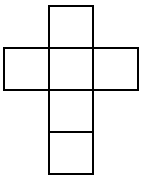
Many people are familiar with how to unfold a cube from three dimensions into two as shown in the figures below. Some of the edges of the cube are separated so that the resulting collection of squares can be unfolded into a planar shape. The resulting diagram is called a “net” for the cube. The net is not unique but one common net resembles a cross.

Dali painted the cross in Corpus Hypercubus as a hypercube unfolded into 3-dimensional space. The hypercube consists of eight three-dimensional cubes for hyperfaces. Each hyperface is attached along a two-dimensional square face to six of the other hyperfaces. Just as one can unfold a cube, one can also unfold a hypercube into the shape depicted in Dali’s painting.

Using the analogy of a (mysterious) higher-dimensional object unfolded into three dimensions, Dali depicts the theological mystery of the crucifixion as an event that originated in a higher plane of existence and then unfolded into the world that we perceive. With this understanding, Corpus Hypercubus communicates the idea that though one can discuss the necessity of the Jesus’ sacrifice for salvation or study theological ramifications of the cross, one can only do so by analogy because human nature simply cannot perceive the scope of God’s plan.

More from the ACMS:

Stewards of the Created Order: A Case for Christian Influence in the Field of Mathematics

Below is a link to my notes for a talk I gave at the 2013 southwest meeting of the Evangelical Theological Society. Most of what is contained in this paper can be found elsewhere on GodandMath.com in further detail. The paper acts as a summary of some key points of connection between mathematics and Christian faith without going into real significant depth on any one of them. One final thing to mention: the attached paper was meant to serve as a guide for my talking points and isn’t exactly written in polished manner. Please forgive any statements that may be worded in a confused manner, and feel free to explore the site for further details or contact me if you have questions. Thank you.

Stewards of the Created Order: A Case for Christian Influence in the Field of Mathematics

Presented by Josh Wilkerson

2013 Evangelical Theological Society Southwest Regional

Dallas Theological Seminary

March 2, 2013