Education: An Act of Justice or an Act of Grace?

It has been a while since my last post. Ph.D. work, conference, and family have all kept me busy throughout the summer. I should hopefully have a few posts over the next few weeks that summarize the conferences that I have attend, the progress I have made in my Ph.D. research, and some general thoughts I have considered this summer. This post falls in the latter category. Enjoy.

I have written here before that education is inherently value-laden. If you are an educator then it is not a question of “are you teaching values?” but rather “which values are you teaching?” In this vein of thinking it can also be argued that education is inherently religious if it instills within us some sense of values and some sense of faith. Now, those values and the object(s) of that faith could vary greatly depending on the educational institution, but the fact is they are always there. This is why for centuries the work of education was undertaken by explicitly religious institutions and it is only fairly recently in society’s history that the state has taken on this endeavor (Wilson). So for everyone who feels that there is something wrong with our current state/system of education, I would argue that the root issue is primarily a religious one.

Every pedagogy assumes an anthropology (Smith). Before you can teach human beings you have to have some understanding of what human beings are. Ultimately I believe this is the reason for the existence of standardized testing (at least in America). The state approaches education from the perspective that all human beings are essentially good. It is simply a matter of providing education equally for all that will result in well-trained, productive citizens who contribute to the good of society. From this perspective, education is an act of justice. It is a citizen’s right to be educated. If the educational system is an administration of justice on the part of the state then it will inextricably be tied to universal standards that students and educators are required to meet. I mean, isn’t that how the justice system works? It sets standards in place that apply equally to everyone in a blanket approach and expects every individual to live up to those standards. There are also consequences when the standard isn’t met. Fail to meet the justice standard in society and go to jail. Fail to meet the standard in school and get remediation or don’t move to the next grade level or don’t graduate. As long as the state is in control of education, expect standardized testing to always be a part of the educational process.

What is the alternative? Maybe, just maybe, human beings aren’t inherently good. Maybe they are inherently evil and no amount of knowledge is going to save them from that. If we adopt this (Christian) anthropology then education will not be seen as an act of justice, as a right of the citizens, but rather as an act of grace. Education can be viewed as an act of grace that missionally reaches out to engage the lost mind. Grace doesn’t set a standard for you to meet. In fact, grace realizes that you can’t meet THE standard. So then the focus of education shifts from universal standards to individual and communal transformation. Results aren’t measured in knowledge gained but rather in affections formed.

My thoughts are still developing on this topic, but for now I can leave you with this fact: as a Christian educator (be it in an explicitly Christian setting or even when I was in public school), I care less about what my students know, and more about what my students love. This is the purpose of education.

Some books that I have been reading that have influenced my thinking on this issue:

Desiring the Kingdom: Worship, Worldview, and Cultural Formation, by James K.A. Smith.

The Case for Classical Christian Education, by Douglas Wilson.
Math and Mission

Any gift we’re given is meant to be of service — to be a blessing to the masses, and to ultimately to meet needs of others and not simply their wants and expectations.

~ Josh Garrels, on why he has given away so much of his music for free

As I’ve mentioned here before, I am a big fan of Josh Garrels. I spent four years in seminary and I don’t think I can teach theology as well as he does – and he does it through music. I was reading a recent interview with him and came across the quote above. “Any gift we are given is meant to be of service.” It is one thing to say this, it is another thing to live it out, and if you do any research on Josh Garrels you’ll find that he truly tries to embody this statement.

It is my hope that we will come to see the community of mathematics educators (and really all educators in general) commit themselves to this mantra: the gift of mathematics is meant to be of service. When I say “gift of mathematics” I’m not referring to just those people who have a natural inclination toward the subject. When I say “gift of mathematics” I simply mean the capacity to do mathematics and to think mathematically and this is gift that God instills into EVERY human being.

Over the past month or so I’ve hear several talks by people who truly understand that the church’s job is not retreat from culture but to engage it, and to engage it in a way that is distinctly Christian. Redemption doesn’t just happen at the individual spiritual level, it happens at a broader cultural level. The church’s job is to go out and get its hands dirty doing the work of service, and we accomplish this through the gifts that God has blessed us with.

One of the talks I heard was by Brian Thomas, an engineering professor at Baylor and faculty sponsor of Engineers with a Mission. His interests include developing simple, low cost, technologically appropriate ways to provide light and electricity to the poor of the majority world. He gave an excellent message on how engineering (which he defined as using math and science to solve problems for people) can be used as a missional gift and is an invaluable skill for doing ministry in the service of God and others. He has graciously allowed me to post the slides of his presentation below (all photos are copyrighted by Brian Thomas).

The second talk I heard was by Steve Vinton of Village Schools International. The purpose of Village Schools International is to “send missionary teachers to small villages in Africa to get involved in the lives of their students, that sharing the Gospel is the natural result of loving them.” While this is not a math-specific ministry, it does view education (of which mathematics is a large part) as a basic human need that the church can aid in meeting. I encourage you to follow the link above to read more about Village Schools International and to keep this ministry in your prayers. Specifically you can be praying for more workers, more open doors, and discernment for their leaders.

My goal as a math teacher is to instill within my students this same appreciation for how the gift of education (and mathematics more specifically) is not just for their own betterment in life, but it should be used in service of others. I’ve posted before on service-learning projects that I’ve implemented and when this semester comes to a close I’ll update you on the projects students completed this year (including my geometry class designing housing for a homeless ministry called Mobile Loaves and Fishes). I’ll also be serving on a panel for service-learning in mathematics at the ACMS conference this June and this summer I will completing an independent study collecting and analyzing the research that is out there on the benefits of incorporating service into the mathematics classroom. So look for updates in the coming months on practical ways to cultivate a desire within students to use their gifts (be it in math or any other subject) to “be a blessing to the masses.”

Aims for Christian Math Education

By Steve Bishop

(Disclaimer: The views expressed by guest authors do not necessarily reflect those of GodandMath.com. Guest articles are sought after for the purpose of bringing more diverse viewpoints to the topics of mathematics and theology. The point is to foster discussion. To this end respectful and constructive comments are highly encouraged.)

It has been said that the most incomprehensible thing about the world is its comprehensibility. Mathematics is only possible because God has created an ordered, law-full, universe that is comprehensible. Part of the task of mathematics is to describe the wonder of God’s good creation and thereby reveal some of the invisible attributes of God e.g. his faithfulness. Mathematics is also integral to the fulfilling of the creation mandate to open up and develop the creation. Mathematics is an important tool to help us steward and unfold the potentialities of the earth. Music, art, science and economics are four subjects that would be severely impoverished without the aid of mathematics.

Mathematics is a collective term for a number of related fields: arithmetic, geometry, topology, statistics, probability, … . All of which investigate and open up the two most basic aspects of reality: the numerical and spatial. (Applied mathematics also deals with a third aspect: the kinematic).

Math is a human activity therefore, it comes replete with human limitations: it is fallible, corrigible, culture- and value-laden. However, it is based in creation – it is not arbitrary or the product of social agreement. This is where a Christian view of math diverges from the social constructivist view. This Christian view of math does justice to both epistemological subjectivity and ontological objectivity.

Mathematics is based in created reality. It is not neutral; religious beliefs shape mathematical theories.

Mathematical Education Aims

Hence, mathematics education should:

1. Be placed in a historical and cultural context.
This will help to expose the myth of mathematical objectivity.

2. Be rooted in reality and everyday applications.
This will help show mathematics as a tool for unfolding and developing the creation.

3. Be integrated with other subjects.
Mathematics deals with the two most basic aspects of reality, the numerical and the spatial, these aspects are basic to all other curriculum subjects. The integration with other subjects, particularly science, reveals the role of mathematics as a tool to help fulfill the cultural mandate.

4. Describe the beauty and order of creation and to help students understand creation.

5. Reveal some of the attributes of God (Rom 1:20; Ps 19:1). Particularly the faithfulness of God to His creation exemplified in His laws and the lawfulness of creation. Without this mathematics would be impossible.

6. Enable us the be better stewards of God’s creation.

7. Provide fun and enjoyment.

8. Focus on understanding rather than rote or memorization.

9. Recognize that each student is created in God’s image and that each student is unique.
Differentiation will be important.  We all learn in different ways and at different rates, this should be taken into account.

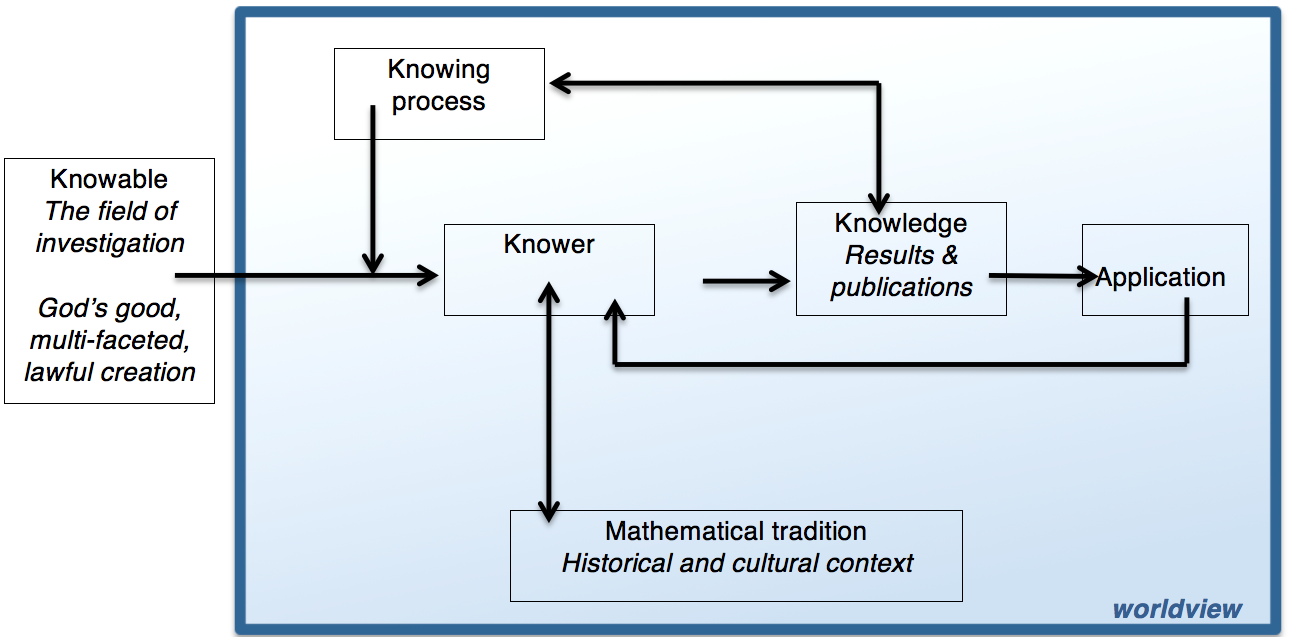
A model for mathematics – all activity takes place within a worldview. Hence epistemological subjectivity, but ontological objectivity. History and application play important roles (Adapted from an original diagram by Revd Richard Russell.)

Steve Bishop is the compiler of A Bibliography for a Christian Approach to Mathematics and the author of several articles on the relationship between faith and math, including his series on Christian Mathematicians here at GodandMath.com.