Resources for Integrating Faith and Mathematics

Well, it is coming down to the end of the spring semester. I am going to be quite busy over the next few weeks making sure I have all my work completed and turned in and that everything is set for graduation. So I don’t know how many posts I might get up before the middle of May. Here are a couple of articles to hold you over until then. If you read through these too quick and are left waiting for more, then check out the link on the top of page: “Resources for Integrating Faith and Mathematics.”

“The Unreasonable Effectiveness of Mathematics in the Natural Sciences,” Eugene Wigner

Wigner observes that the mathematical structure of a physics theory often points the way to further advances in that theory and even to empirical predictions. He argues that this is not just a coincidence and therefore must reflect some larger and deeper truth about both mathematics and physics.

“On Christian Scholarship,” Alvin Plantinga

How should a Christian university and how should the Christian intellectual community think about scholarship and science? Should the kind of scholarship and science that go on at a Catholic university differ from the sort that goes on elsewhere? If so, in what way? Plantinga presents one sort of view–not with the thought that this is the whole and unvarnished truth, but as a contribution to our conversation.

“Advice to Christian Philosophers,” Alvin Plantinga

In each area of serious intellectual endeavor the fundamental and often unexpressed presuppositions that govern and direct the discipline are not religiously neutral; they are often antithetic to a Christian perspective. In these areas then it is up to Christians who practice the relevant discipline to develop the right Christian alternatives. Plantinga pursues this primarily from his own discipline of philosophy, but the ideas translate into all areas of scholarship.
On Informed Ignorance

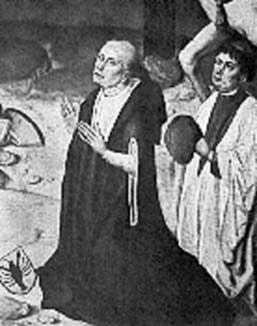
I was reading the other day and came across this name: Nicholas of Cusa. Nicholas was a cardinal and bishop in the mid 1400’s who made some significant contributions to the field of mathematics – most notably his influence on Johannes Kepler (another man of faith who demonstrated that planets move in an elliptical orbit around the sun).

I am always encouraged when I come across people of faith from history who also devoted serious study to mathematics and recognized how the two can be integrated. So while my knowledge of Nicholas is very limited (how well do you someone you just met?), I thought I would pass along what I found for anyone who is interested in examining his works further.

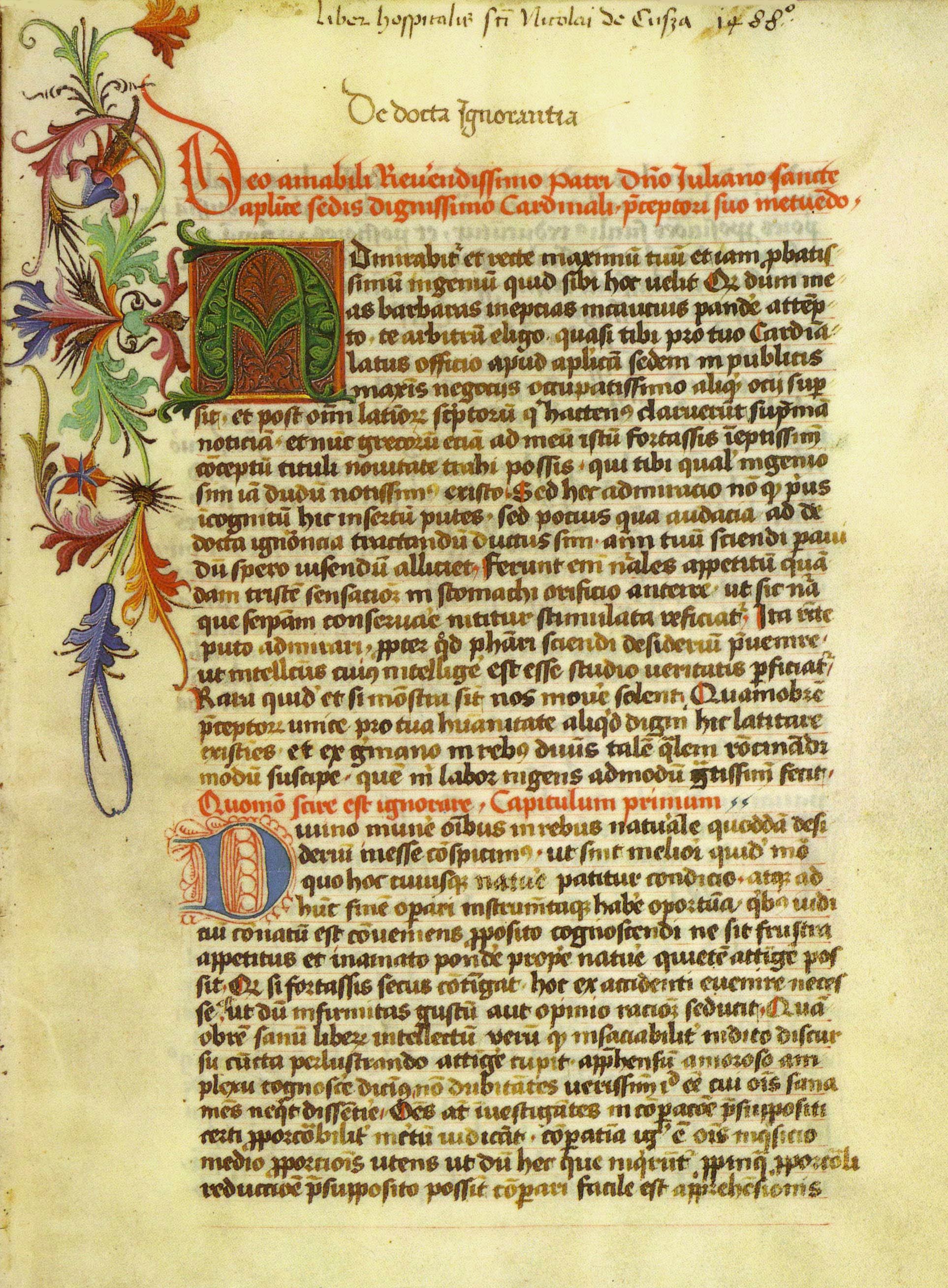
Nicholas is most known for his work De Docta Ignorantia, which is roughly translated “On Informed/Learned Ignorance.” Or perhaps another way to phrase it: “Recognizing the Limitations of Knowledge.” Nicholas used mathematical analogies to show that truth can be approached, but never fully reached (or comprehended).

While I believe Truth can be reached (as long as He reaches out to us), I also believe it is healthy to recognize our inability to fully understand it. I wrote in a previous post about the need for Christian humility in our mathematical scholarship.

The following are some quotes from De Docta Ignorantia:

If we achieve this, we shall have attained to a state of informed ignorance. For even he who is most greedy for knowledge can achieve no greater perfection than to be thoroughly aware of his own ignorance in his particular field. The more be known, the more aware he will be of his ignorance. It is for that reason that I have taken the trouble to write a little about informed ignorance. …

Thus wise men have been right in taking examples of things which can be investigated with the mind from the field of mathematics, and not one of the Ancients who is considered of real importance approached a difficult problem except by way of the mathematical analogy. That is why Boethius, the greatest scholar among the Romans, said that for a man entirely unversed in mathematics, knowledge of the Divine was unattainable. …

The finite mind can therefore not attain to the full truth about things through similarity. For the truth is neither more nor less, but rather indivisible. What is itself not true can no more measure the truth than what is not a circle can measure a circle; whose being is indivisible. Hence reason, which is not the truth, can never grasp the truth so exactly that it could not be grasped infinitely more accurately. Reason stands in the same relation to truth as the polygon to the circle; the more vertices a polygon has, the more it resembles a circle, yet even when the number of vertices grows infinite, the polygon never becomes equal to a circle, unless it becomes a circle in its true nature.

The real nature of what exists, which constitutes its truth, is therefore never entirely attainable. It has been sought by all the philosophers, but never really found. The further we penetrate into informed ignorance, the closer we come to the truth itself. …

Here are some links for more on Nicholas of Cusa:

De Docta Ignorantia

Translator’s Introduction

Book 1: Maximum Absolutum (God)

Book 2: Maximum Contractum (the universe)

Book 3: Maximum Simul Contractum et Absolutum (Christ)

Other works of Cusa

2 + 2 = 5 (For Extremely Large Values of 2)

In keeping with the t-shirt-themed-previous-posting, I thought I would begin this entry with a snapshot of a shirt that I received for Christmas. Pretty awesome huh? Jealous? Well if you are, you can click on the picture and you will be whisked away to the website that sells them (I suppose even if you aren’t jealous, that last statement still holds). They will be happy to take your money and in exchange provide you with a shirt of your very own.

You’ll notice when you go to the website (thinkgeek.com) that they make a reference to a quote from Bishop George Berkeley. In fact, this reference is what initially sparked my interest in the shirt. Berkeley was an Irish philosopher practicing during the early 1700’s (following on the heels of his quite famous British predecessor John Locke). What’s more, Berkeley was a committed Christian, holding the position of Bishop of Cloyne.

I was introduced to the Bishop during a History of Philosophy class. In fact, I wrote a paper on his philosophy of mathematics. One of his most well known works is entitled: The Analyst, subtitled: “A Discourse Addressed to an Infidel Mathematician,” sub-subtitled (?), “Wherein it is Examined whether the Objects, Principles, and Inferences of the modern analysis are more distinctly conceived, or more evidently deduced, than Religious Mysteries and Points of Faith.”

Wow. And I thought the title for my paper on mathematics and process theology was impressive.

You can read The Analyst here.

This work is essentially a critique of the foundations and principles that Sir Isaac Newton (and Gottfried Leibniz) used to develop Calculus. Berkeley thought Newton’s reasoning was as sound as saying 2 + 2 = 5 for extremely large values of 2, hence the t-shirt. And you know what? Berkeley’s critique was a correct one. That’s not just my opinion, it was the consensus of mathematical community. The Analyst was a vital text in driving the revision and development of Calculus that we use and teach today.

The sad part is that while the importance of this work is known to most mathematicians and historians (at least the serious ones), on a popular level The Analyst is largely ignored. I’m quite sure that even those students who loathed math class remember the name Isaac Newton and can generally credit him with developing the concepts of Calculus. I’m also quite certain that, if polled, the same people would attribute Berkeley with the founding of a city in California. (Side note: the city in California is indeed named for the same George Berkeley, but he had nothing to do with its founding… what with being an Irishman who died in 1753).

All Berkeley’s endeavors, according Genevieve Brykman, were directed to the defense of what he saw as the most important truth – that we are in a constant and immediate relationship of dependence on God. Berkeley’s philosophy… was a provisional instrument in the service of his overriding apologetic aim.[1]

George Berkeley was the embodiment of what it means to think about mathematics Christianly and I think that it is important for us (those Christians who want apply their faith to the serious contemplation of mathematics) to give a more careful consideration of his work than we have previously given it.

I hope to provide some snippets from my paper in future posts.


[1] Gerald Hanratty, Philosophers of the Enlightenment: Locke, Hume and Berkeley Revisited. (Dublin: Four Courts Press, 1995), 72. See Genevieve Brykman, Berkeley: Philosophie et Apologetique (Paris, 1984).