God’s Language is Math

by Mark Eckel

Originally published on WarpandWoof.org and again at NurturingFaith.wordpress.com.

(Disclaimer: The views expressed by guest authors do not necessarily reflect those of GodandMath.com. Guest articles are sought after for the purpose of bringing more diverse viewpoints to the topics of mathematics and theology. The point is to foster discussion. To this end respectful and constructive comments are highly encouraged.)

“I’m not a math person.”  For years this had been my response to any question involving numbers, equations, or solutions.  But I had wrongly given up responsibility for a crucial characteristic of God’s creation.  I began to realize my answer was a wrong approach to math or, for that matter, anything else in life.

In the summer of 2003 I was asked to do a Christian school in-service on biblical integration including three hours on elementary math.  I asked for and received the table of contents along with sample lessons from each textbook.  As I pondered God’s natural revelation of arithmetic The Spirit began to open my eyes to at least twelve major concepts directly dependent upon Scriptural truth.

I used to believe that math was the most difficult subject for biblical integration.  Indeed, it seems immediately plain that math is the essential core of God’s world.  As I understand it now, math could well be described as “God’s language.”  For instance, John D. Barrow’s book The Constants of Nature: From Alpha to Omega–the Numbers That Encode the Deepest Secrets of the Universe seems to mirror Scriptural injunctions concerning “the works of God’s hands” that endure “from age to age.”  The stability of creation is consistently used as the measuring rod for God’s interaction with people.  Why?  The Creator’s truthful rule over this world and this life marks his dependability for the next world and afterlife (see examples in Psalms 35, 71, 73, 80, 88, 92, 95, 103, 118, 120, 146, and 148).  Numerical order is essential for life and central to “the whole truth” of God’s creation.

Here is a sample of biblically integrative lesson plan goals from the first of twelve mathematical concepts entitled “systems and roles.”  Each aim is premised upon observations from Genesis one and two.  [I have created 12 lesson plans which include goals, objectives, anticipatory sets, readings, discussion, methods, and questions.]

  1. To prove God’s world is interrelated—each part working within the whole.
  2. To express how God brought various systems together in complementary equilibrium.
  3. To state that creation’s organization is based on the plans and decrees of God.
  4. To explain how something is “unique”—each thing assigned its place, given a role by God.
  5. To appreciate math as a system by which God runs His world.

After describing God’s numerical ordering of His creation Job cries, “And these are but the outer fringe of his works!” (26:14). Never again will I say, “I’m not a math person.”  Since The Personal Eternal Creator binds His world with numbers, I am bound to discover more about math.  Discovering more of God’s world helps us to know more of our God.

Dr. Mark Eckel is Dean of Undergraduate Studies and Professor of Old Testament at Crossroads Bible College, Indianapolis, IN. For over twenty five years Mark has served the Christian education community as a high school teacher, college professor, and international speaker. Mark’s original curricula Let God Be God: The Nature and Characteristics of God and Timeless Truth: An Apologetic for the Reliability, Authenticity, and Authority of Scripture have served the Christian school movement around the world. In 2006 Mark consulted with Chuck Colson to produce a curriculum for high school students called Rewired. Since then he has produced both online and print curricula for various ministries. Mark’s book The Whole Truth: Classroom Strategies for Biblical Integration has helped thousands of Christian school teachers practice biblical integration in their classrooms.

Proof: How it Differs in Math, Science, and Life

by Dr. Marvin Bittinger

(Disclaimer: The views expressed by guest authors do not necessarily reflect those of GodandMath.com. Guest articles are sought after for the purpose of bringing more diverse viewpoints to the topics of mathematics and theology. The point is to foster discussion. To this end respectful and constructive comments are highly encouraged.)

My favorite math professor once said, “You can’t use mathematics to provide an absolute proof of God. The existence of God boils down to the acceptance of a faith axiom based on a vast amount of evidence.” It was a big idea for a young man like myself, and it sparked a lifelong interest in integrating mathematics with religion and philosophy. It led me to ask, How does “proof” in mathematics differ from proof outside of mathematics?

Mathematicians tend not to ask this question because our discipline operates in a comfort zone. We start with a finite set of statements called axioms(assumptions). Such statements are assumed true. Using rules of logic, further true statements are proved by starting with the axioms. The proven statements as well as the axioms are referred to as theorems. In short, the process is like a game. The axioms are the pieces and the logic provides the rules, that allow a string of proven statements.

Furthermore, a property demanded of every mathematical system is that it be consistent, meaning that there is no statement “Q” such that both “Q” and “not-Q” are theorems of the same mathematical system. If such a contradiction were the case, then every statement can be proved as a theorem, and no discernible real truth prevails.
Outside the field of mathematics, however, proofs are created in a zone of less comfort. Researchers using the scientific method begin with an hypothesis, or assumption. Then they design experiments to test the hypothesis. Experiments provide evidence that is observable, empirical, measurable, and subject to reason. Just as important, experiments must be repeatable. If carried out in an unbiased manner, they should always show the same result. The scientist must then make all these findings available to others, who may question the results or want to test them once again.

But finally, the scientific method draws its conclusions based on probability, which comes in degrees. The more an experiment is replicated, the higher the probability its results offer a proof, and replication by an independent source makes that probability even higher. Eventually, we come to the point of making a “decision” or “leap” that accepts an experimental proof. Some leaps are greater than others. For example, that the sun will rise tomorrow has greater certainty than whether cigarette smoking leads to lung cancer. Neither event is absolutely certain, but we nevertheless accept these as proven things about the sun and smoking.

In their own work, mathematicians owe scientists a debt of gratitude. The results of the scientific method can give mathematicians new axioms—axioms that can be used to prove other results. Still, we can go overboard and turn science into an idol, or false god. Some have argued the grandiose axiom that, “Something is only true if it can be proved using the scientific method.” But as with all axioms, how can you prove that assumption is true? Such assertions are self-contradictory under the rules of reason used by the scientific method itself.

For people who are not mathematicians, finding satisfactory “proofs” in the world involves a lifetime journey of reading, studying, scientific investigation, knowledge, eyewitness information, reliable documentation, historical confirmation, and so on. This ordinary method of proof is a process of gathering evidence that confirms things beyond a reasonable doubt, as in a legal proceeding. The process is driven by a dynamic tension between belief and questioning.

While mathematics and the scientific method are two extremely useful, worthful, and productive ways to find proof, they are not the only ways. In mathematics, we create the perfect game. In scientific proof, we leap to a conclusion that is probabilistic. Apart from these, however, most people see each piece of evidence as bringing them closer to a conclusion. For example, we can’t scientifically “prove” that a man went to the moon in 1969, because this event cannot be tested by replication. But obviously, a trail of evidence says it’s true. Today, I would tell my favorite math professor that this kind of accumulation of evidence can  help us draw conclusions about philosophy and religion, and even about the existence of God or reliability of the Bible.

Marvin Bittinger is the author of over 215 mathematics textbooks ranging in topics from developmental mathematics to algebra and trigonometry to brief calculus. Dr. Bittinger has a passionate interest in Christian theology and apologetics. He has written a book entitled The Faith Equation.

Essential Questions

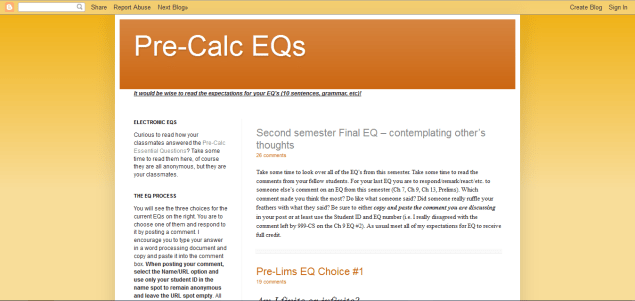
Chris VanSlooten at Christian School Teacher offers some practical ways to get students thinking about their faith in a Pre-Calculus course.

Big Idea: Give students essential questions to reflect on at the end of each unit, then publish them on a blog.

I think this is an amazing idea. I just came across this site and I will definitely be taking some time to read through it. As a Pre-Cal teacher in a public school I’ll be looking for some reflection questions which I can borrow/modify. Check out the student work on the blog below: