God, Math, and Order

When discussing mathematics from a Christian perspective, one statement that always seem to bubble to the top of the conversation is that mathematics reveals God as a God of order.

This is true.

This is also way underselling the connection between God and math.

First, we need to realize that when we say things like “Our God is a God of order,” or “Our God is a God of love,” or ” Our God is just,” that the concepts of order, love, and justice are not qualities that God displays; qualities that exist outside of Him. When we say “God is just” we mean something very different than when we say “that judge is just.” When we say “that judge is just,” we mean they exhibit the qualities of justice. When we say “God is just,” we mean God defines justice. There is no concept of justice apart from an understanding of the nature of God. The same can be said of love. We recognize love in a person because we recognize a quality of God in that person.

It is my belief that we should take this same perspective when we claim that “Our God is a God of order.” By this claim we shouldn’t merely mean that God acts in an orderly fashion. We should mean God defines what an orderly fashion is. Order is not a quality God decided to portray, rather order flows from His nature.

If this can become our perspective, then when we speak of mathematics portraying God as a God of order, that description will carry so much more meaning. Instead of just correlating our mathematical results with some quality that God displays, we can realize those results are better understood as a manifestation of God’s nature. In a way we are communing with Him in our work as mathematicians, gaining deeper insight into His character.

So how do we define justice from the nature of God? How do we define love from the nature of God?

Beloved, let us love one another, for love is from God; and everyone who loves is born of God and knows God. The one who does not love does not know God, for God is love. By this the love of God was manifested in us, that God has sent His only begotten Son into the world so that we might live through Him. In this is love, not that we loved God, but that He loved us and sent His Son to be the propitiation for our sins.

1 John 4:7-10

and

But now apart from the Law the righteousness of God has been manifested, being witnessed by the Law and the Prophets, even the righteousness of God through faith in Jesus Christ for all those who believe; for there is no distinction; for all have sinned and fall short of the glory of God, being justified as a gift by His grace through the redemption which is in Christ Jesus; whom God displayed publicly as a propitiation in His blood through faith. This was to demonstrate His righteousness, because in the forbearance of God He passed over the sins previously committed; for the demonstration, I say, of His righteousness at the present time, so that He would be just and the justifier of the one who has faith in Jesus.

Romans 3:21-26

In other words:

To the cross I look, to the cross I cling
Of its suffering I do drink
Of its work I do sing
For on it my Savior both bruised and crushed
Showed that God is love
And God is just

Lyrics from “Sweetly Broken” by Jeremy Riddle

If stating that “God is love” and “God is just” can reveal such deeply profound and intimate parts of our faith, why not experience that same kind of revelation from seeing God as a God of order through mathematics? Why not see mathematics as worship?

That’s how I see it.

I hope you can too.

Christian Mathematicians – Euler

By Steve Bishop

(Disclaimer: The views expressed by guest authors do not necessarily reflect those of GodandMath.com. Guest articles are sought after for the purpose of bringing more diverse viewpoints to the topics of mathematics and theology. The point is to foster discussion. To this end respectful and constructive comments are highly encouraged.)


Leonhard Euler (1707-1783)


Euler was a committed Christian and, apparently, a biblical literalist as well as being (arguably) one of the greatest mathematicians ever – he was certainly the most prolific (apart from perhaps Paul Erdos).

According to one website (condensed from E T Bell’s Men of Mathematics):

Euler remained a Christian all of his life and often read to his family from the Bible. One story about his religion during his stay in Russia involved the atheistic philosopher Diderot. Diderot had been invited to the court by Catherine the Great, but then annoyed her by trying to convert everyone to atheism. Catherine asked Euler for help, and he informed Diderot, who was ignorant of mathematics, that he would present in court an algebraic proof of the existence of God, if Diderot wanted to hear it. Diderot was interested, and, according to De Morgan, Euler advanced toward Diderot, and said gravely, and in a tone of perfect conviction: “Sir, (a + bn) / n = x , hence God exists; reply! ” Diderot had no reply, and the court broke into laughter. Diderot immediately returned to France.

Leonhard was born into a Calvinist family and his father, Paul, was a minister in the church as was his grandfather. Euler’s father wanted him to follow him into the church. However, being a good Calvinist he realised that one could serve God through mathematics as well as theology and seeing his son’s ability in and passion for mathematics allowing him to pursue mathematics.

Euler always held an interest in theology as well as mathematics. For him mathematics gave insight into God’s good creation.

Eulogy of Euler by Nicolas Fuss:

He was entirely imbued with respect for religion and his piety was sincere and his devotion was full of fervor. He fulfilled with the greatest detail all the duties of a Christian. He loved everyone, and if he felt stirrings of indignations it was against those enemies of religion, especially against the declared apostles of atheism that he made a stand in the defense of the Revelation against the objections of atheists in a work which was published in Berlin in 1747.

Dan Graves in his Scientists of Faith has this to say of Euler:

Euler retained his firm Calvinist beliefs throughout life, holding daily prayer and worship in his home and sometimes preaching.

Euler was one of the first inventors of the number game Suduko. Though he called it Latin squares.

He introduced the letter e to represent the base of natural logs, f(x) to denote functions,and made countless contributions to number theory and graph theory, most notably he showed that the Koinisberg bridge problem was unsolvable.

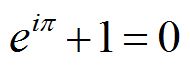
His name is associated with angles, approximation, circles, cycle, criterion, graphs, operator’s, polynomials, pseudo primes, … and Euler’s identity: said to be the most beautiful formula in the world.

And let’s not forget:

V – E + F = 2

Euler was able to serve his God through his mathematics.

Also on Euler:

Steve Bishop is the compiler of A Bibliography for a Christian Approach to Mathematics and the author of several articles on the relationship between faith and math. Look for future posts from him in this series on Christian Mathematicians.

Beyond Practicality

Here is a link to the presentation I am giving at the 2012 Joint Mathematics Meetings in Boston:

If you would like to read the full paper, you can do so here:

Beyond Practicality: George Berkeley and the Need for Philosophical Integration in Mathematics