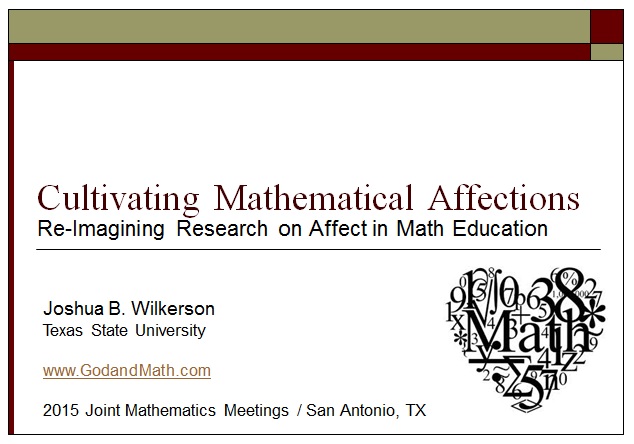
This week I am giving two different talks at the 2015 Joint Mathematics Meetings in San Antonio, TX. What follows is information relating to the first talk. I will post information on the second talk in the coming days.
This talk is taken from my forthcoming article “Cultivating Mathematical Affections: The Influence of Christian Faith on Mathematics Pedagogy” for a special, math-themed issue of Perspectives on Science and Christian Faith. Once that article publishes I will link to the full text. For now I will simply share a copy of the presentation and encourage you that if the topic interests you, I will be posting much more on this concept of affective learning in mathematics as it is the main focus of my dissertation.
ABSTRACT:
“When am I ever going to use this?” is a common question in mathematics. It is also more typically presented as a statement. It is a statement of frustration. It is the culmination of confusion and stress and typically serves as an exclamation by the student of their withdrawal from the mental activity at hand. I argue that the real question being raised by students is “Why should I value this?” We as math educators must do a better job of addressing this non-cognitive question. We need to do a better job of cultivating what I term as mathematical affections.
Affective language permeates national policy documents on the teaching of mathematics as an ideal we should strive to inculcate into students, but there is little discussion on how to go about doing this. This talk will examine the specific passages of the policy documents in question, discuss the shortcomings in the current body of research that exists on affect in math education, and outline a new framework (based on recent work in cognitive psychology and contemporary philosophy) for understanding how we might cultivate mathematical affections. Practical classroom resources and exercises will be offered.
OUTLINE:
Word Document of Outline
- Take a moment and visualize the best classroom experience that you have had as an educator. Or visualize what you would consider to be the ideal mathematics classroom.
- Think through a list of adjectives to describe that scene
- My wager is that those adjectives are more likely to do with the affective learning taking place in the classroom rather than the cognitive
- You certainly may have listed “students performing higher level critical thinking” but much more likely (and much more memorable) are phrases that describe student engagement and attitudes.
- If you did focus more on the affective outcomes of the classroom in this visualization exercise, you wouldn’t be alone…
- In a foundational article on affective learning in mathematics in the Handbook of Research on Mathematics Teaching and Learning, Douglas McLeod states: Affective issues play a central role in mathematics learning and instruction. When teachers talk about their mathematics classes, they seem just as likely to mention their students’ enthusiasm or hostility toward mathematics as to report their cognitive achievements. Similarly, inquiries of students are just as likely to produce affective as cognitive responses, comments about liking (or hating) mathematics are as common as reports of instructional activities. These informal observations support the view that affect plays a significant role in mathematics learning and instruction.
- While we can argue about the importance of affective learning objectives from many different angles, for now, based on our own experiences as educators, we understand the significant impact of affect in math education
- Education is inherently affective; it is inherently value laden. It is not a question of “Are you teaching values?” but rather “Which values are you teaching?”
- Value language is scattered throughout national policy documents on the teaching of mathematics.
- We see this language in national standards such as the NCTM Standards for Teaching Mathematics (1991) when it states that “Being mathematically literate includes having an appreciation of the value and beauty of mathematics as well as being able and inclined to appraise and use quantitative information” (emphasis added). Mathematical literacy, according to the NCTM, involves not merely using quantitative information (remember the “When am I going to use this?” question) but also giving the discipline of mathematics its proper value.
- Another national policy document, Adding it Up: Helping Children Learn Mathematics, a report published by the National Research Council (2001), argues that mathematical proficiency has five strands, one of which is termed “productive disposition.” Productive disposition is defined as “the habitual inclination to see mathematics as sensible, useful, and worthwhile.” To be mathematically proficient (not just literate, but proficient) the valuation of mathematics must lead to a habit of seeing mathematics as worthwhile – that is, valuable to justify time or effort spent. Math education is inherently value-laden.
- While we want to see these ideals in our students, nowhere (in these policy documents or elsewhere) is it discussed how we go about achieving this (How we cultivate these mathematical affections). Why is that? I think there are two perspectives, one from the classroom and one from research:
- Classroom: Veatch (2001) notes that “There is a prevalent attitude that one learns what is good mathematics by seeing and doing it, not by discussing values. The knowledge needed by the person entering the field will rub off on her. The classroom clearly reflects this attitude.”
- This seems to me to be the reason why there is no explanation in national policy documents as to how to go about forming affections in students
- The perception is simply: let’s address the cognitive demands of mathematics and meet those standards and then the students will value the experience.
- Research: In a special issue of Educational Studies in Mathematics devoted entirely to affect in mathematics education, Rosetta Zan states: Affect has been a focus of increasing interest in mathematics education research. However, affect has generally been seen as ‘other’ than mathematical thinking, as just not part of it. Indeed, throughout modern history, reasoning has normally seems to require the suppression, or the control of, emotion.
- Both of these represent incorrect perceptions of affect in mathematics. We will address these in reverse order, dealing with research first and then the classroom.
- Research: if we go back to the original formation of the affective domain of learning we see that affect is not synonymous with emotion.
- The affective (heart/feeling) domain of learning is more specifically referred to as “Krathwohl’s Taxonomy,” due to the work of David Krathwohl. The affective domain is not simply based on subjective emotions (though emotion may play a small part in affective learning), rather it’s about demonstrated behavior, attitude, and characteristics of the learner – all of which are deeply rooted to success in the mathematics classroom, and all of which are largely misunderstood in math education research.
- Affect then is not equal to emotion. Rather affect is an aesthetic, it is an orientation of life, a mechanism for determining what is worthwhile. This perspective matches better with the phrases from the policy documents cited above: Consider once more that being mathematically literate involves having an appreciation of the value and beauty of mathematics, and being mathematically proficient involves a habitual inclination to see mathematics as worthwhile.
- Classroom:
- From McLeod again: As it stands our current methods of teaching mathematics are producing untold numbers of students who see mathematics more about natural ability rather than effort, who are willing to accept poor performance in mathematics, who often openly proclaim their ignorance of math without embarrassment, and who treat their lack of accomplishment in mathematics as permanent state over which they have little control.
- How many of you, when you introduce yourself to someone for the first time and inform them that your work involves mathematics, receive the other person’s condolences? Or the person says something to the effect of “I was never any good at math.” Math is the only profession that I know of where this occurs (nobody every meets a dentist and then unprompted admits to never flossing).
- The business as usual approach to teaching math will continue to produce these affections. How do we change this?
- What if we take a different approach to affections?
- James K.A. Smith: “Behind every pedagogy is a philosophical anthropology.” Before you can teach a human being you must first have a notion of what a human being is.
- What if human beings are primarily affective creatures before they are cognitive ones. How might this change our understanding of how students learn in the math classroom? How might this change how we approach research on affect in math education?
- A new perspective on education (from Smith):
- Education is nor primarily a heady project concerned with providing information; rather, education is most fundamentally a matter of formation, a task of shaping and creating a certain kind of people.
- What makes them a distinctive kind of people is what they love or desire – what they envision as “the good life” or the ideal picture of human flourishing.
- An education, then, is a constellation of practices, rituals, and routines that inculcates a particular vision of the good life by inscribing or infusing that vision into the heart (the gut) by means of material, embodied practices.
- This will be true even of the most instrumentalist, pragmatic programs of education (such as those that now tend to dominate public schools and universities bent on churning out “skilled workers”) that see their task primarily as providing information, because behind this is a vision of the good life that understands human flourishing primarily in terms of production and consumption.
- Behind the veneer of a “value-free” education concerned with providing skills, knowledge, and information is an educational vision that remains formative.
- There is no neutral, nonformative education.
- So how do we cultivate mathematical affections? Through the practices, habits, and rituals of the classroom.
- To try to convince you that affections are shaped through practice, consider the iPhone (or smartphone in general)
- Look around the conference today at how many people are engaged in conversation versus having their heads buried in their phone. Also notice how many people this week will demonstrate frustration at having to wait in long lines.
- While we don’t spend time thinking cognitively about our smartphones (we just use them as a regular practice), the technology is still engraining affections in us. Two specific ones might be:
- Feeling as though we deserve immediacy, being used to information at the push of a button, thus reducing our patience to solve a problem
- Feeling of inflated self-worth, of being in a social situation and responding by saying “I am not having my social needs met by this scenario so I will retreat to my phone where I can look at what I want to look at.”
- Approaching affective studies in this way will not be an easy task: according to Goldin Mathematics educators who set out to modify existing, strongly-held belief structures of their students are not likely to be successful addressing only the content of their students’ beliefs…it will be important to provide experiences that are sufficiently rich, varied, and powerful in their emotional content to foster students’ construction of new meta-affect.
- Here are two areas we should focus on re-imagining our research (and practice) of affect: technology and assessment.
- Similar to the iPhone example above, we need to consider what technological practices of the classroom we participate in that mold our student’s perceptions. We need to be careful not to implement the newest technological accessories in our classroom just because students are used to having technology in their lives outside of school. If we are trying to offer mathematics up as being the technologically savvy discipline and therefore worth the interest of students, I would argue that we are largely going to lose that battle. We are offering math as a competing interest against the newest apps, games, and electronic devices that students are inundated with on a daily basis. As much as I love math, I know that this is a competition it won’t win. What if instead we focused on technological liturgies in the classroom that utilized mathematics as a way of examining and critiquing technological advancements rather than simply using those advancements to try to make math more fun? What if these liturgies could instill in students a sense of mathematics (and education as whole) as being something other than just a competing product for their attention and rather a foundation for their life that informs the product choices and decisions they make? What if we stopped feeding the culture of immediacy that technology has engrained in us and purposefully use the classroom as a time to step back and reflect? Perhaps then students won’t automatically jump to the calculator when faced with a difficult problem and proceed to give up if the answer is not achieved in under a minute.
- More consideration needs to be given to assessment. The NCTM Assessment Standards for School Mathematics (1995) state that “It is through assessment that we communicate to students what mathematics are valued.” If our goal is cultivate mathematical affections (values) in students, assessment is the primary means by which we do so. We need to consider what liturgies of assessment we participate in at both the formative and summative level. For instance, is the emphasis on correctness of a student response? Perhaps a teacher poses a question to the class and a student answers incorrectly. The teacher responds with a simple ‘no’ and moves on to call on another student who they know will provide the right answer and move the lesson along. If we fall into this pattern (liturgy) of formative assessment we are instilling into students the notion that math is only about getting to a correct answer and we ignore the productive struggle that it takes to get there. At a summative level, as long as high stakes standardized exams exist where the main goal is to achieve a certain percentage of correct responses, we will always be fighting an uphill battle in getting students to value mathematics for its creative processes.
- I hope this offers a starting point for us to re-imagine the research on affect in math education and begin the process of cultivating mathematical affections in our students.
REFERENCES:
Goldin, G.A. (2002). Affect, meta-affect, and mathematical belief structures. In G.C. Leder, E. Pehkonen, & G. Törner (Eds.), Beliefs: a hidden variable in mathematics education? Netherlands: Kluwer Academic Publishers, pp. 59-72.
Krathwohl, D.R., Bloom, B.S., & Masia, B.B. (1964). Taxonomy of educational objectives: Handbook II. Affective Domain. New York: Longman.
McLeod, D.B. (1992). Research on affect in mathematics education: A reconceptualization. In D. A. Grouws (Ed.), Handbook of research on mathematics teaching and learning (pp. 575-596). New York: Macmillan.
National Council of Teachers of Mathematics. (1991). Standards for teaching mathematics. Reston, VA: NCTM.
National Council of Teachers of Mathematics. (1995). Mathematics Assessment Standards. Reston, VA: NCTM.
National Research Council (2001). Adding it up: Helping children learn mathematics. Washington D.C.: National Academy Press.
Smith, J.K.A. (2009). Desiring the kingdom: Worship, worldview, and cultural formation. Grand Rapids, MI: Baker Academic.
Veatch, M. (2001). Mathematics and values. In R. Howell & J. Bradley (Eds.), Mathematics in a Postmodern Age: A Christian Perspective. GrandRapids: Eerdmans, pp.223-249.
Zan, R., Brown, L., Evans, J., & Hannula, M.S. (2006). Affect in mathematics education: An introduction. Educational Studies in Mathematics (Affect in Mathematics Education: Exploring Theoretical Frameworks: A PME Special Issue), 63:2, 113-121.


 GOD & MATH: Thinking Christianly About Math Education