2013 ACMS Conference: Call for Papers

The following message is from the Association of Christians in the Mathematical Sciences in regards to paper proposals for the 19th ACMS conference next June at Bethel University in St. Paul, MN.

Call For Papers:

The biennial ACMS conference will be held at Bethel University in St. Paul, Minnesota May 29th – June 1st. Details can be found at http://www.acmsonline.org/conferences/2013/ACMS_2013_ Conference.html

At this time we are soliciting presentation proposals for the parallel session times. Presentations are expected to last 15 minutes (including any questions) with a 5 minute transition time between speakers.

There will also be some limited opportunities for one or two 25-minute panels sessions. One likely session will feature new or pending books on the interaction between faith and our disciplines. You may propose other panels, but should then include suggestions for panel members.

There will be a poster session and two Birds of a Feather sessions. Proposals are also requested for these categories. One Birds of a Feather session will be aimed at graduate students and another along the lines of “the opportunities and pitfalls of the Christian college scene”.

We are looking for presentations in both mathematics and computer science. General categories would include (but not necessarily be limited to)

1. the interaction of faith and discipline

2. pedagogy

3. history of the discipline or interesting topics/achievements of the past

4. social/discipline interaction

5. current research of general interest (with an audience of primarily non-subdiscipline-experts)

Proposals should be sent to Eric Gossett (gossett (at) bethel.edu) by March 15, 2013. After that date, proposals will be considered if space remains.

Proposals should include: your name, the presentation title, and a presentation abstract.
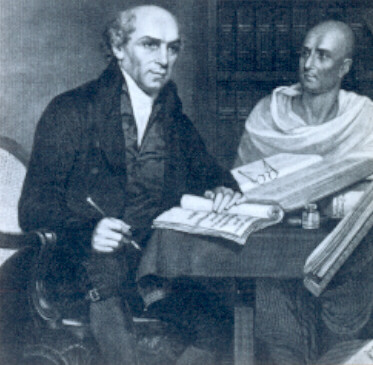
William Carey: Statistics and the Modern Missionary Movement

By Steve Bishop

(Disclaimer: The views expressed by guest authors do not necessarily reflect those of GodandMath.com. Guest articles are sought after for the purpose of bringing more diverse viewpoints to the topics of mathematics and theology. The point is to foster discussion. To this end respectful and constructive comments are highly encouraged.)

William Carey (1761-1834) once wrote: “Expect great things [from God]. Attempt great things [for God].” He did just that. He is considered by some to be the father of the modern missionary movement. As well as a missionary he was also a cobbler; a pastor – he spent six years pastoring Particular Baptist churches in Northamptonshire; a linguist – he promoted Bengali as a language and translated the Scriptures into the Indian languages, was a professor of languages at Calcutta’s Fort William College, as well as compiling a Bengali dictionary; a botanist – he introduced the daisy and the Linnean classification system to India;  a social activist – he campaigned against the cultural oppression of women and battled against sati (widow burning) and helped get it banned; and an educator – he founded Serampore College.

As a shoemaker in Northamptonshire he grew concerned with the fate of the unbelieving “heathen.” He had come into contact with the writings of Jonathan Edwards and came to see that his Calvinism and evangelism were compatible. The responsibility to reach the “heathen” arises out of what God has done.

To help him convince others of the need for word-wide evangelism he began to compile statistics. These were presented in 1792 in his wonderfully titled An Enquiry into the Obligations of Christians, to Use Means for the Conversion of the Heathens, in which the religious state of the different nations of the world, the success of former undertakings, and the practicability of further undertakings, are considered (http://www.wmcarey.edu/carey/enquiry/anenquiry.pdf). In section III he provides a survey of the then present state of the world. He then writes:

FIRST, The inhabitants of the world according to this calculation, amount to about seven hundred and thirty-one millions; four hundred and twenty millions of whom are still in pagan darkness; an hundred and thirty millions the followers of Mahomet; an hundred millions catholics; forty-four millions protestants; thirty millions of the greek and armenian churches, and perhaps seven millions of jews.  It must undoubtedly strike every considerate mind, what a vast proportion of the sons of Adam there are, who yet remain in the most deplorable state of heathen darkness, without any means of knowing the true God, except  what  are  afforded them by the works of nature; and utterly destitute of the knowledge of the gospel of Christ, or of any means of obtaining it.

The statistics and his arguments in the Enquiry led to the formation of the forerunner of the Baptist Missionary Society and Carey and John Thomas as its first missionaries. This provides a good example of mathematics as a tool for the gospel.

Steve Bishop is the compiler of A Bibliography for a Christian Approach to Mathematics and the author of several articles on the relationship between faith and math. He is the author of the Christian Mathematicians series here at GodandMath.com

Statistical Analysis and Textual Criticism

I would like to suggest to you another point of connection between mathematics and faith: the practice of textual criticism. Textual Criticism (TC) is the study of the copies of any written document whose autograph (the original) is unknown, for the purpose of determining the exact wording of the original. In short, this is process by which our modern day Bibles are written.

Why such an emphasis on the original copies of the text? Historically, the doctrines of the inerrancy and inspiration of scripture have applied solely to the original autographs. While we can certainly believe that God has providentially overseen the transmission of the text from generation to generation, the authority of the biblical text lies in its original authorship (both divine and human) and not in scribal copies.

The quote below is taken from the Chicago Statement on Biblical Inerrancy:

We affirm that inspiration, strictly speaking, applies only to the autographic text of Scripture, which in the providence of God can be ascertained from available manuscripts with great accuracy. We further affirm that copies and translations of Scripture are the Word of God to the extent that they faithfully represent the original.

Article X, Chicago Statement on Biblical Inerrancy

Since only the original autograph is considered to be the inspired Word of God, we have a duty to attempt to recover the original as much as possible. As Christians committed to biblical authority we should be especially interested in textual criticism. We need to approach this task with humility and not with dogmatism. There are a great many things about the history of transmission of NT manuscripts that we cannot be absolutely sure about. At the same time, we need to realize that the phrase “with great accuracy” is a statistical statement and there is much that statistical reasoning can bring to bear on the subject of textual criticism, and by extension, our understanding of the original biblical text.

I must confess that the application of statistical methods to textual criticism is a new interest of mine that I am just now beginning to explore. while my seminary training has provided me a background in textual criticism, and my my math training has provided me a background in statistical inference procedures, I have never formally crossed the two. Part of my motivation in this post is to hopefully get some feedback to help me focus my thinking. Below are some of the resources I have come across so far. Let me know what you think and I hope to have more to share in the coming months.

Center for the Study of New Testament Manuscripts

Organization founded by DTS New Testament professor Dan Wallace – dedicated to the digital preservation of manuscripts and the discovery of new ones

Analysis of Textual Variation by Timothy J. Finney

Ebook I came across after an initial search on this topic – applies statistical inference procedures in aanalyzing variant manuscripts on the book of Hebrews

A Statistical Approach to Textual Criticism by M.P. Weitzman

Article produced from a preliminary search – argues for a need to increase the use of formal statistics in TC

Inerrancy and Worldview by Vern Poythress

Work on inerrancy by a new testament scholar who also holds a Ph.D. in mathematics

Actual vs random agreements (B, Heb, multistate)
Analyzing agreements among variant manuscripts from the book of Hebrews (Finney)