Christian Mathematicians – Milner

By Steve Bishop

(Disclaimer: The views expressed by guest authors do not necessarily reflect those of GodandMath.com. Guest articles are sought after for the purpose of bringing more diverse viewpoints to the topics of mathematics and theology. The point is to foster discussion. To this end respectful and constructive comments are highly encouraged.)

Very Reverend Dr. Isaac Milner (1750-1820)

Very Reverend Dr. Isaac Milner (1750-1820) was born to a working class family in Mabgate, Leeds. His father was a coal miner. He later became the Lucasian professor of mathematics at Cambridge, a post held by Isaac Newton, Charles Babbage, George Stokes, P.A. M. Dirac, Stephen Hawking and today, by the eighteenth holder, Micahel B. Green.

In 1774 he graduated from Cambridge as senior wrangler – best of year in mathematics. He was ordained in 1775. He was elected to be a member of the Royal Society in 1776 and then in 1788 he became President of Queens’ College, Cambridge (1788-1820), despite being an evangelical. Evangelicals at the time were regarded with great suspicion. From 1798-1820 he was the Lucasian professor of mathematics at Cambridge.

Milner had a lifelong friendship with the Christian abolitionist and Member of Parliament William Wilberforce. In 1784 Wilberforce asked Milner to accompany him on a tour of Europe. It was this tour that shaped Wilberforce’s’ mind. Milner also acted as an advisor to the influential evangelical Christian Clapham Sect (a sect in name but not nature) to which Wilberforce belonged. The group was formed by Henry Venn, the great grandfather father of John Venn (of the diagram fame).

In 1792 in poor health he took up the role of the Dean of Carlisle University until his death. Milner was the first evangelical to be appointed to the staff of a cathedral.

He co-authored with his brother Joseph the important work The History of the Church of Christ.

Milner requested that his many personal papers and journal entries were burned after his death. Fortunately, his great niece Mary managed to utilise many of these resources before they were destroyed in his biography.

References

http://www.lucasianchair.org/19/milner.html

Melaas-Swanson, Barbara J. (1993) “The Life and Thought of the Very Reverend Dr Isaac Milner and His Contribution to the Evangelical Revival in England” PhD Thesis University of Durham.

Steve Bishop is the compiler of A Bibliography for a Christian Approach to Mathematics and the author of several articles on the relationship between faith and math. Look for future posts from him in this series on Christian Mathematicians.

Previous Entries in this Series:
Serving Through Statistics

Whoever wishes to become great among you shall be your servant, and whoever wishes to be first among you shall be your slave; just as the Son of Man did not come to be served, but to serve, and to give His life a ransom for many.

~ Matthew 20:26-28

I wanted to do things a little differently with my AP Statistics spring project this year. I found in the past that the cumulative project I assigned in the spring (where students designed an experiment, collected data, and used a statistical inference procedure to draw conclusions) just didn’t hold their interest, and therefore the projects didn’t reflect the students’ best work. You have to keep in mind these are high school seniors getting ready to graduate, their GPA is pretty much set in stone regardless of their grade on this project, and they have already taken (and passed, I hope) the AP Stat exam. For some reason they didn’t want to go the extra mile on this stat project simply because it was an interesting application of statistics. Weird right?

Wrong.

Looking back, as a student I would probably approach the project with the same indifferent attitude. The solution? Make the project something truly meaningful that the students have a vested interest in. Of course this is easier said than done. As I racked my brain thinking of ideas I was blessed to receive this notice from PRIMUS (which I posted here on GodandMath):

The journal  PRIMUS announces a special issue on Service-Learning. Kelly Black, Karl-Dieter Crisman, and Dick Jardine will be guest editing the special issue, inspired by a MAA Contributed Paper Session on this topic at the Joint Meetings in 2011.

Service-Learning connects service to the community with academically-based learning. This is a growing concern on college campuses, sometimes even a mandate, but the mathematical sciences are often seen as a more challenging environment to bring service into the classroom.  In particular, there are only a few resources widely available on this topic specifically geared toward collegiate mathematics.  This PRIMUS special issue aims to provide a significant addition to this literature, with a number of tested ideas in a single volume as a pedagogical resource.

I thought a service-learning project would a be a great way for students to apply what they have learned in the classroom to their local community, and all in the context of serving – a Christian maxim that is easy to sell in a public school environment.

After a quick Google search I cam across the National Service-Learning Clearinghouse and their Mathematics resources. This was a valuable resource for me in planning out this project (especially Mark C. Hampton’s Introduction to Statistics syllabus).

I presented the idea to my students and I was amazed to see how excited they became over the project. They quickly determined the focus of their study: evaluating the aid provided to victims of Texas wildfires from last summer. The wildfires had come through our county and affected the lives of many of the students, their family, and their friends. I believe the ownership the students felt in selecting a topic so close to their hearts, as well as the incentive of presenting their results publicly (a commitment was made at the beginning of the project to present the results before the city council and to publish them in the local paper), truly made the project more meaningful. This resulted in motivated and dedicated students, new and interesting learning opportunities, and one amazed teacher.

I knew my students were awesome, but this brought it to a whole new level.

For more details on the organization and implementation of the project I invite you to visit Navasota ISD’s Teaching and Learning Blog for a nice write-up. Below is a video that the district so graciously put together:

I also had the fortune of being a finalist for the HEB Excellence in Education Awards. As part of the awards program, a film crew surprised me in my classroom and did an impromptu interview on this project. Below is their completed video:

If you would like more details, I will be giving a presentation over this project at CAMT (Conference for Advancement in Mathematics Teaching) this summer. Here is a link to the online catalog with the description of “Serving through Statistics.” Below are the mathematical/pedagogical goals of this presentation:

The goal of this presentation is to equip participants with the tools to successfully implement a project that synthesizes the major concepts of AP Statistics: experimental design, data analysis, and statistical inference. Through this project students will integrate their conceptual understanding of statistics with the practical functioning of their local community, ultimately gaining a deeper appreciation for the role statistics plays in the organization and evaluation of service societies.

My hope is to implement more projects like this next year and to begin expanding them to the other subjects I teach.

Geometry, I have you in my sights…with this idea.

Christian Mathematicians – Cundy

By Steve Bishop

(Disclaimer: The views expressed by guest authors do not necessarily reflect those of GodandMath.com. Guest articles are sought after for the purpose of bringing more diverse viewpoints to the topics of mathematics and theology. The point is to foster discussion. To this end respectful and constructive comments are highly encouraged.)

Henry Martyn Cundy (1913-2005)

The Schools Maths Project (SMP) has shaped much of the English and Welsh schools maths curriculum. One of the key people behind it was Henry Martyn Cundy. His obituary in The Times described him as: “A mathematician of exceptional influence in school mathematics” (Thwaites, 2005).

Cundy, born in 1913 in Derby, was the son of an evangelical Anglican vicar. He attended the Christian Monkton Coombe school as a border in 1927 and went on to study mathematics at Trinity College, Cambridge in 1932.

He obtained his doctorate in the area of quantum theory in 1938. He then moved into teaching obtaining a post at the Sherborne public school in Dorset. He remained there until 1966.

Geoffrey Howson describes a meeting with Cundy:

“I realised that I was in the company of someone quite outstanding, with knowledge and interests extending far beyond mathematics, and who, within mathematics, possessed an enviable ability to structure and make connections between various topics and to communicate his thoughts with great fluency and clarity.”

Cundy was a committed Christian. He was secretary of the Cambridge Prayer Fellowship and in 1945 wrote The Faith of a Christian (Inter-Varsity Fellowship). He was an active member of the Anglican church and a Methodist local preacher.

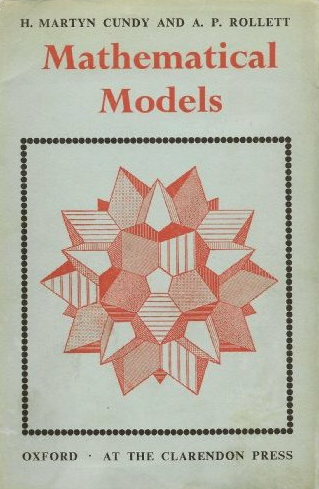
In 1951 Cundy collaborated with A. P. Rollett to write Mathematical Models. In the preface they describe the aim of the book:

Mathematics is often regarded as the bread and butter of science. If the butter is omitted, the result is indigestion, loss of appetite, or both. The purpose of this book is to suggest some ways of buttering the bread. The human mind can seldom accept completely abstract ideas; they must be derived from, or illustrated by, concrete examples. Here the reader will find ways of providing for himself tangible objects which will bring that necessary contact with reality into the symbolic world of mathematics.

The SMP changed the British school mathematics curriculum. One of the instigators Sir Brian Thwaites in his obituary on Cundy describes it:

In 1961, however, there came the opportunity for decisive influence on school mathematics. In that year three heads of mathematics – Tom Jones from Winchester , Douglas Quadling from Marlborough with Martyn Cundy from Sherborne – met largely at the instigation of Bryan Thwaites (then a professor at Southampton and now Sir Bryan) to consider formulating new syllabuses at O- and A-level. They were an exceptional and remarkable trio and it is unlikely that such a powerful group could be formed nowadays from schools. They were hugely ambitious in their plans which included not merely new content but the writing of entirely new, and novel, texts and teachers’ guides, together with a large continuing programme of residential teacher-training courses. For these purposes, many more teachers became involved and a formal organisation was created with the name The School Mathematics Project. The SMP (as it became known) rapidly became the dominant player in the reform of school mathematics and its influence spread internationally and notably in Africa. And now, it is the only project of those heady years of curriculum reform in the early sixties which still operates.

His missionary zeal – for both mathematics and Christianity – led him to take up a post at the University of Malawi. There he became an elder in the Presbyterian Church of Malawi as well as professor of Mathematics at the University.

His son Ian (1945-2009) graduated from Cambridge in mathematics and theology he became the Bishop of Lewes and then the 37th Bishop of Peterborough. His other two sons David and Tim became mathematics teachers.

References

Howson, Geoffrey (2005) Independent 8 March.

http://www.independent.co.uk/news/obituaries/hmartyncundy-6150831.html

Thwaites, Brian  (2005) Times obituary

http://www.oldshirburnian.org.uk/index.php/obituaries/94-cundyhenrymartynstaff-1938-1966

Further resources

Cundy was a regular contributor to the Mathematical Gazette

http://www.jstor.org/action/doBasicSearch?Query=au:”H.+Martyn+Cundy“&wc=on


Steve Bishop is the compiler of A Bibliography for a Christian Approach to Mathematics and the author of several articles on the relationship between faith and math. Look for future posts from him in this series on Christian Mathematicians.

Previous Entries in this Series: