Explore Global Opportunities for Mathematics Scholarship, Teaching, and Service

by Dr. Ron Benbow, Taylor University

The following is from a talk given by Dr. Benbow at the ACMS Conference this past June. It is with his gracious permission that I am sharing it here. Dr. Benbow’s talk can be read in its entirety along with other talks given at the conference in the ACMS-2013-Proceedings. Dr. Benbow’s resources that explain opportunities overseas experiences in mathematics (which he references in his talk below) has been added as a new page to ww.GodandMath.com under the “Resource” tab.

Many members of ACMS have more extensive overseas experience than I have and are more qualified to address the potential of mathematical global involvements on both personal and professional levels. These people are really not my primary intended audience. For those of you who have little or no overseas professional experience, the goal of this paper is two-fold: 1) to stimulate your thinking about international opportunities and how they might pertain to your professional interests and expertise, and 2) to provide some ideas about how you might get started.

The realization that I could use my mathematical knowledge and experience in an overseas setting came relatively late in my professional career. Even from childhood, I have always enjoyed the rewards of travel. But, my journeys were for personal enjoyment and enrichment. It was only about six years ago that I began to connect my professional and personal development goals in a global context. This brief paper will describe some of my recent global experiences within the framework of the three primary domains of academic work: scholarship, teaching, and service. Although we often distinguish these areas of our work, I have learned that in many global experiences, there is often much overlap among the three. Because there is neither time nor space to provide a detailed description of each trip, I would like to provide a brief overview of each of the three types of global experiences in which I have recently participated.

Teacher Mentoring (Teaching and Service)

My first experience in overseas teaching and service occurred in the summer of 2007 when I joined a Teacher Mentoring Team to Liberia, West Africa through Hope Corp, a ministry arm of
World Hope International. WHI describes itself as “a faith-based relief and development organization alleviating suffering and injustice through education, enterprise and community health.” The organization provides a variety of services to developing countries. Such services include anti-trafficking programs, education, child sponsorship, HIV/AIDS prevention and treatment, water projects/well drilling, microfinance loans, and rural development. The Hope Corps Teacher Mentoring program provides professional development workshops for teachers, primarily those teaching in Christian schools. I first learned about the organization through my local church and denomination which has a working relationship with World Hope. I became even more interested when a friend participated, as a science teacher, in a Mentoring Team to Sierra Leone in 2005.

My team consisted of 5 teachers, four from the U.S. and one from Germany, and a college-aged photographer. In a week-long workshop, we provided instruction in teaching reading, math science, and in child psychology and in biblically-based classroom management strategies. Approximately 85 teachers, from PreK – 9th grade, attended the classes held in an elementary school and church near Monrovia. The instruction in math encompassed both content knowledge and teaching methods because both areas were of critical need to the teachers. Most of them had no or minimal teacher training and also lacked much depth of understanding in mathematics. They had been taught math via rote learning and memorization and that was the only model of instruction with which they were familiar.

I prepared booklets of instruction and activities for 4 levels of classes, based on the five NCTM content standards (Principles and Standards for School Mathematics, 2000): number and
operations, algebra, geometry, measurement, data analysis/probability. During the workshops, we worked through many hands-on activities to illustrate the meaningfulness, relationships, and logical nature of mathematics.

Two years later, in 2009, I joined another Mentoring Team to Haiti. Approximately 115 Haitian teachers attend the workshops held on the grounds of a seminary near Port au Prince. These workshops were partially funded by a grant from USAID for HIV/AIDS prevention and treatment. The organization of this workshop was similar to the one in Liberia with teachers
receiving instruction in math science, and language arts content and pedagogy.

My experiences in teaching math at K-12 levels, before joining higher education, were great assets in these two overseas teaching/service experiences. Even so, there were many challenges that probably apply to most developing countries. These include meager facilities, lack of desired teaching/learning resources, climate differences, culture and language issues (we did had translators for Creole in Haiti), and the wide range of teachers’ backgrounds, experience, and knowledge. For example, some participants had many years of teaching experience while others were just beginning their teaching career. Those of you who have been on any kind of “missions trip” to a developing country will certainly understand many of these obstacles and probably be able to add your own list of “challenges” to mine.

Despite the challenges, these kinds of opportunities are tremendously enriching as well. These overseas experiences have expanded my creativity, challenged my flexibility, enlarged my perspectives, and strengthened my faith. When you don’t have the teaching materials to which you are accustomed, you learn how to make do with what you do have and explain things in different ways than you’ve ever done before! When your schedule keeps being altered and your plans are always tentative, you learn to be more flexible! When you encounter new ways of looking at customs, resources, people, and life in general, your perspectives are forever enlarged! When you have the opportunity to join other believers in worshiping in diverse cultural settings and worship styles and to see God working in amazing ways around the world, your faith in the power and grace of God is confirmed and tremendously strengthened!

International teaching has provided a new “reference point” for many of my subsequent personal and professional experiences. I find that I have much more patience with the occasional inconveniences of everyday life in the United States. Things like the lack of air conditioning or modern facilities or resources, or the appearance of potholes in my street, or crowded conditions on a bus, or delayed and cancelled flights have lost much of their “power of annoyance” over me. I merely think back to more challenging circumstances I’ve encountered overseas and realize that “I can handle this.”

I now believe that the process of mentoring teachers in a developing country can be thought of as “service learning for the mentors.” Assisting in the training of inadequately prepared teachers/mentees is indeed a service with far-reaching effects for the teachers, students, and community development. But it also includes a lot of learning for the mentors as well. There is no way to describe or identify everything I have learned through these interactive relationships with teachers in developing countries. These are great opportunities to serve and encourage others with whom you share common goals. I believe it is a “win-win” outcome for everyone.

I have talked about one organization (World Hope) because that has been my experience. However, there are a number of similar humanitarian organizations (some with a Christian foundation) that you might want to investigate. Perhaps some are affiliated with your church or other ministries with which you are already acquainted. The last page of this paper provides a partial listing of some organizations you might want to investigate for overseas opportunities.

MAA Study Tour (Scholarship)

In the spring of 2011, I joined with about 24 others to participate in the MAA Study Tour that year. It was entitled “Mathematics among the Ancient and Modern Maya” and included visits to Guatemala and Honduras. This well-organized and event-packed tour included explorations of ancient Mayan city ruins, various museums, and nightly lectures and discussions led by our archaeologist guide to investigate the ancient Maya civilization. We learned how to interpret Mayan glyphs of numeration, calendars, and historical events. This is information about the history of mathematics that I can readily incorporate into some my current college courses.

Just as interesting to me were our encounters with the current Maya (indigenous) people of Central America. As we visited numerous scenic, historical, and cultural sites, we learned how the modern Maya have both preserved their subculture but also been influenced by the larger “Spanish” culture around it. This was a time of heightened interest in studying Maya history and culture since many people were wondering then if the world would come to an end in December 2012, the end of the Mayan long-count calendar (it didn’t).

As our group engaged in myriad topics on our study tour, I began to notice how multidisciplinary our study had become. So, I started writing down some of the areas that were being addressed: religion, astronomy, mathematics, geography, archaeology, cultural anthropology, history, sociology, philosophy, political science, economics, geology, biology, chemistry, ecology, physics, music, art, linguistics, archeoastrononomy…. It was definitely the most interdisciplinary ten days of my life!

Depending on the destination, some trips may be somewhat expensive. Because of the international and academic nature of the trip, I did receive significant financial assistance from my university. Previous MAA Study Tour destinations, beginning in 2003, have included Greece, England, Mexico, Euler (Germany/Russia), Peru and Galapagos Islands, Egypt, and Italy. For more information on past and future tours, see: www.maa.org/StudyTour

Fulbright Specialists Program (Service and Teaching)

In the summer of 2010, I applied to the Fulbright Specialist Program with hopes that I could include a short-term international experience as part of my sabbatical during the spring of 2011. Because of various timing issues and the number of steps necessary to finalize all arrangements, that did not work out. However, I was accepted to the Fulbright Specialist roster in January 2011 and completed a two-visit experience in Ecuador in 2012 and 2013.

The Fulbright Specialist program awards grants to support short-term (2-6 weeks) overseas experiences for qualified U.S. faculty and professionals in select disciplines iin over 100 countries. It promotes linkages between U. S. academics and professionals and their counterparts at host institutions overseas. Approved projects focus on strengthening and supporting the development needs of the host institutions abroad and is not intended for personal research purposes. Eligible activities include short-term lecturing, conducting seminars, teacher training, special conferences or workshops, collaborating on curriclum planning, institutional and/or faculty development.

Here is an overview of how the program works. U.S. faculty and professionals apply to join a Roster of Specialists for a five-year term. Roster candidates are reviewed by peers in the same discipline and by the J. William Fulbright Foreign Scholarship Board. Eligible institutions wanting to host a Fulbright Specialist submit project applications through the Fulbright Commissions or U.S. Embassies in their home country. Projects are reviewed and approved by the Fulbright office in their home country and the U.S. Department of State.

In essence, the Fulbright program serves as a clearinghouse or “matchmaker” between U.S. specialists and overseas project applications. However, in practice, it appears that many or most specialists secure their own placement by contacting the overseas institution first and coordinating with them to structure the host’s project description to match the qualifications and interests of the specialist. That was the situation in my case.

My project involved working with the University of Azuay (UdA) in Cuenca Ecuador. I chose to work at this particular university because of prior relationships between UdA and some of my colleagues at Taylor. But if you already know someone associated with an overseas institution, that might be a good place for your initial contact.

My work at UdA including the following activities: presentations to math faculty on research-based instructional strategies, formation of a professional development model for mathematics instructors, consultation/advising on the creation of a mathematics department and a master’s degree program, course curriculum evaluation, and conducting workshops for math teachers at an affiliated high school.

In addition to my academic work, Ecuador was a wonderful place to visit. I was able to live with a gracious host family, worship in several churches, fellowship with missionary friends, visit Cajas National Park and Ingapirca (Inca ruins), and participate in many other local cultural events. It was a great opportunity to build new personal and professional relationships that, I hope, will continue.

Another benefit from the Fulbright Specialist Program is that Fulbright pays your travel expenses to the host country and the host institution is responsible for your in-country expenses, including transportation, housing, and food. In addition, Fulbright provides an honorarium of $200 per day for each day of the trip (including travel days).

See this website address for more information on the program: http://www.cies.org/specialists/

A Word of Advice in Getting Started

If you have not traveled abroad professionally, a missions-type trip (e.g. teacher mentoring or other work) can be a good place to begin, if you have the necessary qualifications. Study Tours are also great ways to begin because they are highly structured and organized, leaving little for the participant to worry about. No previous experience is necessary; just jump in and enjoy the trip! I highly recommend the Fulbright Specialist Program but you may want to wait to apply for it until you have some previous overseas experiences to strengthen your qualifications. The following page provides some links to organizations that might have international programs that would be a good fit for your interests.

Conclusion

I want to close with two quotes that I love and that express important ideas that I have found to be true in my global experiences. The first comes from Miriam Beard, “Travel is more than the seeing of sights; it is a change that goes on, deep and permanent, in the ideas of living.” The second is from the late Rev. Bruce Larson, “Every Christian is launched on a life of experiment, discovery, and faith from which he can report on new ways that God may be working in specific situations.” I think that this perspective is especially true for those of us teaching in the sciences in Christian higher education. This life of “experiment, discovery, and faith” can be lived out anywhere, but I believe that international experiences multiply our opportunities to discover and participate in the many amazing things God is doing around the world.

Related post: Math and Mission
Education: An Act of Justice or an Act of Grace?

It has been a while since my last post. Ph.D. work, conference, and family have all kept me busy throughout the summer. I should hopefully have a few posts over the next few weeks that summarize the conferences that I have attend, the progress I have made in my Ph.D. research, and some general thoughts I have considered this summer. This post falls in the latter category. Enjoy.

I have written here before that education is inherently value-laden. If you are an educator then it is not a question of “are you teaching values?” but rather “which values are you teaching?” In this vein of thinking it can also be argued that education is inherently religious if it instills within us some sense of values and some sense of faith. Now, those values and the object(s) of that faith could vary greatly depending on the educational institution, but the fact is they are always there. This is why for centuries the work of education was undertaken by explicitly religious institutions and it is only fairly recently in society’s history that the state has taken on this endeavor (Wilson). So for everyone who feels that there is something wrong with our current state/system of education, I would argue that the root issue is primarily a religious one.

Every pedagogy assumes an anthropology (Smith). Before you can teach human beings you have to have some understanding of what human beings are. Ultimately I believe this is the reason for the existence of standardized testing (at least in America). The state approaches education from the perspective that all human beings are essentially good. It is simply a matter of providing education equally for all that will result in well-trained, productive citizens who contribute to the good of society. From this perspective, education is an act of justice. It is a citizen’s right to be educated. If the educational system is an administration of justice on the part of the state then it will inextricably be tied to universal standards that students and educators are required to meet. I mean, isn’t that how the justice system works? It sets standards in place that apply equally to everyone in a blanket approach and expects every individual to live up to those standards. There are also consequences when the standard isn’t met. Fail to meet the justice standard in society and go to jail. Fail to meet the standard in school and get remediation or don’t move to the next grade level or don’t graduate. As long as the state is in control of education, expect standardized testing to always be a part of the educational process.

What is the alternative? Maybe, just maybe, human beings aren’t inherently good. Maybe they are inherently evil and no amount of knowledge is going to save them from that. If we adopt this (Christian) anthropology then education will not be seen as an act of justice, as a right of the citizens, but rather as an act of grace. Education can be viewed as an act of grace that missionally reaches out to engage the lost mind. Grace doesn’t set a standard for you to meet. In fact, grace realizes that you can’t meet THE standard. So then the focus of education shifts from universal standards to individual and communal transformation. Results aren’t measured in knowledge gained but rather in affections formed.

My thoughts are still developing on this topic, but for now I can leave you with this fact: as a Christian educator (be it in an explicitly Christian setting or even when I was in public school), I care less about what my students know, and more about what my students love. This is the purpose of education.

Some books that I have been reading that have influenced my thinking on this issue:

Desiring the Kingdom: Worship, Worldview, and Cultural Formation, by James K.A. Smith.

The Case for Classical Christian Education, by Douglas Wilson.

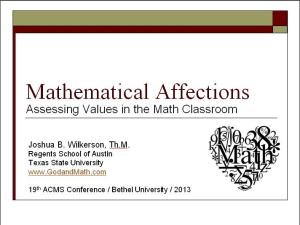
Mathematical Affections: Assessing Values in the Math Classroom

Presented at

19th ACMS Conference

Bethel University, 2013

math affections(Click on the image above for the presentation slides)

I. The Need for Affective Learning

How many of you, as math educators, have heard the question “When am I ever going to use this?” be uttered by your students? If you have been teaching for more than 5 minutes then it’s safe to assume that phrase has been mentioned in your presence. Occasionally it is posed as a valid question; the student is genuinely interested in the future career application of the topic at hand. However, I believe the majority of the time the phrase “When am I ever going to use this?” is spoken it is not as a question, but as a statement. A statement which implies that the obvious answer is “I will never use this so learning it is a waste of time.” The real issue being raised by these students is not one of application, but rather one of values. If we could translate their question into what they are really trying to communicate then “When am I ever going to use this?” will become “Why should I value this?” Students express their inquiry in terms of mathematical practicality because that is the language in which their culture, including their math teachers, has conditioned them to speak.

To illustrate how we as math educators have contributed to this misconception that value equals utility, let us turn our attention to the foundational document for composing the learning objectives and outcomes of an academic course: Bloom’s Taxonomy (pictured below).

Picture1

A quick glance at this chart will reveal that ‘application’ falls under the cognitive (mental/knowledge) domain of learning while ‘valuing’ falls under the affective (heart/feeling) domain of learning. The cognitive domain is almost exclusively emphasized in the preparation of teachers within the modern educational system while the affective domain is largely ignored. So while we ‘improve’ our teaching and questioning to make mathematics less abstract and to focus on real-life applications so that we can address the question of “When am I ever going to use this?” before it is even asked, we are actually implicitly teaching students that mathematical value is to be found only in application. If we really want to help those students address the true foundational question of “Why should I value this?” then we need to do so through increasing our attention on the affective domain of learning; writing rigorous learning objectives and developing quality assessments just as we do for the cognitive domain.

Now, application is certainly useful in the teaching process and it should not be ignored. I am not advocating the promotion of the affective domain over and above the cognitive. My goal is to simply bring the affective up to the same level as the cognitive. The best learning is done when both domains are utilized in conjunction with each other. In The Abolition of Man, C.S. Lewis writes “Education without values, as useful as it is, tends to make man a more clever devil.” I believe this is a fairly accurate statement of the modern day system of education. If we don’t focus on values, if we don’t focus on the affective learning of our students, then their education will still be useful – they’ll increase in cognitive ability and learn to apply their thinking. But is that really valuable in and of itself? Without a proper sense of values to guide their application, aren’t we really just making students “more clever devils”? You see, you can never actually remove values from education. Education is inherently value laden, and I believe Lewis knew this. It is not a question of “Are you teaching values?” but rather “Which values are you teaching?” Lewis’ point is that the value we instill in education should be affective – loving learning for its own sake and valuing wisdom. If you don’t focus on affections, then you still have usefulness, but is that really beneficial? In the words of the Bishop in Victor Hugo’s Les Misérables: “The beautiful is as useful as the useful…Perhaps more so.” Application is indeed useful but it should be presented in a way that promotes the development of what I’ll term mathematical affections. Learning has little meaning unless it produces a sustained and substantial influence not only on the way people think, but also on how they act and feel.

II. The Place of Affective Learning in the Math Classroom

Let me take a moment to define what I mean by mathematical affections. The title of this talk is in homage to Jonathan Edwards’ Treatise Concerning Religious Affections. Edwards’ goal was to discern the true nature of religion and in so doing dissuade his congregation from merely participating in a Christian culture (a mimicked outward expression) and motivate them to long for true Christian conversion (an inward reality of authentic Christian character). The purpose of this talk is to engage us as math educators in discerning the true nature of mathematical assessment and how we use it in the classroom: does it simply mimic the modern culture of utility by requiring outward demonstrations of knowledge retention and application, or does it aim deeper at analyzing true inward character formation? For Edwards, affections were not synonymous with emotions as they tend to be in today’s culture. Because today’s culture sees affective learning as simply an emotional state the culture classifies affective learning as a purely subjective domain and therefore not worthy of developing objective standards or assessments. But Edwards understood affections as aesthetics – a way of orienting your life via a mechanism that determines what was beautiful and worthwhile. If we see affections as character producing then Edwards’ definition leads to a more objective perspective that provides more potential for assessment rather than viewing affections as emotions.

It is Edwards’ definition of affections (orientation of life, determining worth) that actually appears in popular math education literature. According to the NCTM Standards for Teaching Mathematics, “Being mathematically literate includes having an appreciation of the value and beauty of mathematics as well as being able and inclined to appraise and use quantitative information.” Adding it Up: Helping Children Learn Mathematics, a report published by the National Research Council argues that mathematical proficiency has five strands, one of which is termed “productive disposition.” Productive disposition is defined as “the habitual inclination to see mathematics as sensible, useful, and worthwhile.” Both of these foundational documents in the area of math education plainly portray mathematics as beautiful, of value, and affecting the habits of the learner to see math as worthwhile. However, neither of these documents develops how we as teachers are to go about accomplishing this task. It is almost as if these phrases are included in these documents as a courtesy – as a way of saying “this is how we as math teachers feel about math and it would be nice for our students to feel this way too, but feeling is subjective so there is no real way for us to objectively instruct or assess students in this regard.”

This is a point of connection that we as Christian educators can make with educational system as a whole – we can answer the questions of how. We have much to contribute here and we don’t have to be overtly religious in the presentation. What we should really be emphasizing is the classical approach to mathematics. The mission statement of the classical Christian school where I teach states that: “The mission of Regents School is to provide a classical and Christian education, founded upon and informed by a Christian worldview, that equips students to know, love and practice that which is true, good and beautiful, and challenges them to strive for excellence as they live purposefully and intelligently in the service of God and man.” Non-Christians will obviously reject the beginning and end pf that statement but the key phrase here for the purposes of contributing to fixing the problem in education is “equipping students to know, love and practice that which is true, good and beautiful.” The true, The Good, The Beautiful – these are ideas from Plato who believed in a rigorous development of mathematics. Legend has it that above the door to his academy was the phrase “let no one ignorant of Geometry enter here.”

Beyond Plato, the truth, goodness, and beauty of mathematics has been attested throughout history by famous mathematicians who were not espousing a religious view. In regards to truth, Richard Feynman said “To those who do not know mathematics it is difficult to get across a real feeling as to the beauty, the deepest beauty, of nature … If you want to learn about nature, to appreciate nature, it is necessary to understand the language that she speaks in.” In other words, the truths of mathematics are written into the very core of nature. In regards to goodness John Von Neumann wrote “If people do not believe that mathematics is simple, it is only because they do not realize how complicated life is.” I believe no one would argue the good that comes from learning mathematics. There would not be nearly the outcry that we see today over fixing the educational system and increasing our place in mathematics scores if people did not think knowing math was good. And finally, in terms of beauty, G.H. Hardy wrote “Beauty is the first test: there is no permanent place in the world for ugly mathematics.” Every mathematician will attest to the beauty of mathematics. If we can argue that mathematics is objectively true, good, and beautiful, then I believe we can argue that these qualities, which contribute so greatly to our affections, can be more objectively assessed.

III. Cultivating Mathematical Affections

According to the NCTM Assessment Standards for School Mathematics: “It is through assessment that we communicate to students what mathematics are valued.” If we are going to increase our attention on the affective domain of learning we need to do so by writing rigorous learning objectives and developing quality assessments just as we do for the cognitive domain. Assessment is always tied to our objectives; by definition objectives are quantifiable learning outcomes of a lesson. Below, I would like to offer some examples of learning objectives in a statistics course followed by a list of methods for assessing affective learning that very from traditional cognitive assessments.

The following examples of affective objectives use the current taxonomy of the affective domain of learning developed by Bloom and Krathwohl (middle column of the diagram above). I am not endorsing this taxonomy, as I believe there are improvements that can be made to it. For now though, I would like to propose how we can start working within the current system. Notice that in each objective there is an affective verb, a cognitive verb, and a vehicle for assessment.

  • Receiving: The student will (TSW) differentiate (affective verb – AV) between valid and fallacious statistical arguments and argue (cognitive verb – CV) their reasons in a written response (method of assessment – MOA). Assessment should account for the initial discernment between truth and falsehood in addition to the correctness of the argument.
  • Responding: TSW engage (AV) in class discussion (MOA) comparing (CV) and contrasting (CV) religious and statistical knowledge. Assessment should account for the level of engagement in addition to the determination of proper similarities and differences.
  • Valuing: TSW support (AV) the mission of a local non-profit organization through the design (CV) of a statistical study (MOA) done on the organization’s behalf. Assessment should require student to defend the worthiness of the cause motivating the project and not simply report valid data analysis.
  • Organizing: TSW define the limitations (AV) of statistical inference procedures and accordingly make recommendations (CV) to the acting agency in an oral presentation (MOA).Assessment should account for recognition of shortcomings (humility) in the oral presentation.
  • Characterizing: TSW be evaluated (CV) in their intellectual integrity and rated positively by their peers (AV) through a written reflection survey (MOA).Assessment allows for students to communicate their personal reflection and evaluation of others.

The key to the above objectives is the integration of affective and cognitive learning. We need to be creative in our assessment techniques to allow the affective domain an opportunity to be assessed. Some examples of assessments include (but are not limited to): Math Journals, Reflection Assignments, Personal Interviews, Class Discussion/Debate, Oral Presentations, Open-Ended Group Problems, Historical Reading and Response, and Service-Learning Projects. If you are still under the belief that textbook assignments, quizzes, and tests provide a more objective measurement of student ability, let me pose the following questions: Who chooses what problems to assign? Who writes the quiz or test? Who grades the quiz or test? How is partial credit handled? I can ask many more questions in a similar vein that will hopefully allow us to realize that even the cognitive skills that we assess have some level of subjectivity involved. I am not arguing that affective learning is completely objective, but it is at least as equally objective as the cognitive domain.

There is much work to be done in this area. I hope that I have convinced you of the need to engage whole-heartedly into this work. For now I will leave you with a student quote on the impact of affective learning: “I was more dedicated because I saw a deeper purpose.”