Christ is Risen! He is Risen Indeed!

Father, Thank You for Hope

Matthew 28:5-6

But the angel said to the women, “Do not be afraid; I know that you are looking for Jesus, who was crucified. He is not here, for he has been raised, just as he said.”

Christ the Lord is Risen Today (Charles Wesley, 1739)

Christ, the Lord, is risen today
Sons of men and angels say
Raise your joys and triumphs high
Sing, ye heavens, and earth, reply

Lives again our glorious King
Where, O death, is now thy sting?
Once He died our souls to save
Where thy victory, O grave?

Soar we now where Christ hath led
Following our exalted Head
Made like Him, like Him we rise
Ours the cross, the grave, the skies

Alleluia!

1 Peter 1:18-21

You know that from your empty way of life inherited from your ancestors you were ransomed– not by perishable things like silver or gold, but by precious blood like that of an unblemished and spotless lamb, namely Christ. He was foreknown before the foundation of the world but was manifested in these last times for your sake.  Through him you now trust in God, who raised him from the dead and gave him glory, so that your faith and hope are in God.

1 Corinthians 15

Now I want to make clear for you, brothers and sisters, the gospel that I preached to you, that you received and on which you stand, and by which you are being saved, if you hold firmly to the message I preached to you– unless you believed in vain. For I passed on to you as of first importance what I also received– that Christ died for our sins according to the scriptures, and that he was buried, and that he was raised on the third day according to the scriptures…

Listen, I will tell you a mystery: We will not all sleep, but we will all be changed– in a moment, in the blinking of an eye, at the last trumpet. For the trumpet will sound, and the dead will be raised imperishable, and we will be changed. For this perishable body must put on the imperishable, and this mortal body must put on immortality.

Now when this perishable puts on the imperishable, and this mortal puts on immortality, then the saying that is written will happen, “Death has been swallowed up in victory.” “Where, O death, is your victory? Where, O death, is your sting?” The sting of death is sin, and the power of sin is the law.

But thanks be to God, who gives us the victory through our Lord Jesus Christ!

So then, dear brothers and sisters, be firm. Do not be moved! Always be outstanding in the work of the Lord, knowing that your labor is not in vain in the Lord.
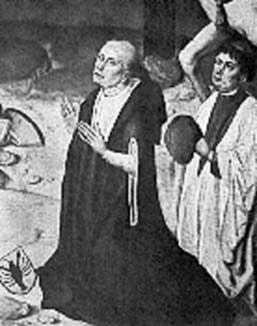
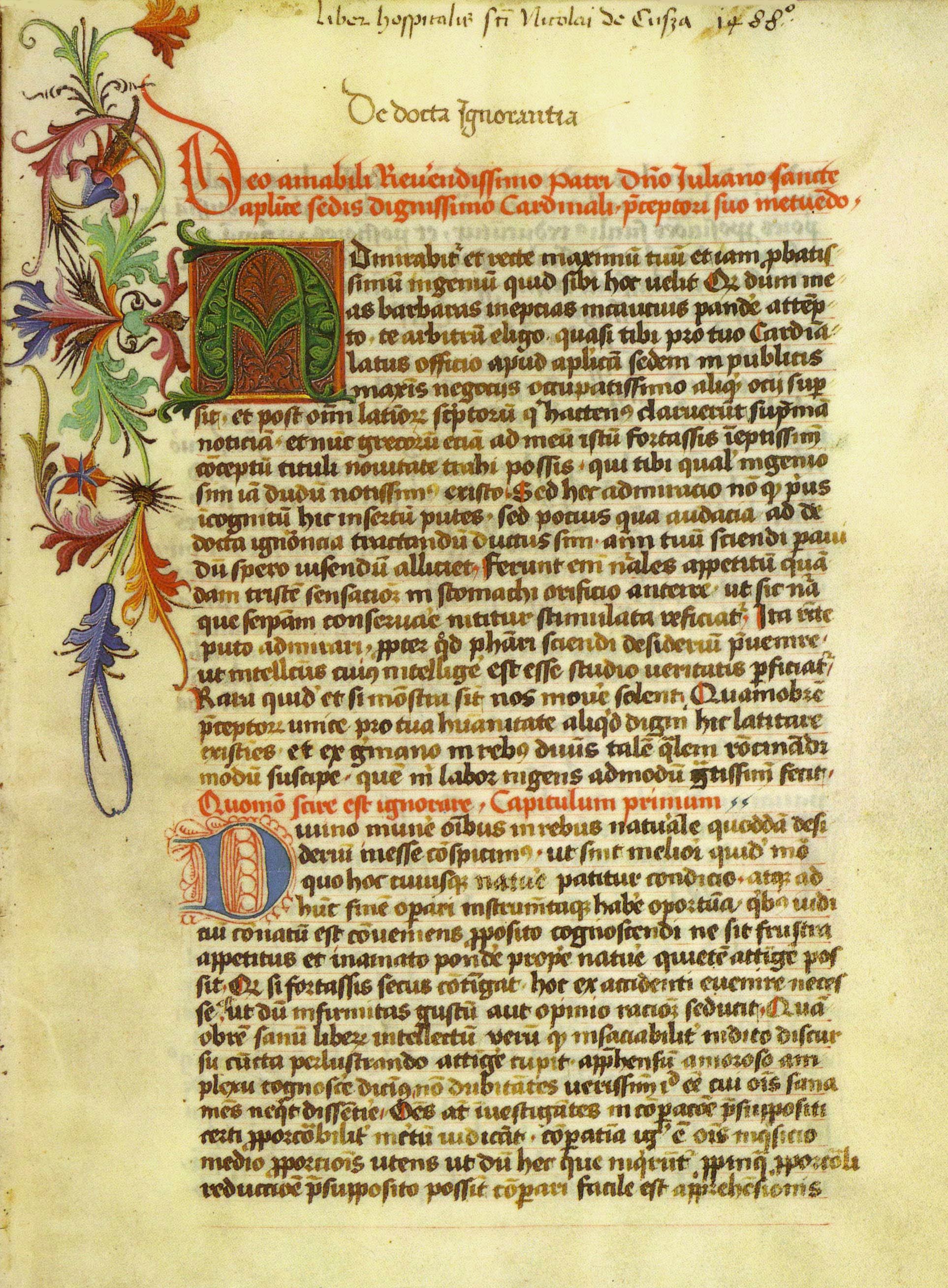
On Informed Ignorance

I was reading the other day and came across this name: Nicholas of Cusa. Nicholas was a cardinal and bishop in the mid 1400’s who made some significant contributions to the field of mathematics – most notably his influence on Johannes Kepler (another man of faith who demonstrated that planets move in an elliptical orbit around the sun).

I am always encouraged when I come across people of faith from history who also devoted serious study to mathematics and recognized how the two can be integrated. So while my knowledge of Nicholas is very limited (how well do you someone you just met?), I thought I would pass along what I found for anyone who is interested in examining his works further.

Nicholas is most known for his work De Docta Ignorantia, which is roughly translated “On Informed/Learned Ignorance.” Or perhaps another way to phrase it: “Recognizing the Limitations of Knowledge.” Nicholas used mathematical analogies to show that truth can be approached, but never fully reached (or comprehended).

While I believe Truth can be reached (as long as He reaches out to us), I also believe it is healthy to recognize our inability to fully understand it. I wrote in a previous post about the need for Christian humility in our mathematical scholarship.

The following are some quotes from De Docta Ignorantia:

If we achieve this, we shall have attained to a state of informed ignorance. For even he who is most greedy for knowledge can achieve no greater perfection than to be thoroughly aware of his own ignorance in his particular field. The more be known, the more aware he will be of his ignorance. It is for that reason that I have taken the trouble to write a little about informed ignorance. …

Thus wise men have been right in taking examples of things which can be investigated with the mind from the field of mathematics, and not one of the Ancients who is considered of real importance approached a difficult problem except by way of the mathematical analogy. That is why Boethius, the greatest scholar among the Romans, said that for a man entirely unversed in mathematics, knowledge of the Divine was unattainable. …

The finite mind can therefore not attain to the full truth about things through similarity. For the truth is neither more nor less, but rather indivisible. What is itself not true can no more measure the truth than what is not a circle can measure a circle; whose being is indivisible. Hence reason, which is not the truth, can never grasp the truth so exactly that it could not be grasped infinitely more accurately. Reason stands in the same relation to truth as the polygon to the circle; the more vertices a polygon has, the more it resembles a circle, yet even when the number of vertices grows infinite, the polygon never becomes equal to a circle, unless it becomes a circle in its true nature.

The real nature of what exists, which constitutes its truth, is therefore never entirely attainable. It has been sought by all the philosophers, but never really found. The further we penetrate into informed ignorance, the closer we come to the truth itself. …

Here are some links for more on Nicholas of Cusa:

De Docta Ignorantia

Translator’s Introduction

Book 1: Maximum Absolutum (God)

Book 2: Maximum Contractum (the universe)

Book 3: Maximum Simul Contractum et Absolutum (Christ)

Other works of Cusa

The Enduring Uniqueness of Mathematics

Why is mathematics different (in a good way) from every other subject you learned in school?

Two words: Pythagorean Theorem.

Let me explain. The Pythagorean Theorem in itself isn’t really the reason math is unique; it is merely an example I wish to use to illustrate my point. I chose this Theorem for an example because it has been my experience that it is one of the few things everyone remembers from math class, regardless of how much they enjoyed math or how well they did in the course. But just in case the P.T. slipped your mind, here is a recap:

For any right triangle, the square of the hypotenuse (side opposite the right (90 degree) angle), is equal to the sum of the square of the other two sides.

This result is attributed to the Greek mathematician and philosopher Pythagoras (hence the creative name for the theorem). Pythagoras lived between the 5th and 6th century B.C. and while he is ultimately the one credited with proving the theorem, there is evidence that the result of the theorem was known to the Babylonians 1000 years before Pythagoras was born. Notice this old tablet:

Wow, that is old. Here you can read more about the Babylonians and the Pythagorean Theorem.

My point is that in what other class are you performing the same operations as people were performing 3000 years ago? Certainly in history class you learn about earlier civilizations, but you are not being taught how to do history in the same manner as those civilizations. The precision that modern history requires was largely unknown to those ancient people. Perhaps in literature you read Homer’s Iliad and Odyssey, but again, you aren’t being taught to write in the same style of epic poetry.

So then why is it that in math class, while advancements have been made and technology certainly has come a long way, we still find it beneficial to perform calculations the way they were performed thousands of years ago?

My answer: there is nothing to perfect, nothing ot improve upon, when you come across truth. Real truth.

To all of us who hold the Christian belief that God is truth, anything that is true is a fact about God, and mathematics is a branch of theology.

~Hilda Phoebe Hudson