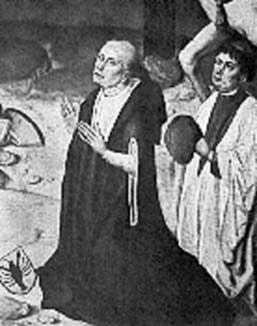
I was reading the other day and came across this name: Nicholas of Cusa. Nicholas was a cardinal and bishop in the mid 1400’s who made some significant contributions to the field of mathematics – most notably his influence on Johannes Kepler (another man of faith who demonstrated that planets move in an elliptical orbit around the sun).

I am always encouraged when I come across people of faith from history who also devoted serious study to mathematics and recognized how the two can be integrated. So while my knowledge of Nicholas is very limited (how well do you someone you just met?), I thought I would pass along what I found for anyone who is interested in examining his works further.
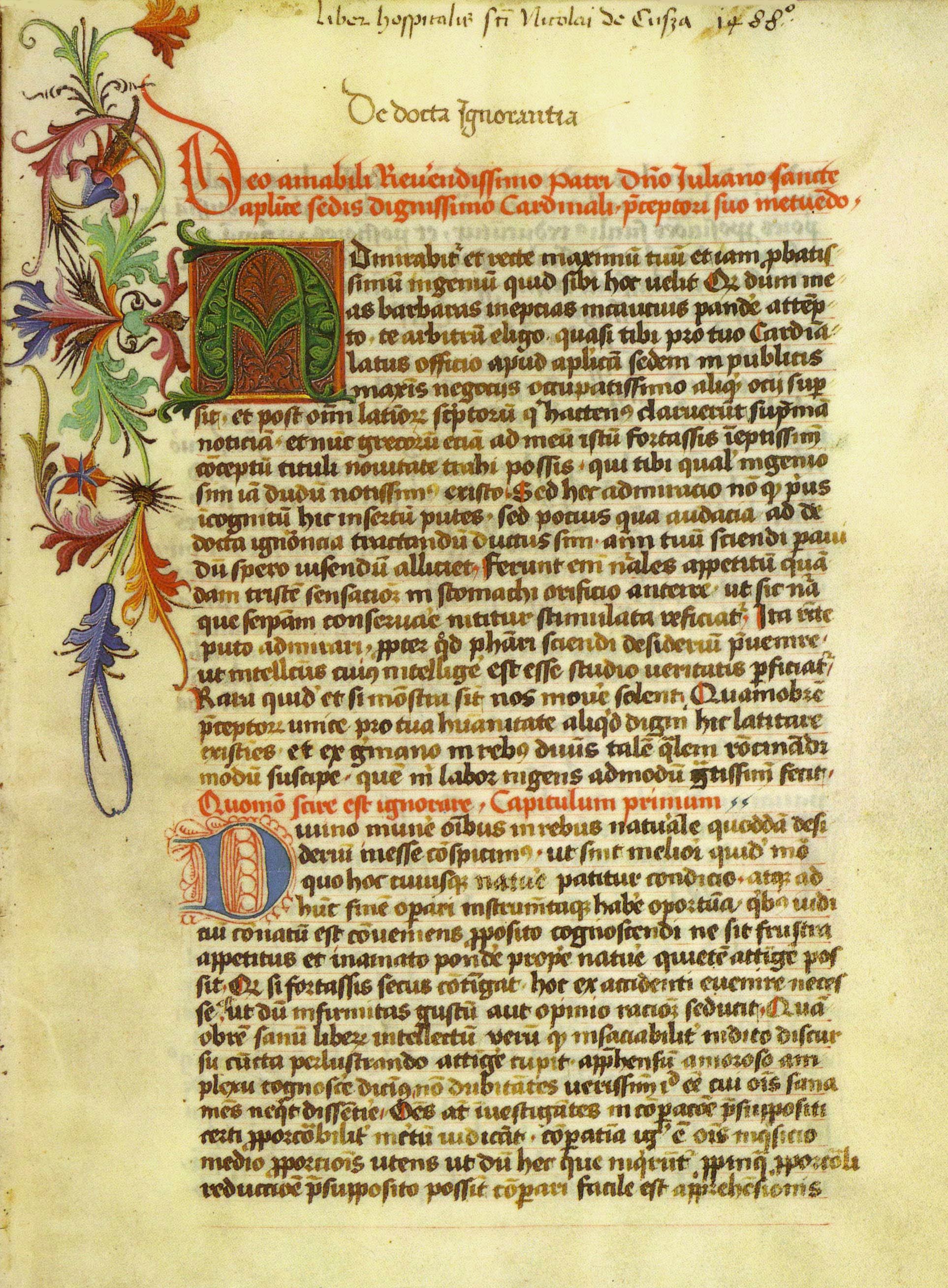
Nicholas is most known for his work De Docta Ignorantia, which is roughly translated “On Informed/Learned Ignorance.” Or perhaps another way to phrase it: “Recognizing the Limitations of Knowledge.” Nicholas used mathematical analogies to show that truth can be approached, but never fully reached (or comprehended).

While I believe Truth can be reached (as long as He reaches out to us), I also believe it is healthy to recognize our inability to fully understand it. I wrote in a previous post about the need for Christian humility in our mathematical scholarship.
The following are some quotes from De Docta Ignorantia:
If we achieve this, we shall have attained to a state of informed ignorance. For even he who is most greedy for knowledge can achieve no greater perfection than to be thoroughly aware of his own ignorance in his particular field. The more be known, the more aware he will be of his ignorance. It is for that reason that I have taken the trouble to write a little about informed ignorance. …
Thus wise men have been right in taking examples of things which can be investigated with the mind from the field of mathematics, and not one of the Ancients who is considered of real importance approached a difficult problem except by way of the mathematical analogy. That is why Boethius, the greatest scholar among the Romans, said that for a man entirely unversed in mathematics, knowledge of the Divine was unattainable. …
The finite mind can therefore not attain to the full truth about things through similarity. For the truth is neither more nor less, but rather indivisible. What is itself not true can no more measure the truth than what is not a circle can measure a circle; whose being is indivisible. Hence reason, which is not the truth, can never grasp the truth so exactly that it could not be grasped infinitely more accurately. Reason stands in the same relation to truth as the polygon to the circle; the more vertices a polygon has, the more it resembles a circle, yet even when the number of vertices grows infinite, the polygon never becomes equal to a circle, unless it becomes a circle in its true nature.
The real nature of what exists, which constitutes its truth, is therefore never entirely attainable. It has been sought by all the philosophers, but never really found. The further we penetrate into informed ignorance, the closer we come to the truth itself. …
Here are some links for more on Nicholas of Cusa:
De Docta Ignorantia
Translator’s Introduction
Book 1: Maximum Absolutum (God)
Book 2: Maximum Contractum (the universe)
Book 3: Maximum Simul Contractum et Absolutum (Christ)
Other works of Cusa
 GOD & MATH: Thinking Christianly About Math Education