Christianity: Always More Than Thinking, Never Less

A student stopped me in the hallway the other day and posed what he thought was a nice brainteaser:

A bat and a ball cost $1.10 in total. The bat costs $1 more than the ball. How much does the ball cost?

After doing the basic algebra:

Bat + Ball = 1.10

Bat = 1 + Ball

Substituting:

1 + Ball + Ball = 1.10

2Ball = .10

Ball = .05

I responded that the ball costs $0.05.

The student seemed disappointed that I had solved the puzzle using math of all things. He objected that I shouldn’t have thought about it but just answered with the first thing that came to my mind (…a little glimpse into the thought process of my students).

This response was expected. What he said next was not. “I guess you are less likely to believe in God.”

Wait…WHAT?!

“It’s true,” he said. “I read it in an article.”

I thought that couldn’t possibly be accurate…but it is. Thank you internet.

Intuitive Thinking May Influence Belief in God

Here are the highlights:

In a series of studies, researchers at Harvard University found that people with a more intuitive thinking style tend to have stronger beliefs in God than those with a more reflective style…”We wanted to explain variations in belief in God in terms of more basic cognitive processes,” researcher Amitai Shenhav said. “Some say we believe in God because our intuitions about how and why things happen lead us to see a divine purpose behind ordinary events that don’t have obvious human causes. This led us to ask whether the strength of an individual’s beliefs is influenced by how much they trust their natural intuitions versus stopping to reflect on those first instincts.”

The research was published online in the Journal of Experimental Psychology: General. The study from the Harvard University Psychology Department was conducted by Shenhav, a doctoral student; post-doctoral fellow David Rand, PhD; and associate professor Joshua Greene, PhD.

In the first part of the study, 882 U.S. adults, with a mean age of 33 and consisting of 64 percent women, completed online surveys about their belief in God before taking a cognitive reflection test. The test had three math problems with incorrect answers that seemed intuitive (like the problem above which has an “intuitive” answer of $0.10)…Participants who had more incorrect answers showed a greater reliance on intuition than reflection in their thinking style.

Participants who gave intuitive answers to all three problems were 1 ½ times as likely to report they were convinced of God’s existence as those who answered all of the questions correctly.

First of all, there is clearly a problem in defining intuitive (or at least measuring intuition) as answering incorrectly to a series of math questions. Intuition, as defined by dicitonary.com: direct perception of truth, fact, etc., independent of any reasoning process (emphasis added). I am uncertain then how answering incorrectly shows a direct perception of truth.

I get the impression that the real claim of this study is that people who respond without thinking tend to accept the idea of religion more than those who analyze information that is presented to them.

This reminded of me of the following comic:
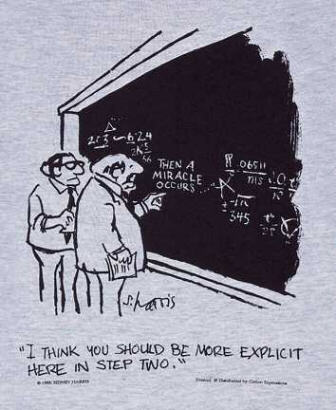
For some people this is the “religious” way of thinking: just believe, don’t analyze. What makes the comic humorous is that this is an obviously flawed approach to mathematics. I contend is an equally flawed approach to faith.

The title of this post is a favorite saying of mine from our former pastor in Dallas, “Christianity is always more than thinking, never less.”

There is great danger in putting religion a step below thinking. I am reminded of a segment on NBC Nightly News, “Show of Faith,” from June 23, 2008. Video Courtesy of NBC. While there have been numerous news segments to survey and comment on the religiosity of Americans, this one stood out to me because of one sentence by Rev. Eugene Rivers (emphasis added):

In some cases, because the American public is not terribly theologically literate, they hold contradictory views because they haven’t thought deeply, or been taught deeply, about their faith tradition.

Not examining one’s religious beliefs tends to lead toward contradictory or false beliefs.

Scripture makes this point itself. The book of Romans clearly explains how we are created with an intuition toward the things of God, but that intuition becomes marred by sin. What we need is a renewal of this intuition, a renewal of our minds, not for the purpose of blind acceptance but for testing and approving the will of God.

For the wrath of God is revealed from heaven against all ungodliness and unrighteousness of men who suppress the truth in unrighteousness, because that which is known about God is evident within them; for God made it evident to them. For since the creation of the world His invisible attributes, His eternal power and divine nature, have been clearly seen, being understood through what has been made, so that they are without excuse. For even though they knew God, they did not honor Him as God or give thanks, but they became futile in their speculations, and their foolish heart was darkened. Professing to be wise, they became fools, and exchanged the glory of the incorruptible God for an image in the form of corruptible man and of birds and four-footed animals and crawling creatures (Romans 1:18-23).

Do not be conformed to this present world, but be transformed by the renewing of your mind, so that you may test and approve what is the will of God– what is good and well-pleasing and perfect (Romans 12:2).

We are charged then to approach our faith as the Bereans. In the book of Acts, the Bereans are praised for examining the Gospel message:

The brothers sent Paul and Silas off to Berea at once, during the night. When they arrived, they went to the Jewish synagogue. These Jews were more open-minded than those in Thessalonica, for they eagerly received the message, examining the scriptures carefully every day to see if these things were so. Therefore many of them believed, along with quite a few prominent Greek women and men (Acts 17:10-12).

As a math teacher I feel that I am charged with teaching students to think well and reason correctly.

As a theologian I feel that I am charged with teaching believers to think well and reason correctly.

We need thinkers. We need teachers of thinkers.
Thinking About Mathematics: Calculators

For my philosophy of mathematics course I am reading the book Thinking About Mathematics, by Stewart Shapiro. It is an excellent read and I highly recommend it. I hope to give this book a fuller treatment on this blog sometime over the summer.

In the meantime, I just finished reading Shapiro’s chapter on Formalism and he makes a telling editorial comment on the use of calculators in math education. Below are a few excerpts from the chapter (emphasis added).

The various philosophies that go by the name of ‘formalism’ pursue a claim that the essence of mathematics is the manipulation of characters. A list of the allowed characters and allowed rules all but exhausts what there is to say about a given branch of mathematics. According to the formalist then, mathematics is not, or need not be, about anything, or anything beyond typographical characters and rules for manipulating them.

For better or worse, much elementary arithmetic is taught as a series of blind techniques, with little or no indication of what the techniques do, or why they work. How many schoolteachers could explain the rules for long division, let alone the algorithm for taking square roots, in terms other than the execution of a routine?

The advent of calculators may increase the tendency toward formalism. If there is a question of justifying or making sense of, the workings of the calculator, it is for an engineer (or a physicist), not a teacher or student of elementary mathematics. Is there a real need to assign ‘meaning’ to the button-pushing?

We hear (or used to hear) complaints that calculators ruin the younger generation’s ability to think, or at least their ability to do mathematics. It seems to me that if the basic algorithms and routines are taught by rote, with no attempt to explain what they do or why they work, then the children might as well use calculators.

Food for thought.

Shadows of Things to Come

Therefore no one is to act as your judge in regard to food or drink or in respect to a festival or a new moon or a Sabbath day– things which are a mere shadow of what is to come; but the substance (literally body) belongs to Christ.

Colossians 2:16-17

For the Law, since it has only a shadow of the good things to come and not the very form (literally image) of things, can never, by the same sacrifices which they offer continually year by year, make perfect those who draw near.

Hebrews 10:1

I love the Biblical imagery of a “shadow.” The Greek word translated as “shadow” (σκιά, pronounced skia) shows up three times in the New Testament in a metaphorical sense. Two of the three verses are listed above and we will get to the third (and perhaps most interesting use for the purposes of this blog) shortly.  The word σκιά can be translated as “shadow” or “foreshadow” or even “reflection.” There are several examples outside of the Bible of the word being used to refer to an image as seen in water – in which case the translation of “reflection” might be more apt. In all metaphorical cases, including the three instances in the New Testament, σκιά can generally be taken to mean: “a mere representation of something real” (BDAG).

One thing about shadows, they need a body to make them (Col. 2:17). Reflections need an original, or true, image (Heb. 10:1). In both passages listed above, Paul and the author of Hebrews are not claiming that the Mosaic Law was bad. The Law was in fact very good, but incomplete. In as much as a person’s shadow is not a complete description of who they are since it only provides an outline of their form, the Law was not a perfect description of how humanity is to relate to God, but it did give an outline, an idea. The Law was meant to point toward Christ. It provided only a boundary of holiness in which Israel was to operate in order to be a distinct and set-apart people of God. The Law was the shadow. Christ is the body. The Scriptures above demonstrate that since Christ has been revealed we no longer live in a shadow of unreachable standards, but instead we are to be intimately related with God in person: Jesus Christ.

So what does this have to do with math?

This brings me to the third passage in which σκιά is used metaphorically:

For every high priest is appointed to offer both gifts and sacrifices; so it is necessary that this high priest (Christ) also have something to offer. Now if He were on earth, He would not be a priest at all, since there are those who offer the gifts according to the Law; who serve a copy and shadow of the heavenly things, just as Moses was warned by God when he was about to erect the tabernacle; for, “See,” He says, “that you make all things according to the pattern which was shown you on the mountain.”

Hebrews 8:5

This passage references Exodus 25 – an entire chapter (plus) devoted to instructions for constructing the Tabernacle. Whereas the two passages we began with seemed to describe the Law as a shadow of Christ, Hebrews 8:5 seems to take that imagery a step further and claim that the physical Tabernacle is a shadow of the heavenly place of worship in the presence of God. What I find interesting is that the construction of Tabernacle is at its root a mathematical process. Exodus 25 is filled with detailed dimensions and lists for construction. When God wanted to teach Israel what He was like and How He was to be worshiped, the language of mathematics played a vital role in communicating that message.

Maybe there is something in this imagery of “shadow” that can help us understand the place of mathematics in this world – both its importance and its limitations. Is the language of mathematics simply a “shadow” of our divine understanding to come? While my thoughts are just beginning on this issue, initially my answer would be yes.

From Stewart Shapiro, Thinking About Mathematics, p. 54

In pursuing this further, it is comforting to know that I am not the only one who believes mathematics can be best understood with this “shadow” imagery. The following is taken from the book Thinking About Mathematics, by Stewart Shapiro:

“At the end of Book 6 of the Republic Plato gives a metaphor of a divided line (see Fig. 3.1). The world of Becoming is on the bottom and the world of Being on the top (with the Form of Good on top of everything). Each part of the line is again divided. The world of becoming is divided into the realm of physical objects on top and reflections of those (e.g. in water) on the bottom. The world of Being is divided into the Forms on top and the objects of mathematics on the bottom. This suggests that physical objects are ‘reflections’ of mathematical objects which, in turn, are ‘reflections’ of Forms” (p. 53-54).

In some sense Plato saw mathematics as reflecting the Forms, or the true world of knowledge.

Plato described Forms such as the Good, the Beautiful, the True, the Just. Today we as Christians can understand these Forms as being attributes and expressions of the divine nature. God’s nature defines goodness, beauty, truth, justice. As we pursue study of the divine nature, in some way mathematics provides a “shadow” (an outline) that guides us.

What exactly that means, I’m not yet certain. I just found this imagery very interesting in light of Scripture and I will be pursuing this line of thinking further in the future. For now I leave it to you to do with this what you will. I would love to hear your comments. As we wrestle with this topic we can be comforted that while we may not understand the shadow completely, there is a true body to whom we relate and who we will one day see.

For now we see (a reflection) in a mirror dimly, but then face to face; now I know in part, but then I will know fully…

1 Corinthians 13:12 (object added)

And Lord, haste the day when my faith shall be sight,
The clouds be rolled back as a scroll;
The trump shall resound, and the Lord shall descend,
Even so, it is well with my soul.