William Carey: Statistics and the Modern Missionary Movement

By Steve Bishop

(Disclaimer: The views expressed by guest authors do not necessarily reflect those of GodandMath.com. Guest articles are sought after for the purpose of bringing more diverse viewpoints to the topics of mathematics and theology. The point is to foster discussion. To this end respectful and constructive comments are highly encouraged.)
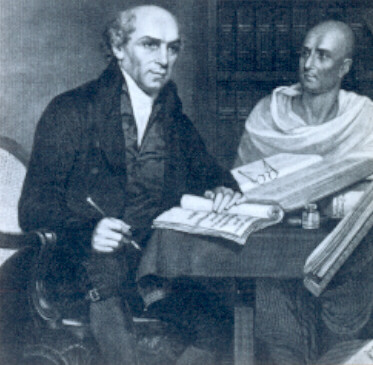
William Carey (1761-1834) once wrote: “Expect great things [from God]. Attempt great things [for God].” He did just that. He is considered by some to be the father of the modern missionary movement. As well as a missionary he was also a cobbler; a pastor – he spent six years pastoring Particular Baptist churches in Northamptonshire; a linguist – he promoted Bengali as a language and translated the Scriptures into the Indian languages, was a professor of languages at Calcutta’s Fort William College, as well as compiling a Bengali dictionary; a botanist – he introduced the daisy and the Linnean classification system to India;  a social activist – he campaigned against the cultural oppression of women and battled against sati (widow burning) and helped get it banned; and an educator – he founded Serampore College.

As a shoemaker in Northamptonshire he grew concerned with the fate of the unbelieving “heathen.” He had come into contact with the writings of Jonathan Edwards and came to see that his Calvinism and evangelism were compatible. The responsibility to reach the “heathen” arises out of what God has done.

To help him convince others of the need for word-wide evangelism he began to compile statistics. These were presented in 1792 in his wonderfully titled An Enquiry into the Obligations of Christians, to Use Means for the Conversion of the Heathens, in which the religious state of the different nations of the world, the success of former undertakings, and the practicability of further undertakings, are considered (http://www.wmcarey.edu/carey/enquiry/anenquiry.pdf). In section III he provides a survey of the then present state of the world. He then writes:

FIRST, The inhabitants of the world according to this calculation, amount to about seven hundred and thirty-one millions; four hundred and twenty millions of whom are still in pagan darkness; an hundred and thirty millions the followers of Mahomet; an hundred millions catholics; forty-four millions protestants; thirty millions of the greek and armenian churches, and perhaps seven millions of jews.  It must undoubtedly strike every considerate mind, what a vast proportion of the sons of Adam there are, who yet remain in the most deplorable state of heathen darkness, without any means of knowing the true God, except  what  are  afforded them by the works of nature; and utterly destitute of the knowledge of the gospel of Christ, or of any means of obtaining it.

The statistics and his arguments in the Enquiry led to the formation of the forerunner of the Baptist Missionary Society and Carey and John Thomas as its first missionaries. This provides a good example of mathematics as a tool for the gospel.

Steve Bishop is the compiler of A Bibliography for a Christian Approach to Mathematics and the author of several articles on the relationship between faith and math. He is the author of the Christian Mathematicians series here at GodandMath.com

An Interview with Andrew Hartley

Andrew Hartley is the author of Christian and Humanist Foundations for Statistical Inference; Religious Control of Statistical Paradigms. For more information on this work, please visit the Resource Book page.

Steve Bishop is the compiler of A Bibliography for a Christian Approach to Mathematics and the author of several articles on the relationship between faith and math. He has contributed a number of articles to GodandMath in his series on Christian Mathematicians.

Andrew recently discussed with Steve how his Christian faith and mathematics relate.

Andrew, thanks for agreeing to this interview, could you please tell us something about yourself?

First and foremost I consider myself a child of God, and then His servant. For me, this means I’m growing to see the world as I believe He does, and do what He calls me to do.  I want to grow in this way in every one of my roles (activities) in the world, including my role as a statistician.

So, how did you become a Christian?

How did you become a Christian? God converted me in my first year of undergraduate studies.  Until that time, I had been trying to manage my emotions and, in general, philosophize my way to happiness. Instead of joy, however, those mind games brought only emptiness. God worked through a campus minister & some friends to show me that the way to fulfillment was to admit my sin and need for a savior, to accept God’s forgiveness, & to live for him in all I do.

How do you use mathematics in your work?

I serve as a statistician in the pharmaceutical and medical device industry; I use most of my time to

1. assist government regulators in evaluating the safety and efficacy of drugs and medical devices, and

2. inform companies in the industry as they select candidate products to research and develop, and as they seek to optimize clinical studies and analyses, balancing costs and benefits in choices of such parameters as sample sizes, adaptive designs, and complexity of analyses.

More abstractly and generally, my occupation involves applying statistical theory to form scientific beliefs and make decisions in the presence of uncertainty and while managing risk, with the overall aim of maximizing expected net benefit.

How does your Christian faith impact how you do mathematics?

My trust in God helps me, I think, appreciate all His good gifts, and not to look solely either to my feelings or to external facts for security and truth. The contrast I want to draw here is between subjectivism and objectivism.

  • Subjectivism says that what matters is people’s feelings and impressions. It’s attractive because it allows individuals to decide to their own favor what matters, and whether a given body of evidence is convincing and conclusive. It attracts those who place a premium on believing what they want to believe.
  • Objectivism goes in the opposite direction, pretending that the data we can collect from experimentation and observation can automatically determine what we believe (or should believe).  A desire to found our beliefs on data as much as possible is commendable; however, objectivism is the dogmatic insistence that data are sufficient in themselves for determining what is right and true.

Faith in God and His provision for us helps me, as a Christian statistician, escape from each of these extremes. Because I’m certain that God gives us everything we need and that we can be satisfied in it, I’m more inclined and better able to draw mathematically on emotions and feelings (“subjective” elements), as well as data (“objective” elements), for guidance in forming scientific beliefs and making decisions. The need for both subjective as well as objective factors in statistical reasoning evinces itself, I believe, in the standard definitions and rules of probability; despite this, however, statisticians have devoted entire careers and multitudes of papers and books, in the last 150 years, to showing that one or the other is sufficient to guide us towards truth or, at least, to meet our desires.

The need, and the ability, of a Christian statistician to keep all created things, such as emotions and data, in proper balance is an instance of a more general responsibility and freedom of all Christians: Insofar as we find our ultimate fulfillment in Him and recognize the limited ability of created things to satisfy us, we are both motivated and able to use those things for God’s glory but not to become completely enraptured by them. This type of devotion to and trust in God is, of course, an ideal to which we should aspire, but which we never attain in this life. Centuries ago, John Calvin wrote that “All the things which make for the enriching of this present life are sacred gifts of God, but we spoil them by our misuse of them…The result is that the very things which ought to be of assistance to us in our pilgrimage through life, become chains which bind us.” He said also, more succinctly, that “…man’s nature, so to speak, is a perpetual factory of idols.” Because we divide our devotion between God and the things of this world, we set our hearts on one “idol” after another, believing that it could make us happy or fulfill all our wants. However, to the extent that we trust God, rather, and rest in His loving provision for us, we will be free to hold those created things “loosely.” We become better able to use them, rather than being possessed by them.

You have written a book on a Christian approach to statistics – how did that come about?

Since the time I became a Christian, I’ve been around people who emphasized serving God in every area of life, including their academic and professional work. They taught that authentic Christian living means using every opportunity to serve God. Expressing my thoughts on some implications of Christian faith for my discipline of statistics has seemed like a very natural way to serve Him in this manner.

Thanks Andrew, I look forward to discussing some of these issues more.

Read Steve’s Review of Andrew’s book in PSCF.

Read A Review by Troy Riggs of the Association of Christians in the Mathematical Sciences.

Look for a future posting on GodandMath from Andrew Hartley.

Our Thanks to both Andrew and Steve.

Christian Mathematicians – Milner

By Steve Bishop

(Disclaimer: The views expressed by guest authors do not necessarily reflect those of GodandMath.com. Guest articles are sought after for the purpose of bringing more diverse viewpoints to the topics of mathematics and theology. The point is to foster discussion. To this end respectful and constructive comments are highly encouraged.)

Very Reverend Dr. Isaac Milner (1750-1820)

Very Reverend Dr. Isaac Milner (1750-1820) was born to a working class family in Mabgate, Leeds. His father was a coal miner. He later became the Lucasian professor of mathematics at Cambridge, a post held by Isaac Newton, Charles Babbage, George Stokes, P.A. M. Dirac, Stephen Hawking and today, by the eighteenth holder, Micahel B. Green.

In 1774 he graduated from Cambridge as senior wrangler – best of year in mathematics. He was ordained in 1775. He was elected to be a member of the Royal Society in 1776 and then in 1788 he became President of Queens’ College, Cambridge (1788-1820), despite being an evangelical. Evangelicals at the time were regarded with great suspicion. From 1798-1820 he was the Lucasian professor of mathematics at Cambridge.

Milner had a lifelong friendship with the Christian abolitionist and Member of Parliament William Wilberforce. In 1784 Wilberforce asked Milner to accompany him on a tour of Europe. It was this tour that shaped Wilberforce’s’ mind. Milner also acted as an advisor to the influential evangelical Christian Clapham Sect (a sect in name but not nature) to which Wilberforce belonged. The group was formed by Henry Venn, the great grandfather father of John Venn (of the diagram fame).

In 1792 in poor health he took up the role of the Dean of Carlisle University until his death. Milner was the first evangelical to be appointed to the staff of a cathedral.

He co-authored with his brother Joseph the important work The History of the Church of Christ.

Milner requested that his many personal papers and journal entries were burned after his death. Fortunately, his great niece Mary managed to utilise many of these resources before they were destroyed in his biography.

References

http://www.lucasianchair.org/19/milner.html

Melaas-Swanson, Barbara J. (1993) “The Life and Thought of the Very Reverend Dr Isaac Milner and His Contribution to the Evangelical Revival in England” PhD Thesis University of Durham.

Steve Bishop is the compiler of A Bibliography for a Christian Approach to Mathematics and the author of several articles on the relationship between faith and math. Look for future posts from him in this series on Christian Mathematicians.

Previous Entries in this Series: