Reclaiming Math

By Katherine Loop

(Disclaimer: The views expressed by guest authors do not necessarily reflect those of GodandMath.com. Guest articles are sought after for the purpose of bringing more diverse viewpoints to the topics of mathematics and theology. The point is to foster discussion. To this end respectful and constructive comments are highly encouraged.)

How can “1 + 1 = 2” be anything but neutral? How can math facts be approached biblically?

If you’ve ever wondered how a biblical worldview applies to math, I’d invite you to join me on a little exploration. We will take a look at some biblical principles that give us a framework for understanding math, explore the worldview conflict in math, and examine how we can “reclaim” this vital subject for the Lord.

Applying a Biblical Worldview to Math

While the Bible does not specifically talk about math, it offers principles through which we can view and understand each aspect of life, including math. For example, the Bible teaches us that Jesus created and sustains all things (Colossians 1:16-17). Thus He created and sustains math! This does not mean He created the symbols on the piece of paper we have come to associate with math; it means He created the real-life principles those symbols represent.

Sit back and think for a moment about why math works. Why do equations we solve on paper apply in real life? They apply because they are ways of describing the consistent way God holds the universe together! One plus one consistently equals two because God keeps objects adding together consistently. We can only rely on math to work because a faithful, never-changing God consistently sustains this universe.

Biblical principles can also govern our use of math. The Bible teaches us that God has given each person work to do—work we are to work at as unto the Lord (Colossians 3:17). So as we learn math, we want to learn to use it to help us in our work—and we want to do it as unto the Lord!

Math proves a useful tool in many areas, both directly and indirectly. Math also helps us learn logical thinking, structured thought process, and problem-solving skills, thus indirectly serving as a tool at a deeper level.

The Secularization of Math

Now that we have an overview of a biblical worldview toward math, let’s take a look at what worldview is prevalent in most math teaching today. Pick up nearly any math textbook, and you’ll notice it does not mention where math came from or why it works. Math “facts” are taught and drilled into students day in and day out, but students are never given a foundation on which to understand those “facts.” They’re left looking at math as a neutral, self-existent structure.

While calling something neutral may not seem like a worldview, it is! It subtly takes God out of math. Neutral means indifferent or, “not engaged on either side; not aligned with a political or ideological grouping.”[1] When taught to view math as neutral, students are subtly being taught that there are certain absolutes and principles that exist independently from God—absolutes that are not engaged with a worldview.

This is a subtle but very dangerous twist on reality. Math should be reminding us to trust God, the One who day in and day out sustains this universe with such faithfulness that math facts can be used to describe how objects will operate! Instead, math facts end up encouraging students to place their faith in human reasoning and math itself. They are left viewing math as the source of truth.

Math works consistently. But if we view math facts as “neutral,” we are subtly giving math itself—or man’s reasoning—credit for the consistency around us. Instead of leaving math awed at God’s faithfulness, we’re learning to trust math and human reasoning. This sort of thinking lies at the root of naturalism and humanism.

Looking back, I can see how the things I learned in math for years subtly harmed my heart. When I began wrestling to make my faith my own, I approached the topic with the thought that I needed to see what math and “science” proved or disproved before I could commit myself to God. My understanding of math, which should have been reinforcing God’s faithfulness (after all, math could not exist without the biblical, faithful Creator!), was actually drawing me away from Him and encouraging me to trust math itself and human reasoning.

Reclaiming Math

So how do we reclaim math? How do we teach the next generation to base their thinking in every area, including math, on God’s Word?

When I first thought about teaching math Biblically, my first inclination was to add a Bible verse or analogy to a math lesson.

However, adding a Bible verse to a secular lesson does not fix the problem. It is similar to taping Bible verses over a bomb. We might succeed in hiding the danger, but not in diffusing it.

If we really want to reclaim math, we need to diffuse the bomb and begin looking at each concept, not as a neutral fact, but as a useful way of describing the consistency in our universe God created and sustains. As we do so, we will discover fascinating glimpses of God’s character revealed in math and begin seeing math as more than numbers on a piece of paper.

For example, when studying addition, rather than merely memorizing how to add two numbers, we can pause and realize that 12 + 4 only consistently equals 16 because day in and day out, God is holding all things together that consistently—by the power of His Word! Wow! What a powerful, faithful God we serve!

Then, rather than memorizing the steps to the addition problem by rote, we can realize that these steps are just one way men, using the ability God gave them, have come up with to describe the consistency around us. There are other ways to add—including ways that do not involve carrying digits at all. We might take a look at some of those other ways…or at various ways addition can help in our daily tasks or in exploring God’s creation.

Rather than looking at math as an independent fact, we are now seeing it as a useful tool to describe God’s creation. We are left marveling at God’s faithfulness and power, encouraged to trust Him in every area.

Yes, indeed, math can be—and needs to be—reclaimed. Its very existence serves as a testimony to God’s faithfulness. Let’s not miss out on seeing Him in math!

Katherine Loop, a homeschool graduate, is the author of various homeschool resources, including two books on teaching math from a biblical worldview. View more information on viewing and teaching math from a biblical perspective and sign up for her free e-newsletters on her website, www.christianperpsective.net.  

This article is based on one originally published in the Home School Enrichment Magazine. Reprinted with permission.


[1] Webster’s New Collegiate Dictionary, 1974 ed., s.v. “neutral.”

Christian Mathematicians – Leibniz

By Steve Bishop

(Disclaimer: The views expressed by guest authors do not necessarily reflect those of GodandMath.com. Guest articles are sought after for the purpose of bringing more diverse viewpoints to the topics of mathematics and theology. The point is to foster discussion. To this end respectful and constructive comments are highly encouraged.)

Gottfried Wilhelm Leibniz (1646-1716) was born in Leipzig. He was a rationalist in that he thought that all knowledge was based on logic. As Herbert Breger in ‘God and Mathematics in Leibniz’s Thought’ in Mathematics and the Divine ed. Teun Koetsier and Luc Bergmans (Elsevier, 2005) puts it:

Leibniz believed in the God of Christianity and he also had an extraordinarily high esteem for reason and its capabilities.

Mathematics Developed

Leibniz discovered calculus at the same time as Newton. This raises an interesting question: why did they discover it at the same time? where there any cultural influences that shaped their thoughts?

The notation we use for differential and integral calculus – dx and the elongated ‘s’ are Leibniz’s. He also gave us the terms ‘function’ and ‘coordinates’ as well as the symbols = for ‘equals’ and x for ‘product’.

Theology and Apologetics

He also devoted much time and energy to theology and apologetics.

In 1709 he attempted to improve the ontological argument for God and in 1710 His Theodicy, or “Vindication of the Justice of God“, was published.  It attempted to justify the existence of God with the existence of evil.

Leibniz also attempted to provide a proof for God’s existence. He wrote, “The first question which should rightly be asked is this: why is there something rather than nothing?”

George MacDonald Ross in Leibniz Oxford University Press (Past Masters)  1984 writes:

Leibniz’s solution had two parts. The first was to admit that the universe was indeed imperfect, but to point out that its imperfection was logically necessary in order to preserve its distinctness from God, the only perfect being. God could not be blamed for failing to contravene the laws of logic. The other part of his answer was to say that, although the universe was not perfect, it was the best possible – it was as perfect as it could be without collapsing back into God himself. Consequently, to blame God for creating this universe as he did would be tantamount to saying that he should not have created anything at all.

His argument has been framed as follows:

  1. Every existing thing has an explanation of its existence, either in the necessity of its own nature or in an external cause.
  2. If the universe has an explanation of its existence, that explanation is God.
  3. The universe exists.
  4. Therefore, the universe has an explanation of its existence (from 1, 3)
  5. Therefore, the explanation of the existence of the universe is God (from 2, 4)

He maintained that that if God did not exist, not only nothing else would exist, but there would be nothing possible either.

Resources for the study of Leiniz are available here http://www.philosophypages.com/ph/leib.html

Previous Entries in this Series:

Christian Mathematicians – Euler

Steve Bishop is the compiler of A Bibliography for a Christian Approach to Mathematics and the author of several articles on the relationship between faith and math. Look for future posts from him in this series on Christian Mathematicians.

Christian Mathematicians – Euler

By Steve Bishop

(Disclaimer: The views expressed by guest authors do not necessarily reflect those of GodandMath.com. Guest articles are sought after for the purpose of bringing more diverse viewpoints to the topics of mathematics and theology. The point is to foster discussion. To this end respectful and constructive comments are highly encouraged.)


Leonhard Euler (1707-1783)


Euler was a committed Christian and, apparently, a biblical literalist as well as being (arguably) one of the greatest mathematicians ever – he was certainly the most prolific (apart from perhaps Paul Erdos).

According to one website (condensed from E T Bell’s Men of Mathematics):

Euler remained a Christian all of his life and often read to his family from the Bible. One story about his religion during his stay in Russia involved the atheistic philosopher Diderot. Diderot had been invited to the court by Catherine the Great, but then annoyed her by trying to convert everyone to atheism. Catherine asked Euler for help, and he informed Diderot, who was ignorant of mathematics, that he would present in court an algebraic proof of the existence of God, if Diderot wanted to hear it. Diderot was interested, and, according to De Morgan, Euler advanced toward Diderot, and said gravely, and in a tone of perfect conviction: “Sir, (a + bn) / n = x , hence God exists; reply! ” Diderot had no reply, and the court broke into laughter. Diderot immediately returned to France.

Leonhard was born into a Calvinist family and his father, Paul, was a minister in the church as was his grandfather. Euler’s father wanted him to follow him into the church. However, being a good Calvinist he realised that one could serve God through mathematics as well as theology and seeing his son’s ability in and passion for mathematics allowing him to pursue mathematics.

Euler always held an interest in theology as well as mathematics. For him mathematics gave insight into God’s good creation.

Eulogy of Euler by Nicolas Fuss:

He was entirely imbued with respect for religion and his piety was sincere and his devotion was full of fervor. He fulfilled with the greatest detail all the duties of a Christian. He loved everyone, and if he felt stirrings of indignations it was against those enemies of religion, especially against the declared apostles of atheism that he made a stand in the defense of the Revelation against the objections of atheists in a work which was published in Berlin in 1747.

Dan Graves in his Scientists of Faith has this to say of Euler:

Euler retained his firm Calvinist beliefs throughout life, holding daily prayer and worship in his home and sometimes preaching.

Euler was one of the first inventors of the number game Suduko. Though he called it Latin squares.

He introduced the letter e to represent the base of natural logs, f(x) to denote functions,and made countless contributions to number theory and graph theory, most notably he showed that the Koinisberg bridge problem was unsolvable.

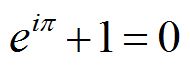
His name is associated with angles, approximation, circles, cycle, criterion, graphs, operator’s, polynomials, pseudo primes, … and Euler’s identity: said to be the most beautiful formula in the world.

And let’s not forget:

V – E + F = 2

Euler was able to serve his God through his mathematics.

Also on Euler:

Steve Bishop is the compiler of A Bibliography for a Christian Approach to Mathematics and the author of several articles on the relationship between faith and math. Look for future posts from him in this series on Christian Mathematicians.