Christian Mathematicians – Bayes

By Steve Bishop

(Disclaimer: The views expressed by guest authors do not necessarily reflect those of GodandMath.com. Guest articles are sought after for the purpose of bringing more diverse viewpoints to the topics of mathematics and theology. The point is to foster discussion. To this end respectful and constructive comments are highly encouraged.)

Thomas Bayes (1702-1761)

Thomas Bayes (1702-1761) was the minister of the Presbyterian Chapel in the English spa town of Tunbridge Wells from around late 1733. By all accounts he was a better mathematician than he was a church minister! The Protestant Dissenter’s Magazine of 1814 describes Bayes as a respected minister, however, he was not according to Timpson (writing in 1859) a popular preacher (Bellhouse, 2004).

As a non-conformist he was prevented from attending the English universities, so he began study in 1719 at Edinburgh University in Scotland.

In 1731 he published a work entitle Divine Benevolence and in 1742 he was made a fellow of the Royal Society after defending Isaac Newton against Bishop Berkeley in a ‘pamphlet war’.

Bayes did work with fluxions, infinite series as well as in probability. In the late 1740s Bayes set out his theory of probability that eventually bore his name. His theorem was discovered after his death. It had no practical applications in his lifetime. He didn’t even bother to publish it. It was his friend and fellow mathematician and church minister Richard Price who discovered it among Bates’ effects after his death and had it published as “An Essay towards solving a problem in the doctrine of chances,” Philosophical Transactions of the Royal Society of London 53 (1763): 370–418. Available here: http://rstl.royalsocietypublishing.org/content/53/370.full.pdf+html

Price suggested that the theory could be used to defend Christianity against the skepticism of David Hume. Price was at the time the minister of the non-conformist chapel in Newington Green, England.

Laplace re-rediscovered it and modified it into the form we largely recognise today.

The statistical community who largely accepted the frequentist view of statistics rejected it; they thought that the bayseian approach was subjective and hence ‘unscientific’. It is only in the last few decades that the bayesian approach is starting to be dominant. McGrayne (2011) writes:

In discovering its value for science, many supporters underwent a near-religious conversion yet had to conceal their use of Bayes’ rule and pretend they employed something else. It was not until the twenty-first century that the method lost its stigma and was widely and enthusiastically embraced.

Today it is used among other things to forecast weather, to identify e-mail spam, to improve low-res images on computers and has been used to identify forgeries.

The formula is known today in this form:

P(A|B)=P(B|A)P(A)/P(B)

where P(A) denotes the probability of A and P(A|B) is the probability of A given that B has occurred.

Sharon Bertsch McGrayne’s (2011) book title summarises its impact: The Theory That Would Not Die: How Bayes’ Rule Cracked the Enigma Code, Hunted Down Russian Submarines & Emerged Triumphant from Two Centuries of Controversy (Yale University Press, 2011)

A recent book by Andrew Hartley, Christian and Humanist Foundations for Statistical Inference (Resource, 2008), suggests that a subjective bayesian approach comports well with a Christian perspective on statistics.

Interestingly, Bayes’ theorem has been used by philosophers of religion such as Richard Swinburne to try and prove God’s existence and by others such as philosopher John Mackie and the atheist evangelist Richard Dawkins in an attempt to disprove God’s existence.

Bill Bryson on Thomas Bayes:

References

Bellhouse, D. R. 2004. “The Reverend Thomas Bayes, FRS: A Biography to Celebrate the Tercentenary of His Birth,” Statistical Science 19 (1) 3–43.

Sharon Bertsch McGrayne (2011) The Theory That Would Not Die (Yale University Press, 2011)

Steve Bishop is the compiler of A Bibliography for a Christian Approach to Mathematics and the author of several articles on the relationship between faith and math. Look for future posts from him in this series on Christian Mathematicians.

Previous Entries in this Series:

Christian Mathematicians – Nightingale

By Steve Bishop

(Disclaimer: The views expressed by guest authors do not necessarily reflect those of GodandMath.com. Guest articles are sought after for the purpose of bringing more diverse viewpoints to the topics of mathematics and theology. The point is to foster discussion. To this end respectful and constructive comments are highly encouraged.)

Florence Nightingale (1820-1910)

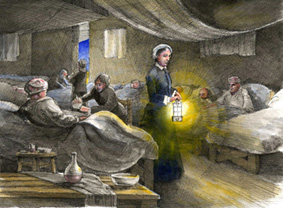
Florence Nightingale was born in Florence to a family of high standing. Her family were there as part of a grand tour of Europe. She shocked them by wanting to become a nurse. She felt called into that service by God.  She is perhaps best remembered as the “lady of the lamp.”

In 1854 she went to serve as a nurse in Sutari during Crimea War. As a result of her work the death rate in war hospitals fell from 42% to 2%. She did this by collecting data; she was a good statistician. She pioneered the idea that social phenomenon could be quantified. She declared:

“To understand God’s thoughts, we must study statistics for these are the measure of His purpose.”

For her there was no conflict between faith and statistics. She was elected to membership of the Statistical Society of England in 1858. Karl Pearson is alleged to have called her a ‘prophetess’ of statistics. In 1874 she was made an honorary member of the American Statistical Association.

Her data collection and statistical analysis changed the nursing profession. She provides a great example of how mathematics can be a useful tool in stewarding the creation.

She was the originator of coxcombs, a polar area diagram – the forerunner of the pie chart. She used it to show the causes of mortality during the Crimea war.


 Further information on Nightingale is available here:

https://nightingale.vtoxford.org/FlorenceNightingale.aspx

http://departments.kings.edu/womens_history/florence.html

Steve Bishop is the compiler of A Bibliography for a Christian Approach to Mathematics and the author of several articles on the relationship between faith and math. Look for future posts from him in this series on Christian Mathematicians.

Previous Entries in this Series:
Christian Mathematicians – Pascal

By Steve Bishop

(Disclaimer: The views expressed by guest authors do not necessarily reflect those of GodandMath.com. Guest articles are sought after for the purpose of bringing more diverse viewpoints to the topics of mathematics and theology. The point is to foster discussion. To this end respectful and constructive comments are highly encouraged.)


Blaise Pascal (1623-1662)


The French mathematician and philosopher Blaise Pascal (1623 – 1662) was born in Claremont and died in Paris. He and his two sisters were raised by his father, his mother died when he was three. His father, a keen mathematician, taught Blaise at home. By all accounts Blaise at an early age was a mathematical genius.

Mathematical achievements

Pascal gave his name to the SI unit for pressure (Pa = 1 N/m2), a rule, a law, a triangle, a wager and a theorem.

He developed one of the first calculating machine, at age 19, to help his tax-collector father with lots of tedious calculations.

He is perhaps best known by school children through Pascal’s Triangle – although he did not ‘invent’ this but did give his name to it as he did so much work with it.

He did pioneering work on conic sections, cycloid curves and number theory. He also worked with Fermat on what became the foundations of probability theory  (Shafer, 1993). As well as work in physics, including work hydrostatics and vacuum, he invented the syringe and a hydraulic press.

Conversion experience

November 23, 1654, Pascal underwent a conversion experience. He had a vision of Jesus on the cross, he wrote:

 “From about half-past ten in the evening until about half-past twelve … FIRE … God of Abraham, the God of Isaac, the God of Jacob, and not of the philosophers and savants. Certitude. Certitude. Feeling. Joy. Peace.”

He kept this on a small piece of paper which he kept with him sewn into the lining of his coat.

Pascal and reason

Pascal was highly dubious about the role of natural theology. In his Pensées , published posthumously, he wrote:

“It is an astounding fact that no canonical writer has ever made use of nature to prove God. They all strive to make us believe in Him. David, Solomon, etc., have never said, “There is no void, therefore there is a God.” They must have had more knowledge than the most learned people who came after them, and who have all made use of this argument. This is worthy of attention.” (Pensées 243)

Natural theology for Pascal leads to the god of the philosophers, not the God of Abraham, Isaac and Jacob, the God of the Bible.

He could perhaps be thought of as an early reformed epistemologist, for him belief in God was properly basic. He asserted that:

 “The heart has its reasons, which reason does not know.” (Pensées  277)

“It is the heart which experiences God, and not the reason. This, then, is faith: God felt by the heart, not by the reason.” (Pensées 278)

Nevertheless, he did provide one argument for belief in God: Pascal’s Wager (Pensées  233). Simply put, if God exists we will be rewarded. If he doesn’t exist we won’t be. If we believe in God and he doesn’t exist we might have lost out on a few ‘sinful pleasures’, however, if we don’t believe in God but he does exist, then we may face eternal damnation. It’s not worth the risk of not believing in God.

References

Schaeffer, Glen, 1993. “The early development of mathematical probability.” Companion Encyclopedia of the History and Philosophy of the Mathematical Sciences, edited by I. Grattan-Guinness. Routledge: London, 1293-1302.

Pascal, Blaise, 1958.Pensées  <http://www.gutenberg.org/files/18269/18269-h/18269-h.htm>

Donald Adamson, David “Pascal’s views on mathematics and the divine.” In Mathematics and the Divine: A Historical Study edited by Teun Koetsier Luc Bergmans. Amsterdam: Elsevier, 2005, ch. 21.

Steve Bishop is the compiler of A Bibliography for a Christian Approach to Mathematics and the author of several articles on the relationship between faith and math. Look for future posts from him in this series on Christian Mathematicians.

Previous Entries in this Series: