Math and Music

Mathematics and music have a long and storied history together. Extensive writing has been done on the relationship between these disciplines (see above for example). To this extensive writing I have contributed absolutely nothing, so the point of this post is not to offer any ground-breaking new ideas on the matter. The point of this post is to accomplish three things:

  1. To introduce, albeit briefly, the unique bond between these subjects for those who might not have been aware and provide links for further inquiry. Check.
  2. To offer some ideas (and hopefully get some back) for those interested in taking advantage of their students’ musical interests in order to engage them in mathematical thinking.
  3. To promote what I feel is some top-notch, musically creative, theologically deep and meaningful, Christian music that is currently being produced.

A Math Music Lesson Plan

If there are two things I can say with certainty about my students in general it is this: they don’t like math, but they do like music. They will quickly become bored with a worksheet and, as their mind drifts to other things, they will almost subconsciously start laying down beats of popular songs on their desks. So I ask myself this question: how do I tell my students that what they are doing has equal (and in reality probably greater) mathematical value than their worksheet without receiving a look back from them that implies I need serious mental help?

I offer up this lesson plan as a possible first step. I’m afraid I don’t know enough music to make this lesson as dynamic as it could potentially be. Hopefully in my free time (I’ve heard such a thing exists and I’m looking forward to experiencing it someday) I’ll be able to glean some insights from that extensive writing and make some improvements and additional lessons to exploit a connection that desperately needs exploiting. If there is anyone out there with their own suggestions, they would be greatly appreciated.

In case you are interested here is the typed lesson plan with student handouts.

Sample Lesson: Amplitude, Period, and Applications of Sinusoidal Functions (Pre-Cal)

Objectives/TEKS: The students will…

  1. define the amplitude, period and frequency of a sinusoidal function.
  2. discover how modifying the amplitude/period affects the graph of sine and cosine.
  3. correlate their understanding of general transformations from Algebra II to the specific transformations of amplitude and period.
  4. apply transformations of sinusoidal functions to sound waves and musical notes.
  5. …learn to value the influence mathematics has on discussions of beauty in music.

Scripture:

It is good to give thanks to the Lord, And to sing praises to Your name, O Most High; To declare Your lovingkindness in the morning, And Your faithfulness by night, With the ten-stringed lute and with the harp, With RESOUNDING MUSIC upon the lyre. For You, O LORD, have made me glad by what You have done, I will sing for joy at the works of Your hands.

Psalm 92:1–4

Materials:

  1. Unit Circle that the students have been assembling throughout the semester
  2. “Audacity” audio software, laptop, and projection device
  3. Handouts: student notes and worksheet

Opening:

The students will be introduced to the “Audacity” audio software. This software displays a graphical representation of sound waves for any given piece of music. This software can also play a single note and display the corresponding sound wave, which results in a perfect sinusoid. The students will note that sound waves are modeled by a sinusoidal function. (In the previous lesson the students used their unit circles to derive the graphs of the sine and cosine functions).

Various notes will be played with the similarities and differences in their graphs being discussed. The question will be posed: how can we modify the way we write sinusoidal functions to model these changes that we observe in the sound waves of various notes?

Introduction of New Material:

The students will be presented with the terminology of amplitude and period as descriptions of sinusoid graphs. The students will then discover how amplitude and period are affected when constant coefficients A and B are introduced into the expression for the sinusoidal function: y = A sin (Bθ). The students will do this using pages one and two of the attached notes, completing a table of values and then sketching the graphs.

Guided Practice:

The students will then use their understanding of amplitude and period to graph several sinusoids without a chart of points – considering the graph purely as a transformation of the sinusoidal parent functions. This can be seen on the third page of the attached student notes.

Independent Practice:

The students will be given several problems on a worksheet similar to those presented in the guided practice section.

Closing/Assessment:

Returning to the “Audacity” audio software, the students will be asked to apply their knowledge of amplitude and period to their previous descriptions of how the sound waves varied between different notes.

For example, at the beginning of the lesson when the students were asked to describe the change in the sound wave that resulted from a move from an A to a G, answers will fall along the lines of: “The graph has more repetitions” or “the graph repeats itself sooner and more often” or perhaps even “the graph repeats itself more frequently.”

Now at the close of the lesson, the students’ answers should fall along the lines of: “The period is decreased/increased” and “the frequency is increased/decreased.”

Sample questions can include:

  1. If we modify the frequency (inverse of the period) of the sinusoid, how does that change affect the musical note that is produced?
  2. Based on the answer to (1), if we want to produce a higher note, how should we modify the period? If we want to produce a lower note, how should we modify the period?

Extension Questions:

  1. What can we glean from the fact that a perfectly played musical note produces a smooth and symmetrical sinusoid, while an off-key note does not?
  2. Can we classify certain music as good and certain music as not good? In other words, is there such a thing as objectively good music? How does math contribute to this discussion?

Josh Garrels

If you have never heard of Josh Garrels, do yourself a favor and check out his music. In a world of contemporary “Christian” music that produces a lot of fluff (for lack of a better word), Josh’s music stands out as being both theologically literate and musically creative. I’m sure you’ll catch me using phrases from his songs in various postings.

Other Lectures on Math and Music

The Geometry of Music

Why Are Pianos Out of Tune?

Math in Process: Critiquing the Process (Revelation and the Trinity)

Disclaimer: the author of this post does not in any way support the views of process theology or believe that its views can legitimately be considered thinking Christianly. The purpose of this post is to summarize these views in order to critique them.

Previous entries in this series:

Math in Process

Math in Process: An Introduction

Math in Process: Process Theology 101

Math in Process: The Influence of Mathematics on Process Theology

Many critiques have been leveled against process theology. One that I have found to be particularly well written comes from Bruce Demarest entitled “The Process Reduction of Jesus and the Trinity,” in Process Theology (ed. Ronald H. Nash, Grand Rapids: Baker Book House, 1987). Many of the points I make below can be attributed to the framework of Demarest’s argument.

In general, the criticisms of process theology have focused on the process theologians’ redefinition of divine omniscience. The question that began this series of posts, “Do mathematicians create new mathematical objects that are surprising to God?” appears to be rooted in the discussion of God’s knowledge. Extensive work has been done in the area of divine foreknowledge producing responses to the tension that exists between God’s omniscience, omnipotence and human freedom which keep orthodox Christians from necessarily making a move to process theology. One such option is to recognize God’s existence outside of time. Therefore to speak of His future knowledge is a very different thing than to speak of human future knowledge.[1]

It is my contention, however, that the conversation need not go that far for our purposes. In other words it is not simply because viable, orthodox, philosophical arguments exist that we should refuse to accept process theology and a process perspective of Christian mathematics. Rather it is because process theology greatly damages foundational Christian doctrines that it cannot be accepted.

If we are to maintain an orthodox faith and practice the discipline of mathematics in a distinctly Christian way there are core tenets that must be maintained. Philosophical and mathematical results that develop from (or necessarily involve) the forfeiture of any of these tenets cannot be accepted. That is not to say that they cannot be discussed, so long as that discussion brings us back to the core beliefs that Scripture is authoritative, God is Trinity, and Jesus as the God-man was crucified and resurrected as atonement for our sins. To be clear that process theology simply does give us a viable option in these doctrines, the implications of process thought in each will now be briefly discussed.

Revelation and the Trinity

Process thought accepts the notion that God is revealed through scripture in some sense, but because of the evolving nature of any tradition, process theology allows for considerable freedom on the part of the interpreter. In process theology, reference to the historical Jesus or the apostolic tradition is only one way that a critical element can be brought to bear on the question of the authority of Scripture.[2]

Rather than viewing the Bible through this traditionally orthodox lens, process theologians prefer to approach the Scripture from the viewpoint of scientific modernity.[3] This excludes a belief in miracles (supernatural intrusions by God into the natural order). This is discarded for a trust in the evidence of science that all events have a natural sequence of cause and effect in the evolutionary process. The process school comes to the theological task with a low view of scripture – modern study precludes accepting all that is written therein as true. If God does not supernaturally intrude from without the natural order, divine revelation is by definition excluded.

With the elimination of divine revelation, and along with it the authority of scripture, the door is open to modify any other doctrine in a way we see fit. That a doctrine appears in the Bible or that it was faithfully upheld by the historic Christian church provides no basis for its acceptance by modern, empirically minded process thinkers. This conclusion is obviously unacceptable to historically orthodox Christians.

Orthodox View of Trinity

Once the Bible (and the creeds) have been discarded, the doctrine of God as Trinity is easily modified. The doctrine of Trinity has historically been defined as God existing as one essence in three persons. Whitehead’s identification of person with substance led him to conclude that the Christian doctrine of trinity is really a crude tri-theism. Therefore the term person, in process theology, was viewed as a mode of activity (an abstract quality) of a single concrete subject. This means that process theology upholds a tri-unity of abstract and impersonal principles.[4] The subject of Jesus cannot be identified with the second member of the Trinity and likewise, the subject of the Holy Spirit cannot be identified with the third member of the Trinity.[5] These parts of the Trinity are viewed as abstract and impersonal principles in God’s primordial (or unchanging) nature. While they may interact with the world through God’s consequent (or changing) nature (since his consequent nature by definition includes his primordial nature – if you are confused, don’t worry, I am too), the process construction of Trinity is decidedly inferior to a dynamic society of three conscious, active, and loving persons.

In summary it would seem that the process view of trinity is defined in terms of functionality rather than objectivity. By that I mean the process view sees trinity as a reference to the unity of the three different functions of God. If this interpretation is true then process theology can be filed under the heresy of modalism – the view that there is one God who manifests himself in three different modes: father, son, and holy spirit. Even if this interpretation of the process view is incorrect, at the very least it is clear that the process definition detracts from the orthodox Christian definition (given below) in order to resolve their philosophical tensions and their emphasis on becoming over being.

The Christian doctrine of trinity, thus viewed as three related persons in one substantial unity, provides demonstration of the classical philosophical problems of the relation of the one to the many and of being to becoming.[6] It is unacceptable for Christians to dismantle the traditional view of Trinity in order to philosophically resolve these lingering tensions.

More on this in the closing post of this series in which I lay the groundwork for a distinctly Christian foundation for mathematics.

Coming Up Next:

Critiquing the Process View of The Person and Work of Jesus Christ

Let us close this post with a clear statement against the process view of trinity: the Athanasian Creed.

Whosoever will be saved, before all things it is necessary that he hold the catholic faith, which except everyone shall have kept whole and undefiled, without doubt he will perish eternally.  Now the catholic faith is this: We worship one God in Trinity and Trinity in Unity, neither confounding the Persons nor dividing the substance.

For there is one Person of the Father, another of the Son, and another of the Holy Spirit.  But the Godhead of the Father, of the Son, and of the Holy Spirit, is one, the Glory equal, the Majesty co-eternal.  Such as the Father is, such is the Son, and such is the Holy Spirit; the Father is uncreated, the Son is uncreated, and the Holy Spirit is uncreated; the Father is infinite, the Son is infinite, and the Holy Spirit is infinite; the Father is eternal, the Son is eternal, and the Holy Spirit is eternal.  And yet there are not three eternals but one eternal, as also not three infinites, nor three uncreateds, but one uncreated and one infinite.

So, likewise, the Father is almighty, the Son almighty, and the Holy Spirit almighty; and yet not three almighties but one almighty.  So the Father is God, the Son God, and the Holy Spirit God; and yet there are not three Gods but one God.  So the Father is Lord, the Son Lord, and the Holy Spirit Lord; and yet not three Lords but one Lord.  For like as we are compelled by Christian truth to acknowledge every Person by Himself to be both God and Lord; so are we forbidden by the catholic religion to say, there be three Gods or three Lords.

The Father is made of none, neither created nor begotten.  The Son is of the Father alone, not made nor created but begotten.  The Holy Spirit is of the Father and the Son, not made nor created nor begotten but proceeding.  So there is one Father not three Fathers, one Son not three Sons, and one Holy Spirit not three Holy Spirits.

And in this Trinity there is nothing before or after, nothing greater or less, but the whole three Persons are coeternal and coequal.  So that in all things, as is aforesaid, the Trinity in Unity and the Unity in Trinity is to be worshipped.

He therefore who wills to be in a state of salvation, let him think thus of the Trinity.


[1] Jonathan L. Kvanvig, The Possibility of an All-Knowing God, (New York: St. Martin’s Press, 1986), 166..

[2] Russell Pregeant, “Scripture and Revelation,” In Handbook of Process Theology, ed. Jay McDaniel and Donna Bowman (St. Louis, MO: Chalice Press, 2006), 72.

[3] Bruce Demarest, “The Process Reduction of Jesus and the Trinity,” In Process Theology, ed. Ronald H. Nash (Grand Rapids: Baker Book House, 1987), 64.

[4] Ibid., 82.

[5] Ibid.

[6] Ibid.

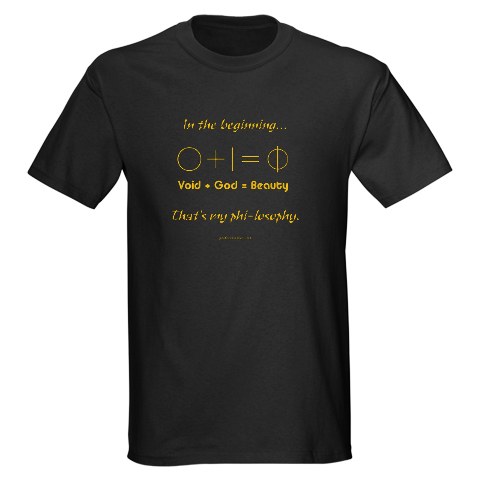
Void + God = Beauty

From a cool site goldennumber.net, everything Φ related.

In the beginning God created the heavens and the earth. The earth was formless and void, and darkness was over the surface of the deep, and the Spirit of God was moving over the surface of the waters.

– Genesis 1:1-2

Of old You founded the earth, And the heavens are the work of Your hands.

– Psalm 102:25

He has made everything beautiful in its time. He has also set eternity in the hearts of men; yet they cannot fathom what God has done from beginning to end.

– Ecclesiastes 3:11