Later this week I will be giving a talk at the 19th ACMS Conference entitled “Mathematical Affections: Assessing Values in the Math Classroom.” Overall I argue for 1) the need for affective learning, 2) the place of affective learning in mathematics, and 3) how we cultivate what I’ve termed as “mathematical affections.” I will post the talk in its entirety once I have given it. For now, I thought I would share a teaser from the introduction. Enjoy.

How many of you, as math educators, have heard the question “When am I ever going to use this?” be uttered by your students? If you have been teaching for more than 5 minutes then it’s safe to assume that phrase has been mentioned in your presence. Occasionally it is posed as a valid question; the student is genuinely interested in the future career application of the topic at hand. However, I believe the majority of the time the phrase “When am I ever going to use this?” is spoken it is not as a question, but as a statement. A statement which implies that the obvious answer is “I will never use this so learning it is a waste of time.” The real issue being raised by these students is not one of application, but rather one of values. If we could translate their question into what they are really trying to communicate then “When am I ever going to use this?” will become “Why should I value this?” Students express their inquiry in terms of mathematical practicality because that is the language in which their culture, including their math teachers, has conditioned them to speak.
To illustrate how we as math educators have contributed to this misconception that value equals utility, let us turn our attention to the foundational document for composing the learning objectives and outcomes of an academic course: Bloom’s Taxonomy (pictured below).
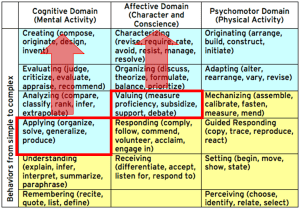
A quick glance at this chart will reveal that ‘application’ falls under the cognitive (mental/knowledge) domain of learning while ‘valuing’ falls under the affective (heart/feeling) domain of learning. The cognitive domain is almost exclusively emphasized in the preparation of teachers within the modern educational system while the affective domain is largely ignored. So while we ‘improve’ our teaching and questioning to make mathematics less abstract and to focus on real-life applications so that we can address the question of “When am I ever going to use this?” before it is even asked, we are actually implicitly teaching students that mathematical value is to be found only in application. If we really want to help those students address the true foundational question of “Why should I value this?” then we need to do so through increasing our attention on the affective domain of learning; writing rigorous learning objectives and developing quality assessments just as we do for the cognitive domain.
Now, application is certainly useful in the teaching process and it should not be ignored. I am not advocating the promotion of the affective domain over and above the cognitive. My goal is to simply bring the affective up to the same level as the cognitive. The best learning is done when both domains are utilized in conjunction with each other. In The Abolition of Man, C.S. Lewis writes “Education without values, as useful as it is, tends to make man a more clever devil.” I believe this is a fairly accurate statement of the modern day system of education. If we don’t focus on values, if we don’t focus on the affective learning of our students, then their education will still be useful – they’ll increase in cognitive ability and learn to apply their thinking. But is that really valuable in and of itself? Without a proper sense of values to guide their application, aren’t we really just making students “more clever devils”?
You see, you can never actually remove values from education. Education is inherently value laden, and I believe Lewis knew this. It is not a question of “Are you teaching values?” but rather “Which values are you teaching?” Lewis’ point is that the value we instill in education should be affective – loving learning for its own sake and valuing wisdom. If you don’t focus on affections, then you still have usefulness, but is that really beneficial? In the words of the Bishop in Victor Hugo’s Les Misérables: “The beautiful is as useful as the useful…Perhaps more so.”
Application is indeed useful but it should be presented in a way that promotes the development of what I’ll term mathematical affections. Learning has little meaning unless it produces a sustained and substantial influence not only on the way people think, but also on how they act and feel.


