The excerpt below is taken from the paper, “A Mathematician’s Lament,” by Paul Lockhart. Lockhart also has a recent book by the same name, that is based off of the original paper. This excerpt is a little less than what you get when you sample the book on iTunes, so I believe it is safe to share here.
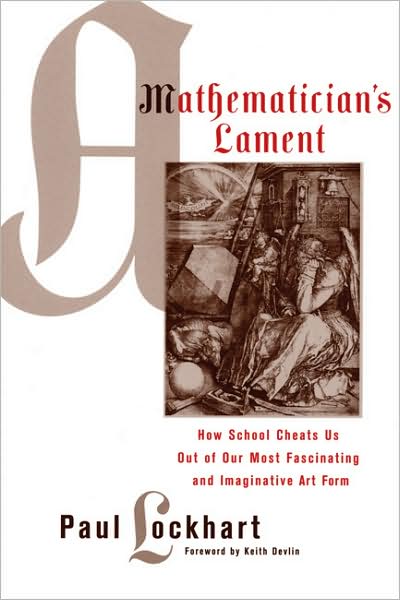
I must say I don’t agree with Mr. Lockhart’s perspectives on how to fix the problems prevalent in math education. However, he does an excellent job of giving you a mathematician’s perspective on the problems. It is clear that he feels very passionate about this issue, as do the rest of us who are paying attention. That is why I share this here.
…
A musician wakes from a terrible nightmare. In his dream he finds himself in a society where music education has been made mandatory. “We are helping our students become more competitive in an increasingly sound-filled world.” Educators, school systems, and the state are put in charge of this vital project. Studies are commissioned, committees are formed, and decisions are made— all without the advice or participation of a single working musician or composer.
Since musicians are known to set down their ideas in the form of sheet music, these curious black dots and lines must constitute the “language of music.” It is imperative that students become fluent in this language if they are to attain any degree of musical competence; indeed, it would be ludicrous to expect a child to sing a song or play an instrument without having a thorough grounding in music notation and theory. Playing and listening to music, let alone composing an original piece, are considered very advanced topics and are generally put off until college, and more often graduate school.
As for the primary and secondary schools, their mission is to train students to use this language— to jiggle symbols around according to a fixed set of rules: “Music class is where we take out our staff paper, our teacher puts some notes on the board, and we copy them or
transpose them into a different key. We have to make sure to get the clefs and key signatures right, and our teacher is very picky about making sure we fill in our quarter-notes completely. One time we had a chromatic scale problem and I did it right, but the teacher gave me no credit because I had the stems pointing the wrong way.”
In their wisdom, educators soon realize that even very young children can be given this kind of musical instruction. In fact it is considered quite shameful if one’s third-grader hasn’t completely memorized his circle of fifths. “I’ll have to get my son a music tutor. He simply won’t apply himself to his music homework. He says it’s boring. He just sits there staring out the window, humming tunes to himself and making up silly songs.”
In the higher grades the pressure is really on. After all, the students must be prepared for the standardized tests and college admissions exams. Students must take courses in Scales and Modes, Meter, Harmony, and Counterpoint. “It’s a lot for them to learn, but later in college when they finally get to hear all this stuff, they’ll really appreciate all the work they did in high school.” Of course, not many students actually go on to concentrate in music, so only a few will ever get to hear the sounds that the black dots represent. Nevertheless, it is important that every member of society be able to recognize a modulation or a fugal passage, regardless of the fact
that they will never hear one. “To tell you the truth, most students just aren’t very good at music. They are bored in class, their skills are terrible, and their homework is barely legible. Most of them couldn’t care less about how important music is in today’s world; they just want to take the minimum number of music courses and be done with it. I guess there are just music people and non-music people. I had this one kid, though, man was she sensational! Her sheets were impeccable— every note in the right place, perfect calligraphy, sharps, flats, just beautiful. She’s going to make one hell of a musician someday.”
Waking up in a cold sweat, the musician realizes, gratefully, that it was all just a crazy dream. “Of course!” he reassures himself, “No society would ever reduce such a beautiful and meaningful art form to something so mindless and trivial; no culture could be so cruel to its children as to deprive them of such a natural, satisfying means of human expression. How absurd!”

 GOD & MATH: Thinking Christianly About Math Education