Math is fun.
It is amazing how many people today would simply scoff at that statement. In their minds, math is the complete opposite of fun. But I’m not stating an opinion, as in “I think math is fun” (though I do). This is a fact: Math. Is. Fun.
…at least it is when we first encounter it, as young children who simply have unending curiosity and interest in puzzles. The biggest flaw in our current math educational system is that it by in large removes that genuine curiosity and interest that students bring with them to the classroom. The result is that over time math becomes less fun and more of a rote chore.
Over the last few weeks a series of similar articles, all addressing the importance of recreational mathematics for children, came across my inbox:
“Bedtime problems boost kids’ math performance” (sciencemag.org)
“Mommy? Daddy? Read me a word problem,” is probably not a request that many parents hear. Yet if a school child’s parents replace a bedtime story with a math discussion even one night a week, the child’s math skills may improve markedly compared with peers who listen to nonmathematical stories, a new study shows.
“Where the Wild Fractions Are: The Power of a Bedtime (Math) Story” (npr.org)
…I talk about stress and performance, I mention how you don’t hear people walking around bragging that they’re not good at reading. But very intelligent people brag about not being good at math. And it turns out that that anxiety and social acceptability has implications for our nation’s success in math and science fields. And it’s really important that we as parents and teachers and adults try to convey to our kids that math is something that’s (a) enjoyable and (b) learned. You’re not born a math person or not; it’s something that’s acquired. And every time we talk about it and we integrate it into our daily lives, children may see the importance of it and that math is not something to be fearful of.
The Importance of Recreational Math (nytimes.com)
In his final article for Scientific American, in 1998, Mr. (Martin) Gardner lamented the “glacial” progress resulting from his efforts to have recreational math introduced into school curriculums “as a way to interest young students in the wonders of mathematics.” Indeed, a paper this year in the Journal of Humanistic Mathematics points out that recreational math can be used to awaken mathematics-related “joy,” “satisfaction,” “excitement” and “curiosity” in students, which the educational policies of several countries (including China, India, Finland, Sweden, England, Singapore and Japan) call for in writing. In contrast, the Common Core in the United States does not explicitly mention this emotional side of the subject, regarding mathematics only as a tool.
A colleague of mine, Scott Eberle, I know has a great interest in these issues of engaging children’s natural curiosity (particularly on the level of aesthetics), authoring an article on “The role of children’s mathematical aesthetics: The case of tessellations” for the Journal of Mathematical Behavior. I am still hoping to have Scott write a guest post for this site when he is able. For now, I’d like to share how I have tried to put this into practice at my school.
Our school recently started an after school recreational math club for kids in grades K-5. We use the materials from the first two articles cited above generated by Bedtime Math. The first activity actually had to do with tessellations (as referenced in Scott’s article). Below are some pictures of the kids playing math using glow sticks to make glow-in-the-dark tessellations:
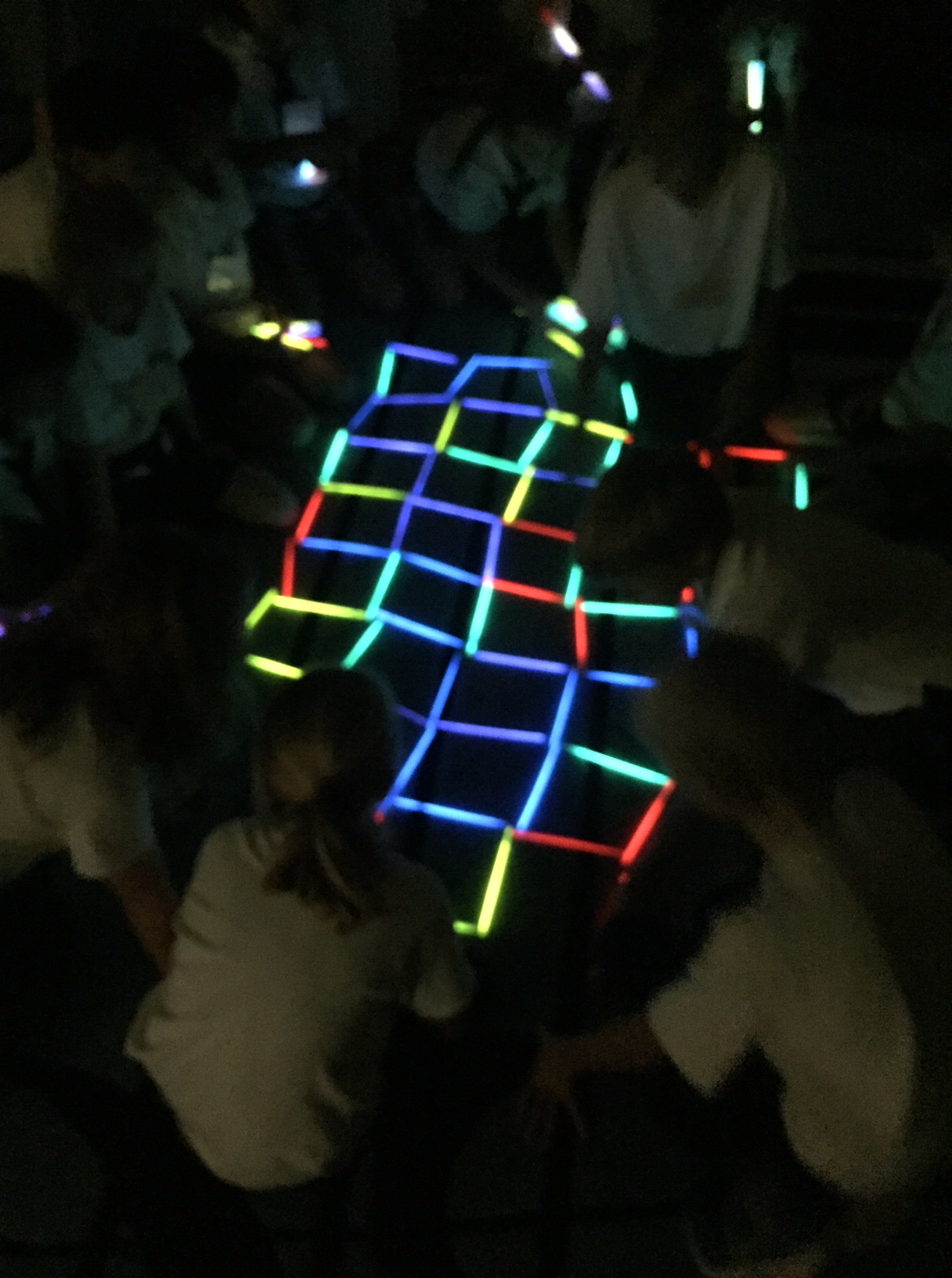

It has been exciting to hang out with the younger kids and play math. We have even involved our high school Mu Alpha Theta students as volunteers to further show the younger kids that even the older kids can still find this fun. Every activity also has follow up questions to help extend students’ curiosity to deeper levels of mathematical insight.
Everything we do in math club is meant to show how much fun math can be. Our hope is that all of our recreational math activities will instill in these kids an abiding affection for math.
Go play math and enjoy!


 GOD & MATH: Thinking Christianly About Math Education