Integrating Faith and Mathematics: What We Can Learn From Process Theology

If you are a regular visitor to the blog, then you know that I have been intermittently posting items on the relationship of process theology and a Christian philosophy of mathematics. Well I am presently at the ACMS (Association of Christians in the Mathematical Sciences) Conference at Westmont College where tomorrow I will be presenting the paper from which these blog posts derive.

For the benefit of giving the live audience a point of reference (and I suppose also for the benefit of the reader at home) I wanted to post the paper here in its entirety:

Integrating Faith and Mathematics: What We Can Learn From Process Theology

Power Point Presentation Version

If you would like to read the entries in a more un-academified blog form, here you go (though I have not gotten around to posting the conclusions yet… you’ll have to read the paper for those):

Math in Process

Math in Process: An Introduction

Math in Process: Process Theology 101

Math in Process: The Influence of Mathematics on Process Theology

Math in Process: Critiquing the Process (Revelation and the Trinity)

Math in Process: Critiquing the Process (Person and Work of Christ)

While here at the ACMS conference I hope to blog regularly about different talks and conversations. Both for myself, as a way of working through the wealth of material I’m receiving, and for those readers at home (there I go being so thoughtful again) who might not have been able to attend the conference.

Looking forward to it.
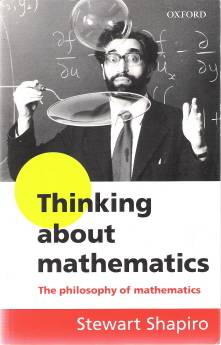
Thinking About Mathematics: Calculators

For my philosophy of mathematics course I am reading the book Thinking About Mathematics, by Stewart Shapiro. It is an excellent read and I highly recommend it. I hope to give this book a fuller treatment on this blog sometime over the summer.

In the meantime, I just finished reading Shapiro’s chapter on Formalism and he makes a telling editorial comment on the use of calculators in math education. Below are a few excerpts from the chapter (emphasis added).

The various philosophies that go by the name of ‘formalism’ pursue a claim that the essence of mathematics is the manipulation of characters. A list of the allowed characters and allowed rules all but exhausts what there is to say about a given branch of mathematics. According to the formalist then, mathematics is not, or need not be, about anything, or anything beyond typographical characters and rules for manipulating them.

For better or worse, much elementary arithmetic is taught as a series of blind techniques, with little or no indication of what the techniques do, or why they work. How many schoolteachers could explain the rules for long division, let alone the algorithm for taking square roots, in terms other than the execution of a routine?

The advent of calculators may increase the tendency toward formalism. If there is a question of justifying or making sense of, the workings of the calculator, it is for an engineer (or a physicist), not a teacher or student of elementary mathematics. Is there a real need to assign ‘meaning’ to the button-pushing?

We hear (or used to hear) complaints that calculators ruin the younger generation’s ability to think, or at least their ability to do mathematics. It seems to me that if the basic algorithms and routines are taught by rote, with no attempt to explain what they do or why they work, then the children might as well use calculators.

Food for thought.

Death in Vain Forbids Him Rise

Listen to these words: Jesus the Nazarene, a man attested to you by God with miracles and wonders and signs which God performed through Him in your midst, just as you yourselves know– this Man, delivered over by the predetermined plan and foreknowledge of God, you nailed to a cross by the hands of godless men and put Him to death. But God raised Him up again, putting an end to the agony of death, since it was impossible for Him to be held in its power.

– Acts 2:22-24

There is love that came for us
Humbled to a sinner’s cross
You broke my shame and sinfulness
You rose again victorious

You are stronger! You are stronger!
Sin is broken
You have saved me
It is written
Christ is risen
Jesus You are Lord of all!

So let Your name be lifted higher!