A student stopped me in the hallway the other day and posed what he thought was a nice brainteaser:
A bat and a ball cost $1.10 in total. The bat costs $1 more than the ball. How much does the ball cost?
After doing the basic algebra:
Bat + Ball = 1.10
Bat = 1 + Ball
Substituting:
1 + Ball + Ball = 1.10
2Ball = .10
Ball = .05
I responded that the ball costs $0.05.
The student seemed disappointed that I had solved the puzzle using math of all things. He objected that I shouldn’t have thought about it but just answered with the first thing that came to my mind (…a little glimpse into the thought process of my students).
This response was expected. What he said next was not. “I guess you are less likely to believe in God.”
Wait…WHAT?!
“It’s true,” he said. “I read it in an article.”
I thought that couldn’t possibly be accurate…but it is. Thank you internet.
Intuitive Thinking May Influence Belief in God
Here are the highlights:
In a series of studies, researchers at Harvard University found that people with a more intuitive thinking style tend to have stronger beliefs in God than those with a more reflective style…”We wanted to explain variations in belief in God in terms of more basic cognitive processes,” researcher Amitai Shenhav said. “Some say we believe in God because our intuitions about how and why things happen lead us to see a divine purpose behind ordinary events that don’t have obvious human causes. This led us to ask whether the strength of an individual’s beliefs is influenced by how much they trust their natural intuitions versus stopping to reflect on those first instincts.”
The research was published online in the Journal of Experimental Psychology: General. The study from the Harvard University Psychology Department was conducted by Shenhav, a doctoral student; post-doctoral fellow David Rand, PhD; and associate professor Joshua Greene, PhD.
In the first part of the study, 882 U.S. adults, with a mean age of 33 and consisting of 64 percent women, completed online surveys about their belief in God before taking a cognitive reflection test. The test had three math problems with incorrect answers that seemed intuitive (like the problem above which has an “intuitive” answer of $0.10)…Participants who had more incorrect answers showed a greater reliance on intuition than reflection in their thinking style.
Participants who gave intuitive answers to all three problems were 1 ½ times as likely to report they were convinced of God’s existence as those who answered all of the questions correctly.
First of all, there is clearly a problem in defining intuitive (or at least measuring intuition) as answering incorrectly to a series of math questions. Intuition, as defined by dicitonary.com: direct perception of truth, fact, etc., independent of any reasoning process (emphasis added). I am uncertain then how answering incorrectly shows a direct perception of truth.
I get the impression that the real claim of this study is that people who respond without thinking tend to accept the idea of religion more than those who analyze information that is presented to them.
This reminded of me of the following comic:
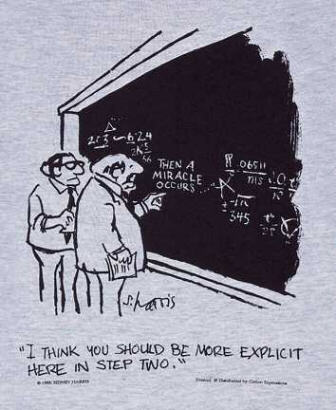
For some people this is the “religious” way of thinking: just believe, don’t analyze. What makes the comic humorous is that this is an obviously flawed approach to mathematics. I contend is an equally flawed approach to faith.
The title of this post is a favorite saying of mine from our former pastor in Dallas, “Christianity is always more than thinking, never less.”
There is great danger in putting religion a step below thinking. I am reminded of a segment on NBC Nightly News, “Show of Faith,” from June 23, 2008. Video Courtesy of NBC. While there have been numerous news segments to survey and comment on the religiosity of Americans, this one stood out to me because of one sentence by Rev. Eugene Rivers (emphasis added):
In some cases, because the American public is not terribly theologically literate, they hold contradictory views because they haven’t thought deeply, or been taught deeply, about their faith tradition.
Not examining one’s religious beliefs tends to lead toward contradictory or false beliefs.
Scripture makes this point itself. The book of Romans clearly explains how we are created with an intuition toward the things of God, but that intuition becomes marred by sin. What we need is a renewal of this intuition, a renewal of our minds, not for the purpose of blind acceptance but for testing and approving the will of God.
For the wrath of God is revealed from heaven against all ungodliness and unrighteousness of men who suppress the truth in unrighteousness, because that which is known about God is evident within them; for God made it evident to them. For since the creation of the world His invisible attributes, His eternal power and divine nature, have been clearly seen, being understood through what has been made, so that they are without excuse. For even though they knew God, they did not honor Him as God or give thanks, but they became futile in their speculations, and their foolish heart was darkened. Professing to be wise, they became fools, and exchanged the glory of the incorruptible God for an image in the form of corruptible man and of birds and four-footed animals and crawling creatures (Romans 1:18-23).
Do not be conformed to this present world, but be transformed by the renewing of your mind, so that you may test and approve what is the will of God– what is good and well-pleasing and perfect (Romans 12:2).
We are charged then to approach our faith as the Bereans. In the book of Acts, the Bereans are praised for examining the Gospel message:
The brothers sent Paul and Silas off to Berea at once, during the night. When they arrived, they went to the Jewish synagogue. These Jews were more open-minded than those in Thessalonica, for they eagerly received the message, examining the scriptures carefully every day to see if these things were so. Therefore many of them believed, along with quite a few prominent Greek women and men (Acts 17:10-12).
As a math teacher I feel that I am charged with teaching students to think well and reason correctly.
As a theologian I feel that I am charged with teaching believers to think well and reason correctly.
We need thinkers. We need teachers of thinkers.


 GOD & MATH: Thinking Christianly About Math Education