*This is a book review that I wrote several years ago and recently came across again. While the work is a statement on general scholarship and not necessarily mathematically focused, the ideas in the book can certainly be applied to doing mathematics in a distinctly Christian manner. This is why I thought it might be valuable to post.
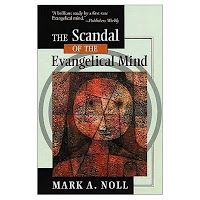
The Scandal of the Evangelical Mind. By Mark Noll. Grand Rapids, MI: William B. Eerdman’s Publishing Company, 1994. ix + 274 pp.
 “‘Which commandment is the most important of all?’ Jesus answered, ‘The most important is: Listen, Israel, the Lord our God, the Lord is one. Love the Lord your God with all your heart, with all your soul, with all your mind, and with all your strength'” (Mark 12:28-30).
Jesus quotes this passage from Deuteronomy 6:4-5. Commonly referred to as the Shema, named after the first word שְׁמַע meaning “hear,” this commandment is the very heart of Jewish confession and faith. Love, in this context, means more than simply an emotional affection, it refers to an expression of covenant-based life commitment and devotion. When you read this passage, which action do you tend to gravitate towards? Do you focus on genuine affections for God flowing from the seat of your heart, dedicating the entirety of your being found in your soul, serving faithfully with your bodily strength, or making conscious effort for the deep intellectual pursuits of the mind? If you are an evangelical like me, then the sad truth which Mark Noll examines is that while we succeed in exploring and developing the life of the heart, soul, and body, we tend to ignore giving much consideration to the ability of the mind.
The scandal of the evangelical mind is that there is not much of an evangelical mind (p.3).
As modern evangelicals, we are the product of our past; a past birthed in the revivalism of the mid eighteenth-century and decorated throughout history as primarily an affectional movement. Within this tradition there has existed a dualistic tendency to label a cultivated mind as a hindrance to a heart of faith. The scandalous aspect is that by definition we evangelicals are a community devoted to the Word of God (which reveals Him as the author of nature, as the sustainer of human institutions, and as the source of harmony, creativity, and beauty) and the passionate pursuit of Jesus Christ, yet we have largely neglected intellectual reflection upon the outworking of God’s revelation in nature and society. This has lead to a decline in distinctively evangelical critical thinking, and an illness upon the life of the mind. As Noll states the problem:
By “the mind” or “the life of the mind,” I am not thinking primarily of theology [or biblical scholarship] as such… I mean more the effort to think like a Christian – to think within a specifically Christian framework – across the whole spectrum of modern learning… but the point is not simply whether evangelicals can learn how to succeed in the modern academy. The much more important matter is what it means to think like a Christian about the nature and workings of the physical world, the character of human social structures like government and the economy, the meaning of the past, the nature of artistic creation, and the circumstances attending our perception of the world outside ourselves. Failure to exercise the mind for Christ in these areas has become acute in the twentieth-century. That failure is the scandal of the evangelical mind (p.6-7).
As a thoroughly trained historian, the overall outline of Noll’s work is to handle key moments on the evangelical time line, offering evidence of their impact on evangelicalism and its approach of intellectual pursuits, as well as insight as to how history develops, constantly building on the past and compounding the issues of previous generations, ultimately elucidating why recent evangelicalism finds itself so culturally disinterested.
{Aside}
I must disagree with Noll’s analysis on one point: the rise of dispensationalism and its eschatological focus as a major detriment to the evangelical mind at the turn of the twentieth-century. Just as Noll argues that it is not the canons of evangelicalism themselves that have lead to the scandal of the mind, but rather the misapplication of these canons, I would argue that it is not dispensationalism itself that deters Christian intellectualism, but rather a dispensationalism misapplied. In fact, a thriving, distinctively Christian, life of the mind necessitates a proper eschatological focus.
Returning to the topic at hand…
Though dedicated largely to a treatment of historical trends and results, particularly focusing on the arenas of science and politics, Noll concludes his sobering presentation of the scandal with a message of hope. The strength of his argument lies in the demonstration of how a focus on the matters of the intellect is not in contradiction with spiritual concerns, but rather it flows from them. The canons that define us as evangelicals, and which have seemingly driven us in a direction against scholarly endeavorer, in actuality form the very remedy which, when applied properly, can steer us back on course.
There exists a scandal greater than the scandal of the evangelical mind and that is the scandal of the cross. As argued, a dedication to the development of the life of the mind is in reality a biblical mandate. Our evangelical dedication to Scripture and unyielding faith in the teachings, actions, and person of Christ, serves as the source from which a distinctly Christian mind can develop. We must take caution, however, in our treatment of the text and the applications we draw from it concerning the life of the mind. For example, when Paul states in Philippians 4:8 “whatever is true, whatever is worthy of respect, whatever is just, whatever is pure, whatever is lovely, whatever is commendable, if something is excellent or praiseworthy, think about these things,” we need not treat ‘these things’ as applying to a Christianity in isolation from the culture around it, but rather ‘these things’ as applying to elements within the culture, in and of themselves created good in the eyes of God, that yearn for Christian involvement and direction to foster proper, God-glorifying, societal development.
The answers to the questions and problems facing Western civilization will come from somewhere. The center of developing such answers to the problems of family and social structures, the problems of economics and politics, and even the problems of the church can be found in our intellectual institutions. The evangelical contribution to these institutions has been largely absent, vacating these arenas to the enemy in favor of ‘practical ministry.’
Who among the evangelicals can stand up to the great secular or naturalistic or atheistic scholars on their own terms of scholarship and research? Who among the evangelical scholars is quoted as a normative source by the greatest secular authorities on history or philosophy or psychology or sociology or politics? Does your mode of thinking have the slightest chance of becoming the dominant mode of thinking in the great universities of Europe and America which stamp your entire civilization with their own spirit and ideas? (p.26, as quoted from Charles Malik, The Two Tasks, (Westchester, IL: Cornerstone, 1980), 29-34).
By the end of Noll’s work evangelicals can agree that our responses to society must be improved intellectually. Offering a quotation from scripture or the encouragement of faith as a cure to a societal ill does far less good than spending time in meaningful contemplation of the scriptures, as well as God’s involvement in His creation, and applying that to our everyday work and thought.
This is admittedly a thin line to tread, emphasizing a need for cultural involvement but not to the detriment of heavenly contemplation, and Noll is to be commended for articulating his argument so clearly. I have presented my best attempt at a concise summary of the work (with my own interjections on the subject included as well) but any treatment of such a topic as this in a forum as limited as a blog can never be complete. If I have assumed to much on the part of reader or if I have misspoken in any way, I apologize and I encourage your comments and emails on the matter.
In closing, I leave you with Noll’s concluding remarks, as well as a directive from Scripture on which I pray you meditate and contemplate the dedication of your mind for the service and glory of Christ.
To think like a Christian is… to take seriously the sovereignty of God over the world He created, the lordship of Christ over the world He died to redeem, and the power of the Holy Spirit over the world He sustains each and every moment (p. 253).
Therefore I exhort you, brothers and sisters, by the mercies of God, to present your bodies as a sacrifice – alive, holy, and pleasing to God – which is your reasonable service. Do not be conformed to this present world, but be transformed by the renewing of your mind, so that you may test and approve what is the will of God – what is good and well-pleasing and perfect (Romans 12:1-2).
Check out The Scandal of the Evangelical Mind on Amazon
About Mark Noll


 GOD & MATH: Thinking Christianly About Math Education